Loading...
Done
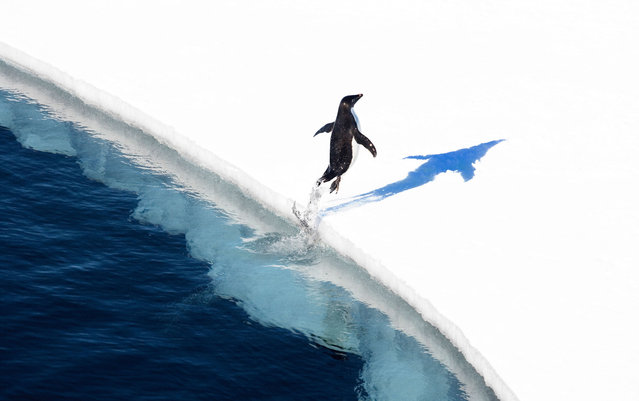
This undated handout photo received from the Antarctic Ocean Alliance on October 28, 2016 shows a adelie penguin jumping onto the ice in the Ross Sea in Antarctica. The world's largest marine reserve aimed at protecting the pristine wilderness of Antarctica will be created after a “momentous” agreement was finally reached on October 28, 2016 with Russia dropping its long-held opposition. A remote and largely pristine stretch of ocean off Antarctica received international protection on Friday, becoming the world's largest marine reserve as a broad coalition of countries came together to protect 598,000 square miles of water. The new marine protected area in the Ross Sea was created by a unanimous decision of the international body that oversees the waters around Antarctica – the Commission for the Conservation of Antarctic Marine Living Resources – and was announced at the commission's annual meeting in Tasmania. The commission comprises 24 countries, including the United States, and the European Union. (Photo by John Weller/AFP Photo/Antarctic Ocean Alliance)

This undated handout photo received from the Antarctic Ocean Alliance on October 28, 2016 shows a adelie penguin jumping onto the ice in the Ross Sea in Antarctica. The world's largest marine reserve aimed at protecting the pristine wilderness of Antarctica will be created after a “momentous” agreement was finally reached on October 28, 2016 with Russia dropping its long-held opposition. (Photo by John Weller/AFP Photo/Antarctic Ocean Alliance)
Details
29 Oct 2016 11:43:00
This Thursday, January 22, 2015 photo made with a long exposure shows the glow from a Noctiluca scintillans algal bloom along the seashore in Hong Kong. The luminescence, also called Sea Sparkle, is triggered by farm pollution that can be devastating to marine life and local fisheries, according to University of Georgia oceanographer Samantha Joye. (Photo by Kin Cheung/AP Photo)

This Thursday, January 22, 2015 photo made with a long exposure shows the glow from a Noctiluca scintillans algal bloom along the seashore in Hong Kong. The luminescence, also called Sea Sparkle, is triggered by farm pollution that can be devastating to marine life and local fisheries, according to University of Georgia oceanographer Samantha Joye. Noctiluca itself does not produce neurotoxins like other similar organisms do. But its role as both prey and predator tends can eventually magnify the accumulation of toxins in the food chain, according to R. Eugene Turner at Louisiana State University. (Photo by Kin Cheung/AP Photo)
Details
23 Jan 2015 13:12:00
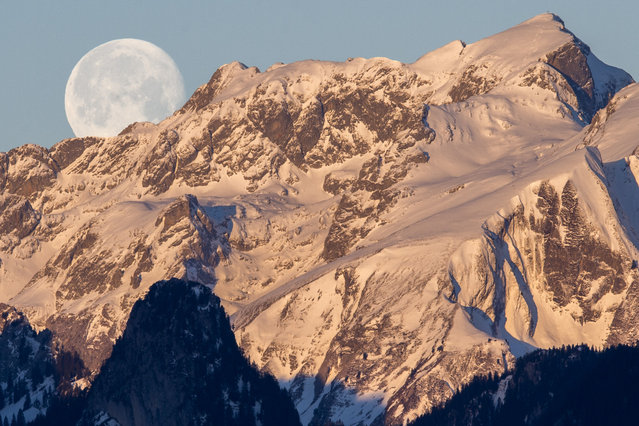
The waning moon is setting over the mountain “Les Cornettes de Bise” located at the border of the Haute-Savoie and the Valais canton of Switzerland in the Chablais Alps, photographed from Glutieres, January 7, 2015. (Photo by Anthony Anex/EPA)

The waning moon is setting over the mountain “Les Cornettes de Bise” located at the border of the Haute-Savoie and the Valais canton of Switzerland in the Chablais Alps, photographed from Glutieres, January 7, 2015. (Photo by Anthony Anex/EPA)
Details
15 Apr 2015 12:53:00
Balinese I Ketut Widanta or known as Lelut rides to collect fodder with his dogs sits on his motorbike in Canggu, Bali, Indonesia on November 05, 2021. Lelut becomes famous for his attractive style of carrying six of his rescued dogs with a modified motorbike while collecting food waste from restaurants. Currently, he takes care of twenty rescued dogs which some of them were dumped by the owners on the street due to the Covid-19 pandemic. Often he receives dog food donations from dog lovers since the collapse of Bali tourism affects his income. (Photo by Johannes P. Christo/Anadolu Agency via Getty Images)

Balinese I Ketut Widanta or known as Lelut rides to collect fodder with his dogs sits on his motorbike in Canggu, Bali, Indonesia on November 05, 2021. Lelut becomes famous for his attractive style of carrying six of his rescued dogs with a modified motorbike while collecting food waste from restaurants. Currently, he takes care of twenty rescued dogs which some of them were dumped by the owners on the street due to the Covid-19 pandemic. Often he receives dog food donations from dog lovers since the collapse of Bali tourism affects his income. (Photo by Johannes P. Christo/Anadolu Agency via Getty Images)
Details
01 Dec 2021 08:57:00
Gemma Chan poses for photographers upon arrival at the premiere of the film “Indiana Jones and the Dial of Destiny” at the 76th international film festival, Cannes, southern France, Thursday, May 18, 2023. (Photo by Scott Garfitt/Invision/AP Photo)

English actress Gemma Chan poses for photographers upon arrival at the premiere of the film “Indiana Jones and the Dial of Destiny” at the 76th international film festival, Cannes, southern France, Thursday, May 18, 2023. (Photo by Scott Garfitt/Invision/AP Photo)
Details
02 Jun 2023 03:09:00
A jogger runs on the bank of Donaukanal channel in central Vienna, Austria, September 5, 2016. (Photo by Heinz-Peter Bader/Reuters)

A jogger runs on the bank of Donaukanal channel in central Vienna, Austria, September 5, 2016. (Photo by Heinz-Peter Bader/Reuters)
Details
17 Sep 2016 10:47:00
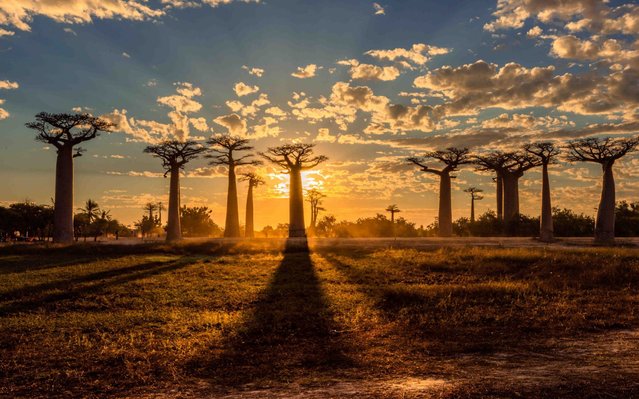
Madagascan sunset setting over the 98-foot-tall baobab trees of the Avenue of the Baobabs located in Menabe, Madagascar on August 2020. (Photo by Kim Paffen/MediaDrumImages)

Madagascan sunset setting over the 98-foot-tall baobab trees of the Avenue of the Baobabs located in Menabe, Madagascar on August 2020. (Photo by Kim Paffen/MediaDrumImages)
Details
23 Sep 2020 00:03:00
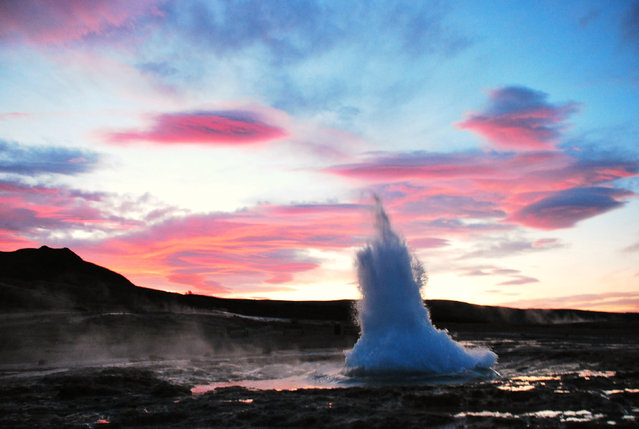
Strokkur geyser against cloudy sky at sunset. Strokkur is a fountain geyser located in a geothermal area beside the Hvítá River in Iceland in the southwest part of the country, east of Reykjavík. It is one of Iceland's most famous geysers, erupting once every 6–10 minutes. Its usual height is 15–20 m, although it can sometimes erupt up to 40 m high. (Photo by Teatsche Dijkhuis/Getty Images/EyeEm)

Strokkur geyser against cloudy sky at sunset. Strokkur is a fountain geyser located in a geothermal area beside the Hvítá River in Iceland in the southwest part of the country, east of Reykjavík. It is one of Iceland's most famous geysers, erupting once every 6–10 minutes. Its usual height is 15–20 m, although it can sometimes erupt up to 40 m high. (Photo by Teatsche Dijkhuis/Getty Images/EyeEm)
Details
18 Oct 2016 12:43:00