Loading...
Done
A Russian-made rifle, carried by this woman when she was captured in Nearby Brush, is slung around her neck by South Vietnamese soldiers before they began their interrogation of her as Viet Cong suspect near AP La Ghi in Vietnam, August 25, 1965. The girl behind the woman, also was captured in the brush. (Photo by AP Photo)

A Russian-made rifle, carried by this woman when she was captured in Nearby Brush, is slung around her neck by South Vietnamese soldiers before they began their interrogation of her as Viet Cong suspect near AP La Ghi in Vietnam, August 25, 1965. The girl behind the woman, also was captured in the brush. (Photo by AP Photo)
Details
26 Aug 2015 09:55:00
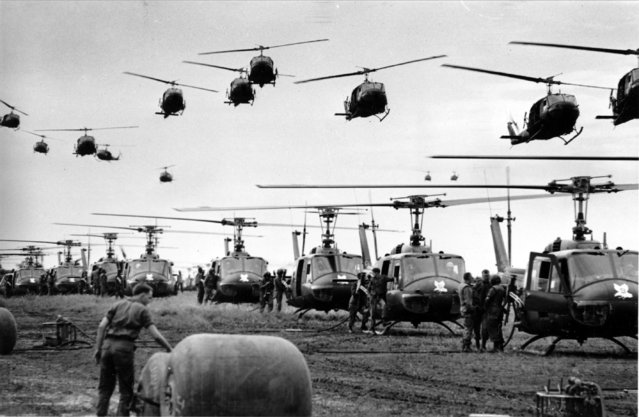
U.S. Army helicopters providing support for U.S. ground troops  fly into a staging area fifty miles northeast of Saigon, Vietnam, August 28, 1966. Helicopter fuel is stored in the large rubber tanks, foreground. (Photo by Henri Huet/AP Photo)

U.S. Army helicopters providing support for U.S. ground troops fly into a staging area fifty miles northeast of Saigon, Vietnam, August 28, 1966. Helicopter fuel is stored in the large rubber tanks, foreground. (Photo by Henri Huet/AP Photo)
Details
29 Aug 2015 11:05:00
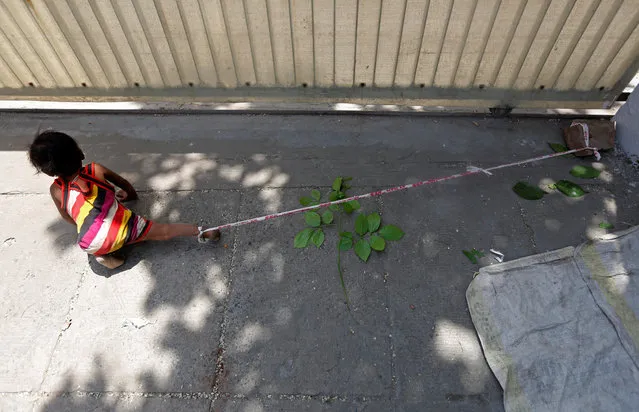
Barrier tape is tied around 15-month-old Shivani's ankle to prevent her from running away, while her mother Sarta Kalara works at a construction site nearby, in Ahmedabad, India, April 19, 2016. Kalara says she has no option but to tether her daughter Shivani to a stone despite her crying, while she and her husband work for 250 rupees ($3.8) each a shift digging holes for electricity cables in the city of Ahmedabad. There are about 40 million construction workers in India, at least one in five of them women, and the majority poor migrants who shift from site to site, building infrastructure for India's booming cities. Across the country it is not uncommon to see young children rolling in the sand and mud as their parents carry bricks or dig for new roads or luxury houses. (Photo by Amit Dave/Reuters)


Barrier tape is tied around 15-month-old Shivani's ankle to prevent her from running away, while her mother Sarta Kalara works at a construction site nearby, in Ahmedabad, India, April 19, 2016. Kalara says she has no option but to tether her daughter Shivani to a stone despite her crying, while she and her husband work for 250 rupees ($3.8) each a shift digging holes for electricity cables in the city of Ahmedabad. There are about 40 million construction workers in India, at least one in five of them women, and the majority poor migrants who shift from site to site, building infrastructure for India's booming cities. Across the country it is not uncommon to see young children rolling in the sand and mud as their parents carry bricks or dig for new roads or luxury houses. (Photo by Amit Dave/Reuters)
Details
14 Dec 2016 07:39:00
A boy uses a mobile phone as he sits inside his father's snacks shop along a road in Kolkata, India, February 22, 2016. (Photo by Rupak De Chowdhuri/Reuters)

A boy uses a mobile phone as he sits inside his father's snacks shop along a road in Kolkata, India, February 22, 2016. (Photo by Rupak De Chowdhuri/Reuters)
Details
23 Feb 2016 11:38:00
Auxiliary Territorial Service (ATS) plotters at work at Coastal Artillery Headquarters in Dover, December 1942. (Photo by Ted Dearberg/IWM/PA Wire)

Auxiliary Territorial Service (ATS) plotters at work at Coastal Artillery Headquarters in Dover, December 1942. The Auxiliary Territorial Service was the women's branch of the British Army during the Second World War. It was formed on 9 September 1938, initially as a women's voluntary service, and existed until 1 February 1949, when it was merged into the Women's Royal Army Corps. The ATS had its roots in the Women's Auxiliary Army Corps (WAAC), which was formed in 1917 as a voluntary service. During the First World War its members served in a number of jobs including clerks, cooks, telephonists and waitresses. The WAAC was disbanded after four years in 1921. (Photo by Ted Dearberg/IWM/PA Wire)
Details
13 Jul 2017 07:52:00
A man walks past an overturned car in the street that was damaged in flooding caused by torrential rain in Cannes, France, October 4, 2015. (Photo by Eric Gaillard/Reuters)

A man walks past an overturned car in the street that was damaged in flooding caused by torrential rain in Cannes, France, October 4, 2015. (Photo by Eric Gaillard/Reuters)
Details
07 Oct 2015 08:00:00
In this August 21, 2017 photo released by the U.S. Defense Department, Qatari special operations personnel conduct a military free-fall Friendship Jump over Qatar. The U.S. military has halted some exercises with its Gulf Arab allies over the ongoing diplomatic crisis targeting Qatar,  trying to use its influence to end the monthslong dispute, authorities told The Associated Press on Friday, October 6, 2017. (Photo by Staff Sgt. Trevor T. McBride/ U.S. Air Force via AP Photo)

In this August 21, 2017 photo released by the U.S. Defense Department, Qatari special operations personnel conduct a military free-fall Friendship Jump over Qatar. The U.S. military has halted some exercises with its Gulf Arab allies over the ongoing diplomatic crisis targeting Qatar, trying to use its influence to end the monthslong dispute, authorities told The Associated Press on Friday, October 6, 2017. (Photo by Staff Sgt. Trevor T. McBride/ U.S. Air Force via AP Photo)
Details
07 Oct 2017 07:43:00
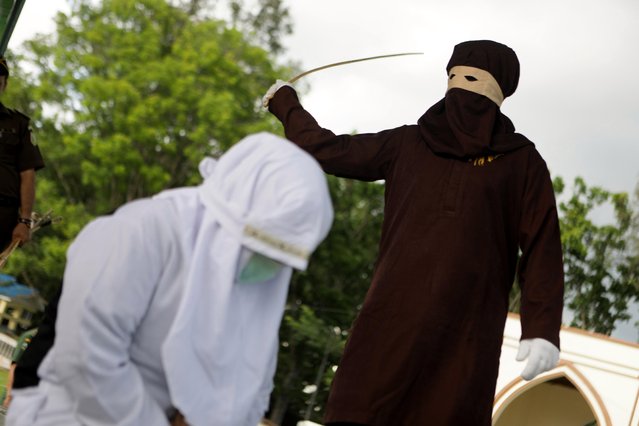
A sharia executor, know as algojo, during a public caning punishment in Jantho, Aceh Besar Regency, Indonesia, 17 November 2017. Ten people were sentenced to public caning for adultery in Aceh, the only province in Indonesia which implements sharia law. (Photo by Hotli Simanjuntak/EPA/EFE)

A sharia executor, know as algojo, during a public caning punishment in Jantho, Aceh Besar Regency, Indonesia, 17 November 2017. Ten people were sentenced to public caning for adultery in Aceh, the only province in Indonesia which implements sharia law. (Photo by Hotli Simanjuntak/EPA/EFE)
Details
18 Nov 2017 04:16:00