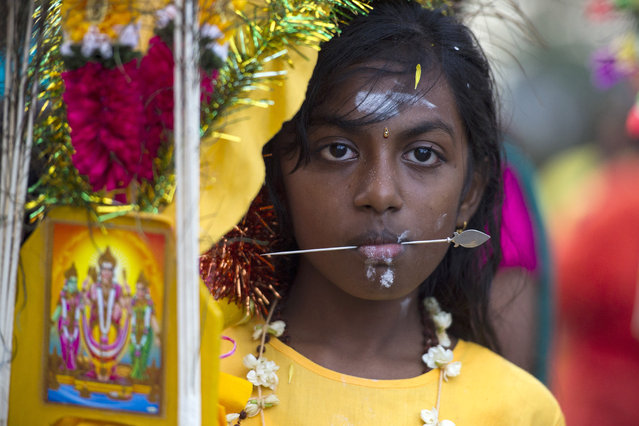
A Hindu devotee girl stands after getting her tongue pierced with a metal rod during the Thaipusam festival in Kuala Lumpur, Malaysia, Tuesday, February 3, 2015. Thaipusam, which is celebrated in honor of Hindu god Lord Murugan, is an annual procession by Hindu devotees seeking blessings, fulfilling vows and offering thanks. (Photo by Joshua Paul/AP Photo)
Cast members Ryan Hansen, Kristen Bell, and Jason Dohring (L-R) pose at the premiere of “Veronica Mars” in Hollywood, California in this March 12, 2014 file photo. (Photo by Mario Anzuoni/Reuters)
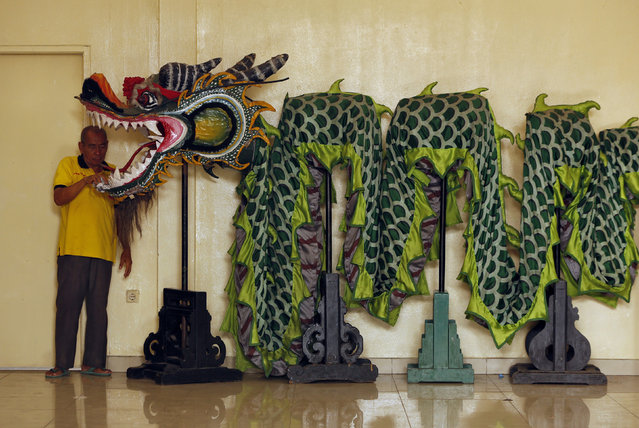
A worker cleans a dragon ahead of the upcoming Chinese Lunar New Year celebrations at the Boen Tek Bio temple in Tangerang, Banten province, Indonesia February 1, 2016. (Photo by Reuters/Beawiharta)
People take part in the “The Burial of the Sardine” funeral procession, which marks the end of carnival festivities, in Madrid, Spain, February 10, 2016. “Mourners” carry a coffin with a mock sardine through the streets to celebrate the countdown to Lent. Spanish painter Francisco de Goya's painting “El entierro de la sardina” (The Burial of the Sardine) was inspired by this tradition, which started in Madrid in the 18th century, around the time of Spanish King Carlos III. (Photo by Juan Medina/Reuters)
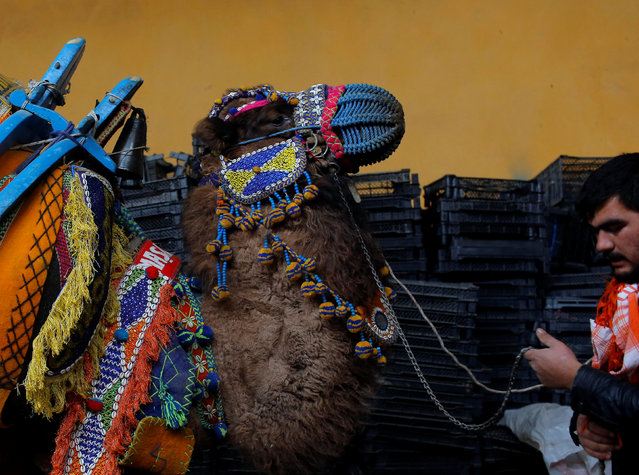
Wrestling camel “Faytoncu” adorned with colourful ornaments is escorted by his groom as he waits for the Camel Beauty Contest ahead of the annual Selcuk-Efes Camel Wrestling Festival in the Aegean town of Selcuk, near Izmir, Turkey, January 14, 2017. (Photo by Murad Sezer/Reuters)
A Thai and foreign revelers battle with water guns during the annual Songkran celebration at Khaosan Road, a tourist spot in Bangkok, Thailand, 12 April 2017. The four southeast Asian nations of Myanmar, Thailand, Cambodia and Laos started the Buddhist new year, known as Thingyan in Myanmar and Songkran in Thailand, on April 13. (Photo by Rungroj Yongrit/EPA)
For her series “Japanese Whispers”, Belgian photographer Zaza Bertrand headed inside the intimate world of rabuhos – Japanese love hotels. Love hotels became popular in Japan from the 1960s onwards, due to a lack of privacy in many family homes. There are now around 37,000 of these hotels in Japan, allowing short daytime “rests” or overnight stays. (Photo by Zaza Bertrand/The Guardian)