Loading...
Done
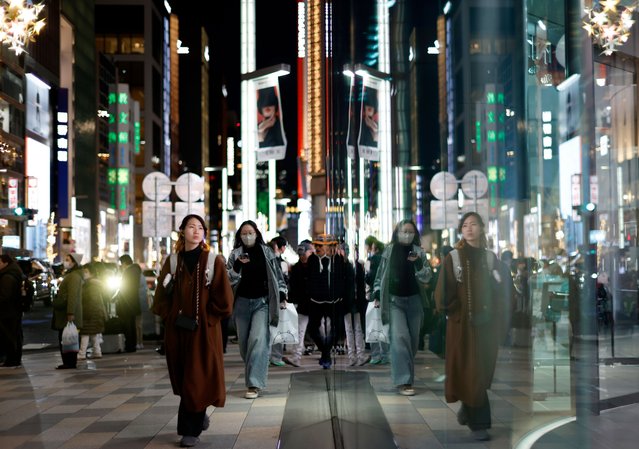
People walk through Ginza’s shopping district in Tokyo, Japan, 15 December 2025. Japan’s economic focus is on the upcoming Bank of Japan (BOJ) meeting where the central bank is expected to raise its policy rate to combat inflation. The BOJ signaled a rate hike bar is cleared with the wage momentum still intact. (Photo by Franck Robichon/EPA)

People walk through Ginza’s shopping district in Tokyo, Japan, 15 December 2025. Japan’s economic focus is on the upcoming Bank of Japan (BOJ) meeting where the central bank is expected to raise its policy rate to combat inflation. The BOJ signaled a rate hike bar is cleared with the wage momentum still intact. (Photo by Franck Robichon/EPA)
Details
23 Dec 2025 11:51:00
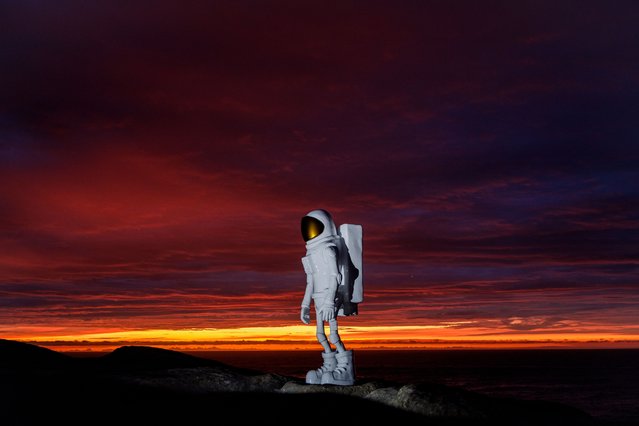
The work “Naught: Bondi” by Milarky is seen pre-dawn at Sculpture by The Sea on October 18, 2024 in Sydney, Australia. A striking inflatable sculpture resembling a melanoma is set to be showcased at Sculpture by the Sea 2024, running from October 18 to November 4 along the Bondi to Tamarama coastal walk. (Photo by Brook Mitchell/Getty Images)

The work “Naught: Bondi” by Milarky is seen pre-dawn at Sculpture by The Sea on October 18, 2024 in Sydney, Australia. A striking inflatable sculpture resembling a melanoma is set to be showcased at Sculpture by the Sea 2024, running from October 18 to November 4 along the Bondi to Tamarama coastal walk. (Photo by Brook Mitchell/Getty Images)
Details
10 Feb 2026 09:22:00
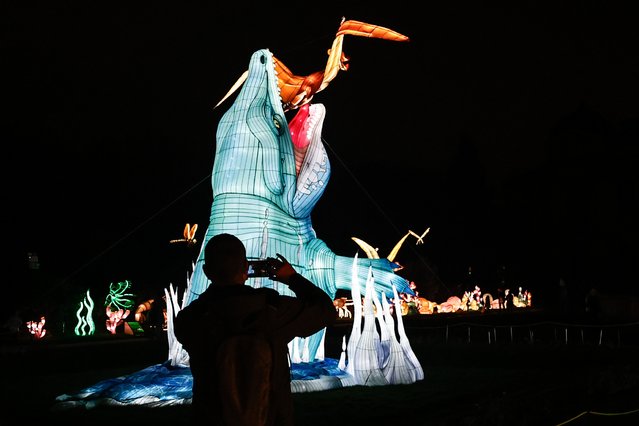
A visitor takes a picture of illuminated sculptures on display at the Festival de lumiere “Light festival” at Paris Jardin des Plantes in Paris, France, 15 November 2024. Festival de lumiere “Light festival” runs in Paris from 20 November 2024 to 19 January 2025. (Photo by Mohammed Badra/EPA/EFE)

A visitor takes a picture of illuminated sculptures on display at the Festival de lumiere “Light festival” at Paris Jardin des Plantes in Paris, France, 15 November 2024. Festival de lumiere “Light festival” runs in Paris from 20 November 2024 to 19 January 2025. (Photo by Mohammed Badra/EPA/EFE)
Details
22 Feb 2026 12:53:00
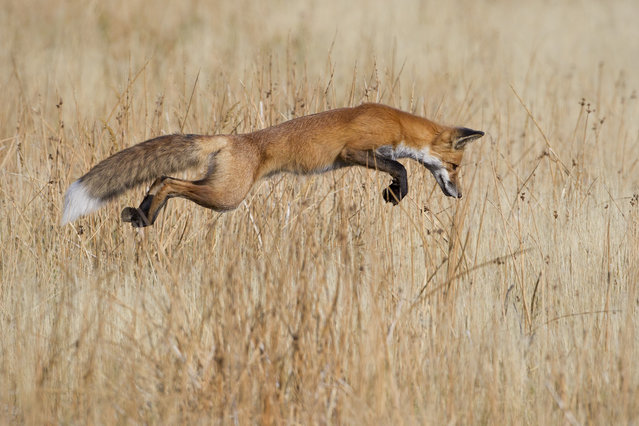
Canada: “Lucky pounce”. (Photo by Connor Stefanison/Wildlife Photographer of the Year 2013)

The winners of The London’s Natural History Museum's prestigious Wildlife Photographer of the Year for 2013 have finally been unveiled. Selected from almost 43,000 entries from 96 countries, the winners offer a glimpse of the stunning array of natural beauty on our planet. Photo: Canada: “Lucky pounce”. “Anticipating the pounce – that was the hardest part”, says Connor, who had come to Yellowstone National Park, Wyoming, USA, in search of wildlife as much as the spectacular landscape. He had found this fox, his first ever, on his last day in the park. It was so absorbed in hunting that Connor had plenty of time to get out of the car and settle behind a rock. It quartered the grassland, back and forth, and then started staring intently at a patch of ground, giving Connor just enough warning of the action to come. When it sprung up, Connor got his shot. And when it landed, the fox got his mouse. (Photo by Connor Stefanison/Wildlife Photographer of the Year 2013)

Details
17 Oct 2013 08:12:00
Detroit Pistons vs. New York Knicks at Madison Square Garden, January 7, 2014. Actress Michelle Rodriguez and model Cara Delevingne sitting in the front row during the 4th quarter. The two were hugging and touching each other and Rodriguez appeared to be very intoxicated. (Photo by Charles Wenzelberg/New York Post)

How awkward! Michelle Rodriguez (35) got very visibly drunk and sloppily kissed model Cara Delevigne (21) at the January 7 New York Knicks game, in what has to be the greatest public waste of court side seats of all time. Photo: Detroit Pistons vs. New York Knicks at Madison Square Garden, January 7, 2014. Actress Michelle Rodriguez and model Cara Delevingne sitting in the front row during the 4th quarter. The two were hugging and touching each other and Rodriguez appeared to be very intoxicated. (Photo by Anthony J. Causi/Charles Wenzelberg/The New York Post)
Details
09 Jan 2014 08:17:00
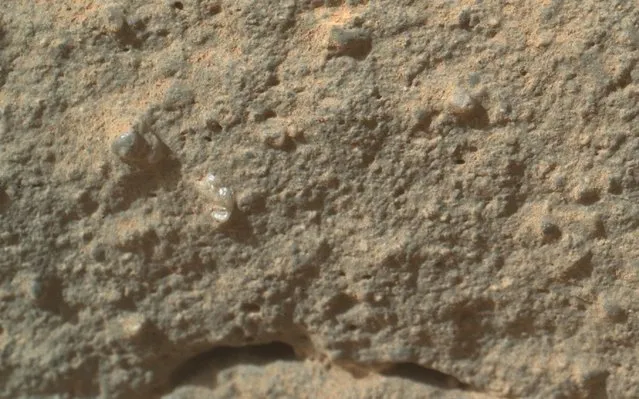
Scientists say that a “Martian flower”, seen here in an image from the Curiosity rover's Mars Hand Lens Imager, is a 2-millimeter-wide grain or pebble that's embedded in the surrounding rock. Another, darker-colored mineral grain can be seen above and to the left. (Photo by NASA)

“The scientists behind NASA's $2.5 billion Curiosity rover mission on Mars on Tuesday explained the nature of a tiny, gleaming "flower" embedded in Red Planet rock, and revealed where they'll be using the SUV-sized robot's drill for the first time”. – Alan Boyle via NBCNews.com

Photo: Scientists say that a “Martian flower”, seen here in an image from the Curiosity rover's Mars Hand Lens Imager, is a 2-millimeter-wide grain or pebble that's embedded in the surrounding rock. Another, darker-colored mineral grain can be seen above and to the left. (Photo by NASA)
Details
16 Jan 2013 11:12:00
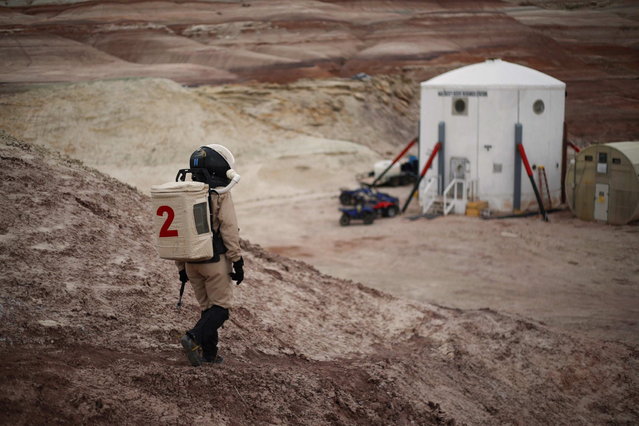
Csilla Orgel, a geologist of Crew 125 EuroMoonMars B mission, makes her way back to the Mars Desert Research Station (MDRS) in the Utah desert March 3, 2013. (Photo by Jim Urquhart/Reuters)

NASA says it could be another 20 years before humans touch down on Mars, but in a sense, the Mars Society has been exploring the red planet for more than a decade – in Utah. Photo: Csilla Orgel, a geologist of Crew 125 EuroMoonMars B mission, makes her way back to the Mars Desert Research Station (MDRS) in the Utah desert March 3, 2013. The MDRS aims to investigate the feasibility of a human exploration of Mars and uses the Utah desert's Mars-like terrain to simulate working conditions on the red planet. Scientists, students and enthusiasts work together developing field tactics and studying the terrain. All outdoor exploration is done wearing simulated spacesuits and carrying air supply packs and crews live together in a small communication base with limited amounts of electricity, food, oxygen and water. Everything needed to survive must be produced, fixed and replaced on site. (Photo by Jim Urquhart/Reuters)
Details
14 Mar 2013 12:11:00
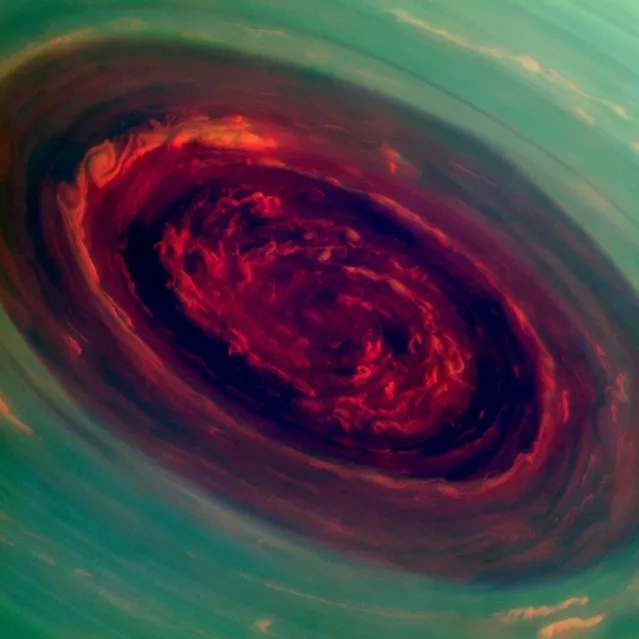
The spinning vortex of Saturn's north polar storm resembles a deep red rose of giant proportions surrounded by green foliage in this false-color image from NASA's Cassini spacecraft. (Photo by NASA/JPL-Caltech/SSI)

NASA's Cassini spacecraft has provided scientists the first close-up, visible-light views of a behemoth hurricane swirling around Saturn's north pole. In high-resolution pictures and video, scientists see the hurricane's eye is about 1,250 miles (2,000 kilometers) wide, 20 times larger than the average hurricane eye on Earth. Thin, bright clouds at the outer edge of the hurricane are traveling 330 mph(150 meters per second). The hurricane swirls inside a large, mysterious, six-sided weather pattern known as the hexagon. Photo: The spinning vortex of Saturn's north polar storm resembles a deep red rose of giant proportions surrounded by green foliage in this false-color image from NASA's Cassini spacecraft. (Photo by NASA/JPL-Caltech/SSI)
Details
31 May 2015 09:11:00