Loading...
Done
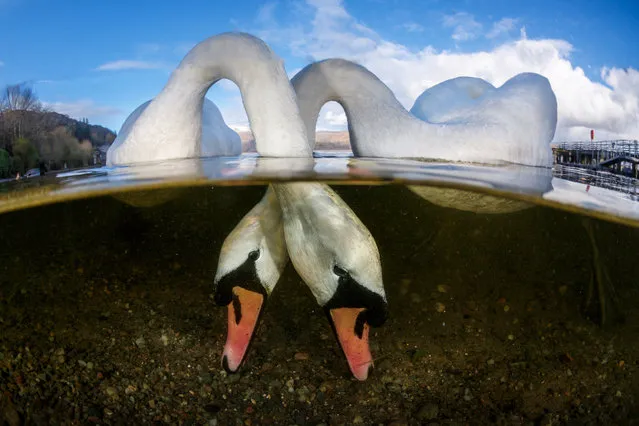
British underwater photographer of the year – winner. “Love Birds” by Grant Thomas (UK). Location: Luss Pier, Loch Lomond, Scotland. Thomas’s initial idea was to frame a split shot of one swan feeding below the surface of the water but when he noticed how comfortable they were around him he was confident, with some patience, he could get that magical shot of the two. (Photo by Grant Thomas/UPY 2018)

British underwater photographer of the year – winner. “Love Birds” by Grant Thomas (UK). Location: Luss Pier, Loch Lomond, Scotland. Thomas’s initial idea was to frame a split shot of one swan feeding below the surface of the water but when he noticed how comfortable they were around him he was confident, with some patience, he could get that magical shot of the two. (Photo by Grant Thomas/UPY 2018)
Details
16 Feb 2018 00:02:00
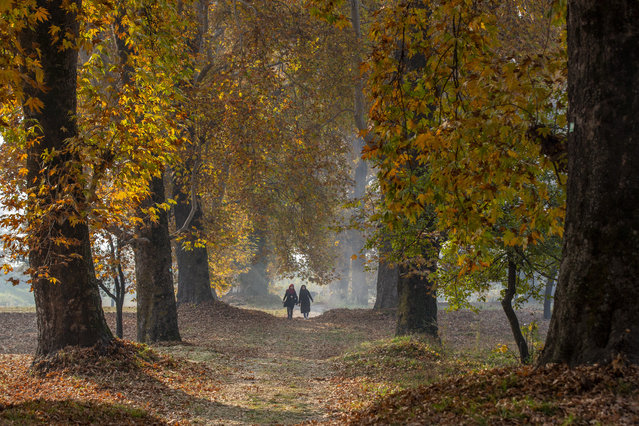
Kashmiri women walk in a garden covered with fallen Chinar leaves on the outskirts of Srinagar, Indian controlled Kashmir, Wednesday, November 4, 2020. Kashmiris collect fallen leaves in autumn to make charcoal for use during winters. (Photo by Dar Yasin/AP Photo)

Kashmiri women walk in a garden covered with fallen Chinar leaves on the outskirts of Srinagar, Indian controlled Kashmir, Wednesday, November 4, 2020. Kashmiris collect fallen leaves in autumn to make charcoal for use during winters. (Photo by Dar Yasin/AP Photo)
Details
11 Nov 2020 00:01:00
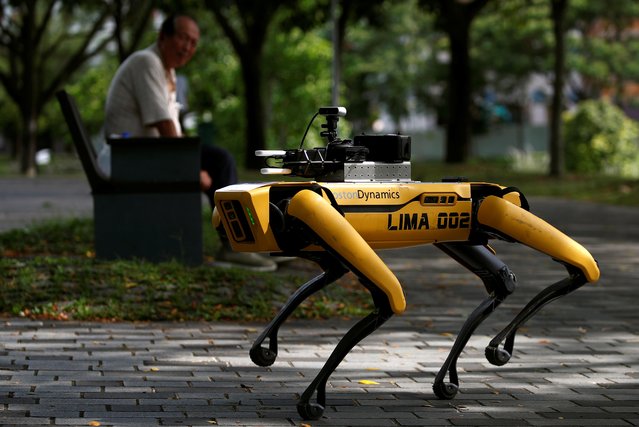
A four-legged robot dog called SPOT patrols a park as it undergoes testing to be deployed as a safe distancing ambassador, following the coronavirus disease (COVID-19) outbreak, in Singapore on May 8, 2020. (Photo by Edgar Su/Reuters)

A four-legged robot dog called SPOT patrols a park as it undergoes testing to be deployed as a safe distancing ambassador, following the coronavirus disease (COVID-19) outbreak, in Singapore on May 8, 2020. (Photo by Edgar Su/Reuters)
Details
10 May 2020 00:07:00
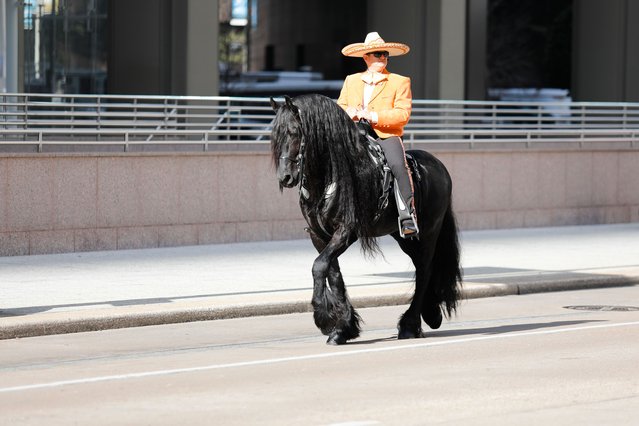
A participant in the Downtown Parade kicks off the Houston Livestock Show and Rodeo in Houston, Texas, US on February 25, 2023. (Photo by Reginald Mathalone/NurPhoto/Rex Features/Shutterstock)

A participant in the Downtown Parade kicks off the Houston Livestock Show and Rodeo in Houston, Texas, US on February 25, 2023. (Photo by Reginald Mathalone/NurPhoto/Rex Features/Shutterstock)
Details
06 Mar 2023 04:44:00
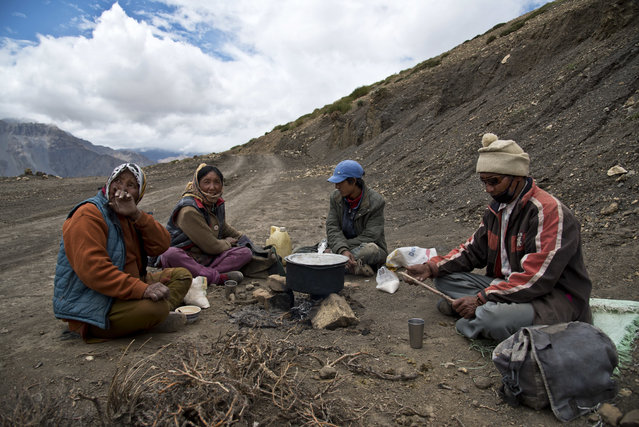
In this August 17, 2016, photo, from left to right, Chhering Chodom, 60, Tashi Yangzom, 50, Lobsang Chhering, 27, and Dorje Tandup, 58, drink milk tea on the side of the road. For centuries, the sleepy valley nestled in the Indian Himalayas remained a hidden Buddhist enclave forbidden to outsiders. Enduring the harsh year-round conditions of the high mountain desert, the people of Spiti Valley lived by a simple communal code – share the Earth's bounty, be hospitable to neighbors, and eschew greed and temptation at all turns. That's all starting to change, for better or worse. Since India began allowing its own citizens as well as outsiders to visit the valley in the early 1990s, tourism and trade have boomed. And the marks of modernization, such as solar panels, asphalt roads and concrete buildings, have begun to appear around some of the villages that dot the remote landscape at altitudes above 4,000 meters (13,000 feet). (Photo by Thomas Cytrynowicz/AP Photo)

In this August 17, 2016, photo, from left to right, Chhering Chodom, 60, Tashi Yangzom, 50, Lobsang Chhering, 27, and Dorje Tandup, 58, drink milk tea on the side of the road. For centuries, the sleepy valley nestled in the Indian Himalayas remained a hidden Buddhist enclave forbidden to outsiders. Enduring the harsh year-round conditions of the high mountain desert, the people of Spiti Valley lived by a simple communal code – share the Earth's bounty, be hospitable to neighbors, and eschew greed and temptation at all turns. That's all starting to change, for better or worse. (Photo by Thomas Cytrynowicz/AP Photo)
Details
15 Sep 2016 09:22:00
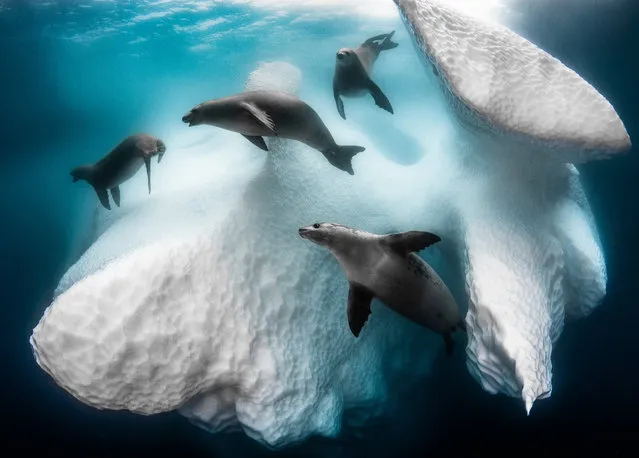
Underwater photographer of the year 2020 and wide angle category winner: Frozen Mobile Home by Greg Lecoeur (France) in the Antarctic peninsula, Antarctica. Crabeater seals swim around an iceberg. These massive and mysterious habitats are dynamic kingdoms that support marine life. As they swing and rotate slowly through polar currents, icebergs fertilise the oceans by carrying nutrients from land that spark blooms of phytoplankton, fundamental to the carbon cycle. (Photo by Greg Lecoeur/Underwater Photographer of the Year 2020)

Underwater photographer of the year 2020 and wide angle category winner: Frozen Mobile Home by Greg Lecoeur (France) in the Antarctic peninsula, Antarctica. Crabeater seals swim around an iceberg. These massive and mysterious habitats are dynamic kingdoms that support marine life. As they swing and rotate slowly through polar currents, icebergs fertilise the oceans by carrying nutrients from land that spark blooms of phytoplankton, fundamental to the carbon cycle. (Photo by Greg Lecoeur/Underwater Photographer of the Year 2020)
Details
28 Feb 2020 00:05:00
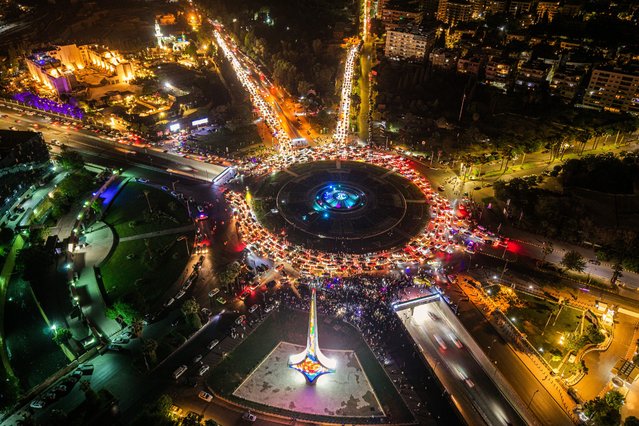
An aerial view of Syrian people flocked to the streets in the capital Damascus to celebrate US President Donald Trump's decision to lift sanctions in Damascus, Syria on May 13, 2025. (Photo by Amadeusz Mikolaj Swierk/Anadolu via Getty Images)

An aerial view of Syrian people flocked to the streets in the capital Damascus to celebrate US President Donald Trump's decision to lift sanctions in Damascus, Syria on May 13, 2025. (Photo by Amadeusz Mikolaj Swierk/Anadolu via Getty Images)
Details
09 Jun 2025 02:33:00
Bodie, Mono County, California. Gold was discovered at Bodie in 1859 (just after the initial California gold rush) and it went from mining camp to boomtown. Its decline began in 1880, when word spread of new boomtowns elsewhere. The Standard Consolidated Mine closed in 1913, and four years later the Bodie Railway was abandoned. By 1940 the population was down to 40. Today, Bodie is maintained in a state of arrested decay as a visitor attraction. (Photo by Alamy Stock Photo)

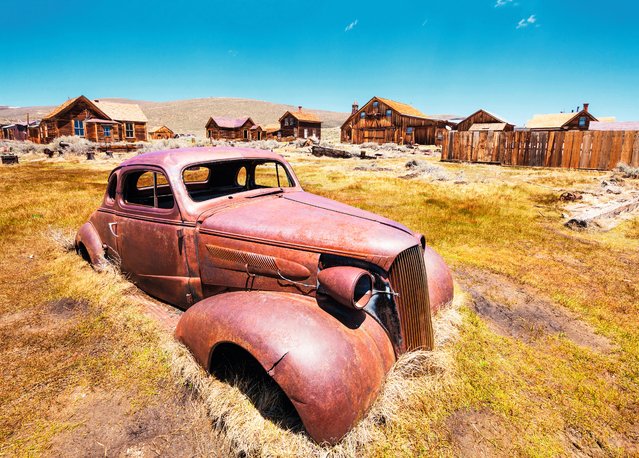
Kieron Connolly’s new book of photographs of more than 100 once-busy and often elegant buildings gives an idea of how the world might look if humankind disappeared. Here: Bodie, Mono County, California. Gold was discovered at Bodie in 1859 (just after the initial California gold rush) and it went from mining camp to boomtown. Its decline began in 1880, when word spread of new boomtowns elsewhere. The Standard Consolidated Mine closed in 1913, and four years later the Bodie Railway was abandoned. By 1940 the population was down to 40. Today, Bodie is maintained in a state of arrested decay as a visitor attraction. (Photo by Alamy Stock Photo)
Details
07 Sep 2016 09:50:00