Loading...
Done
In Groundhog Day Tradition, Punxsutawney Phil Predicts End Of Winter

Groundhog handler Ron Ploucha holds Punxsutawney Phil after he saw his shadow predicting 6 more weeks of winter during the 126th annual Groundhog Day festivities on February 2, 2012 in Punxsutawney, Pennsylvania. (Photo by Jeff Swensen/Getty Images)
Details
03 Feb 2012 11:12:00
Casey Station 2017. (Photo by Chris J. Wilson/The Guardian)

The annual Antarctic photography exhibition, which is part of Hobart’s Antarctica festival is back on with its chilly, majestic imagery. The winner this year is Sydney’s Sam Edmonds with his striking photo of a gentoo penguin in the snow. Here: Casey Station 2017. (Photo by Chris J. Wilson/The Guardian)
Details
16 Aug 2018 00:03:00
Kirby waits to be judged during the 44th annual Drake Relays Beautiful Bulldog Contest, Monday, April 24, 2023, in Des Moines, Iowa. (Photo by Charlie Neibergall/AP Photo)

Kirby waits to be judged during the 44th annual Drake Relays Beautiful Bulldog Contest, Monday, April 24, 2023, in Des Moines, Iowa. The pageant kicks off the Drake Relays festivities at Drake University where a bulldog is the mascot. (Photo by Charlie Neibergall/AP Photo)
Details
04 May 2023 02:46:00
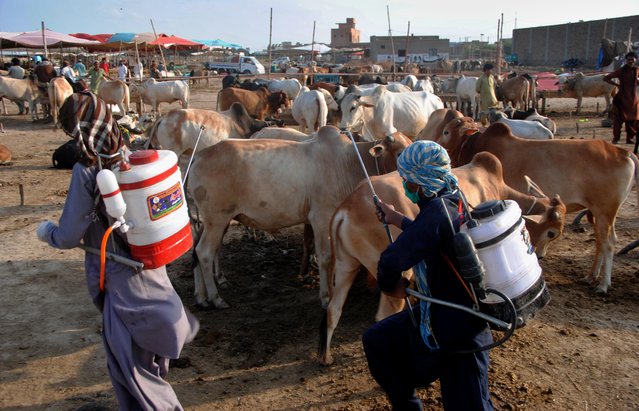
Health workers wearing face masks spray disinfectant liquid on sacrificial animals amid concerns over the spread of the SARS-CoV-2 coronavirus that causes the pandemic COVID-19 disease ahead of the Muslim festival of Eid al-Adha at an animal market in Hyderabad, southern Pakistan, 21 July 2020. Eid al-Adha, also known as the Festival of the Sacrifice, is the second and holiest of the two main Islamic holidays celebrated each year (the other one being Eid al-Fitr). Every year, on the 10th day of the Islamic lunar month of Dhu al-Hijjah, Muslims around the world ritually slaughter a sacrificial animal and split the meat into three parts: one is reserved for the family, another for friends and relatives, and the third is given to the poor and needy. The Saudi Supreme Court has declared that the first day of Eid al-Adha this year falls on 31 July. (Photo by Nadeem Khawar/EPA/EFE)

Health workers wearing face masks spray disinfectant liquid on sacrificial animals amid concerns over the spread of the SARS-CoV-2 coronavirus that causes the pandemic COVID-19 disease ahead of the Muslim festival of Eid al-Adha at an animal market in Hyderabad, southern Pakistan, 21 July 2020. (Photo by Nadeem Khawar/EPA/EFE)
Details
23 Jul 2020 00:07:00
Street musicians with their faces covered with animal masks play to earn some money in central Vienna, Austria, November 8, 2015. (Photo by Vasily Fedosenko/Reuters)

Street musicians with their faces covered with animal masks play to earn some money in central Vienna, Austria, November 8, 2015. (Photo by Vasily Fedosenko/Reuters)
Details
11 Nov 2015 08:07:00
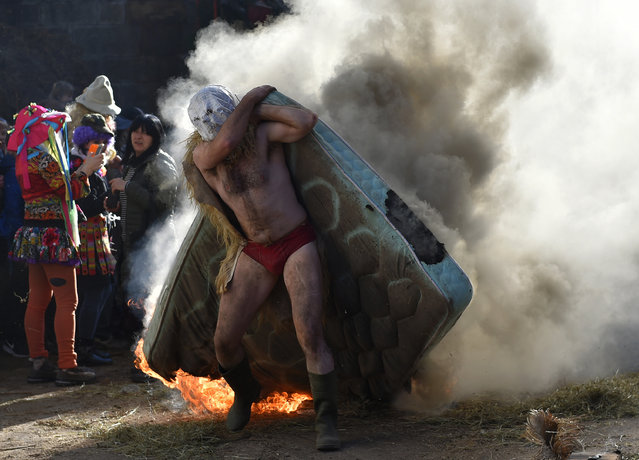
A masked participant carries a burning matress during the ancient carnival of Zubieta, in the northern Spanish Navarra province on January 30, 2018. The yearly three day festivities, revolving mainly around agriculture and principally sheep hearding, run on the last Sunday, Monday and Tuesday of January where Navarra Valley locals from two villages dress up and participate in a variety of activites as they perform a pilgrimage through each village. (Photo by Ander Gillenea/AFP Photo)

A masked participant carries a burning matress during the ancient carnival of Zubieta, in the northern Spanish Navarra province on January 30, 2018. The yearly three day festivities, revolving mainly around agriculture and principally sheep hearding, run on the last Sunday, Monday and Tuesday of January where Navarra Valley locals from two villages dress up and participate in a variety of activites as they perform a pilgrimage through each village. (Photo by Ander Gillenea/AFP Photo)
Details
01 Feb 2018 08:52:00
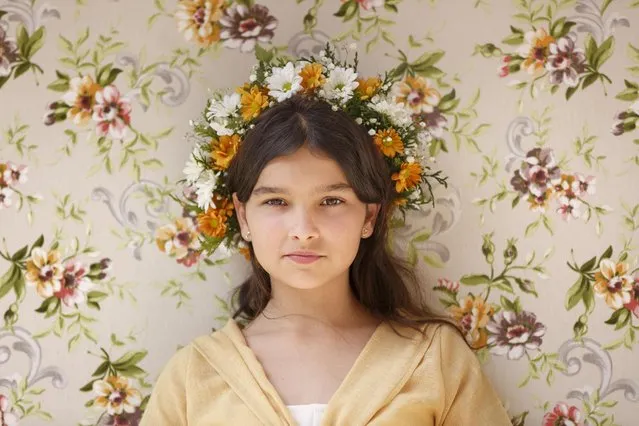
A “Maya” girl sits in an altar during the traditional celebration of “Las Mayas” on the streets in Madrid, Spain Sunday, May 10, 2015. The festivity of the Maya comes from pagan rites and dates from the medieval age, appearing in ancient documents. It takes place every year in the beginning of May and celebrates the beginning of the spring. (Photo by Daniel Ochoa de Olza/AP Photo)

A “Maya” girl sits in an altar during the traditional celebration of “Las Mayas” on the streets in Madrid, Spain Sunday, May 10, 2015. The festivity of the Maya comes from pagan rites and dates from the medieval age, appearing in ancient documents. It takes place every year in the beginning of May and celebrates the beginning of the spring. Girls between 7 and 11 years old are chosen as “Maya” and should sit still, serious and quiet for a couple of hours in altars on the street decorated with flowers and plants and afterwards they walk to the church with their family where they attend a ceremony. (Photo by Daniel Ochoa de Olza/AP Photo)
Details
14 May 2015 11:12:00
Mud-covered tourists pretend to be trapped inside a mud prison at the Daecheon Beach Mud Plaza in the city of Boryeong on South Korea's west coast, July 17, as they take part in the Boryeong Mud Festival, which opened that day and runs through July 26. Boryeong mud is rich in natural mineral component and is considered to prevent skin aging. (Photo by EPA/Yonhap)

Mud-covered tourists pretend to be trapped inside a mud prison at the Daecheon Beach Mud Plaza in the city of Boryeong on South Korea's west coast, July 17, as they take part in the Boryeong Mud Festival, which opened that day and runs through July 26. Boryeong mud is rich in natural mineral component and is considered to prevent skin aging. (Photo by EPA/Yonhap)
Details
18 Jul 2015 13:33:00