Loading...
Done
Artist Pyotr Pavlensky sits on the wall enclosing the Serbsky State Scientific Center for Social and Forensic Psychiatry after he cut off a part of his earlobe during his protest action titled “Segregation” in Moscow October 19, 2014. (Photo by Maxim Zmeyev/Reuters)

Artist Pyotr Pavlensky sits on the wall enclosing the Serbsky State Scientific Center for Social and Forensic Psychiatry after he cut off a part of his earlobe during his protest action titled “Segregation” in Moscow October 19, 2014. Pavlensky protested against the usage of forensic psychiatry for politically motivated purposes. He cut off his earlobe to demonstrate how authorities could “cut off” an unwanted individual from society by using psychiatric and medical diagnosis to forcefully send a person to a penitentiary hospital, according to Pavlensky. (Photo by Maxim Zmeyev/Reuters)
Details
21 Oct 2014 12:10:00
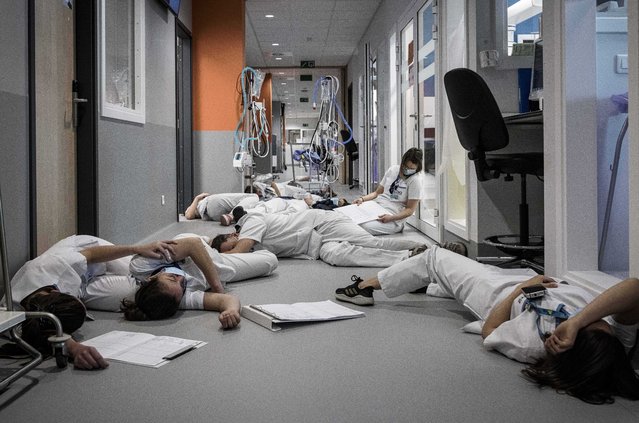
Nursing and care personnel lay on the floor in the ICU unit, during a demonstration on International Nursing and Care day, at the Mont Legia Hospital in Liege, Belgium, Wednesday, May 12, 2021. Hospital personnel around Belgium took part in various actions around the country on Wednesday to highlight the work they do and demand better recognition. (Photo by Valentin Bianchi/AP Photo)

Nursing and care personnel lay on the floor in the ICU unit, during a demonstration on International Nursing and Care day, at the Mont Legia Hospital in Liege, Belgium, Wednesday, May 12, 2021. Hospital personnel around Belgium took part in various actions around the country on Wednesday to highlight the work they do and demand better recognition. (Photo by Valentin Bianchi/AP Photo)
Details
13 May 2021 08:28:00
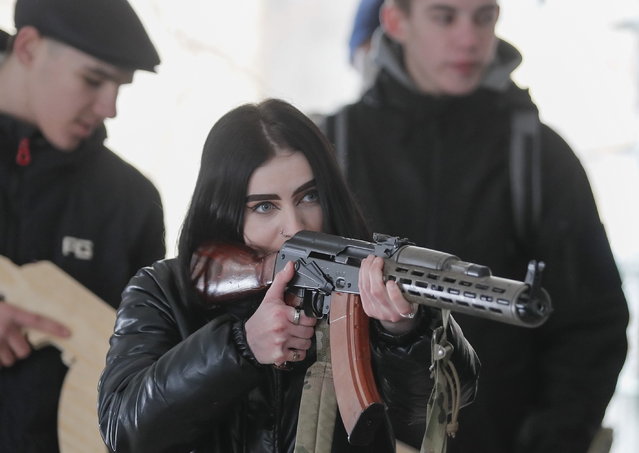
Ukrainians attend an open military training for civilians on a training range in Kiev, Ukraine, 30 January 2022. According to a survey conducted by the Kiev International Institute of Sociology (KIIS) from December 2021, 50.2 percent of Ukrainians said they would resist in case of a Russian military intervention into their city, town or village. Every third respondent to the poll said they were ready to engage in armed resistance, and 21.7 percent said they were ready to participate in civil resistance actions. (Photo by Sergey Dolzhenko/EPA/EFE)

Ukrainians attend an open military training for civilians on a training range in Kiev, Ukraine, 30 January 2022. According to a survey conducted by the Kiev International Institute of Sociology (KIIS) from December 2021, 50.2 percent of Ukrainians said they would resist in case of a Russian military intervention into their city, town or village. Every third respondent to the poll said they were ready to engage in armed resistance, and 21.7 percent said they were ready to participate in civil resistance actions. (Photo by Sergey Dolzhenko/EPA/EFE)
Details
31 Jan 2022 06:47:00
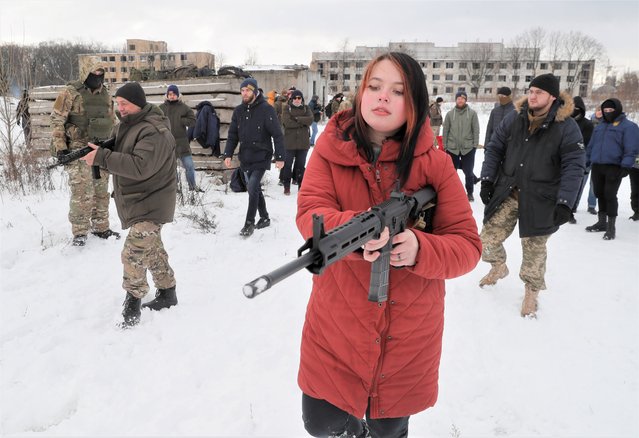
Ukrainians attend an open military training for civilians on a training range in Kiev, Ukraine, 06 February 2022. According to a survey conducted by the Kiev International Institute of Sociology (KIIS) from December 2021, 50.2 percent of Ukrainians said they would resist in case of a Russian military intervention into their city, town or village. Every third respondent to the poll said they were ready to engage in armed resistance, and 21.7 percent said they were ready to participate in civil resistance actions. (Photo by Sergey Dolzhenko/EPA/EFE/Rex Features/Shutterstock)

Ukrainians attend an open military training for civilians on a training range in Kiev, Ukraine, 06 February 2022. According to a survey conducted by the Kiev International Institute of Sociology (KIIS) from December 2021, 50.2 percent of Ukrainians said they would resist in case of a Russian military intervention into their city, town or village. Every third respondent to the poll said they were ready to engage in armed resistance, and 21.7 percent said they were ready to participate in civil resistance actions. (Photo by Sergey Dolzhenko/EPA/EFE/Rex Features/Shutterstock)
Details
15 Feb 2022 05:34:00
A demonstrator uses her phone to take a “selfie” picture during the 12th annual “SlutWalk” march through central Jerusalem on June 14, 2024 to protest against rape culture, including sеxual assault and harassment directed at women, and calling for an end to the ongoing war in the Gaza Strip and action to release hostages taken captive during the October 7 attacks. (Photo by Hazem Bader/AFP Photo)

A demonstrator uses her phone to take a “selfie” picture during the 12th annual “SlutWalk” march through central Jerusalem on June 14, 2024 to protest against rape culture, including sеxual assault and harassment directed at women, and calling for an end to the ongoing war in the Gaza Strip and action to release hostages taken captive during the October 7 attacks. (Photo by Hazem Bader/AFP Photo)
Details
17 Oct 2025 03:59:00
Sequence Photography

Sequence photography is a technique of shooting a series of images in where the subject is captured in successive motion. This technique conveys motion in a static image, and comes in great use for sport based photography. A merged photo sequence can radically show a different perspective much more than what can be captured in a single image, you get to experience the entire process of the action taken by the athlete.
Details
14 Jul 2012 04:44:00
Lion fights crocs over hippo. (Photo by Richard Chew/Caters News)

“These photographs show the food chain in action as a hungry lion braved a river full of crocodiles to try and sink his teeth into a dead hippo. The photos were taken in the Maasi Mara nature reserve, in Kenya and show hungry lion braving a crocodile-infested river to get to an upside down hippo, which had died overnight of natural causes”. – Caters News. (Photo by Richard Chew/Caters News)
Details
25 Mar 2014 11:09:00
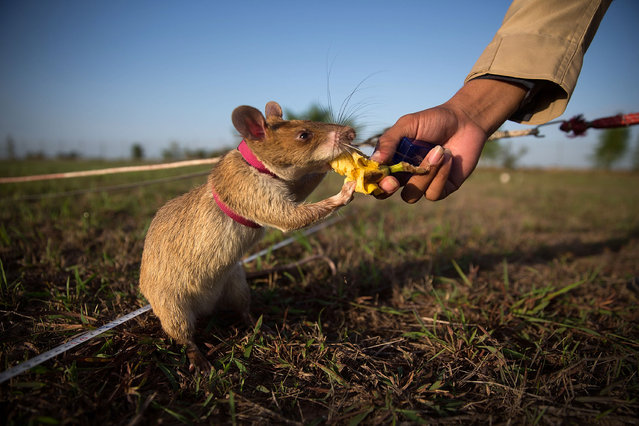
A mine detection rat is given banana as a reward after successfully identifying an inactive mine on July 2, 2015 in Siem Reap, Cambodia. (Photo by Taylor Weidman/Getty Images)

A mine detection rat is given banana as a reward after successfully identifying an inactive mine on July 2, 2015 in Siem Reap, Cambodia. The Cambodian Mine Action Center (CMAC) working with the Belgian NGO APOPO has recently begun testing the feasability of using large mine detection rats from Tanzania to help clear fields of mines and unexploded ordnance in one of the most bombed and mined countries in the world. (Photo by Taylor Weidman/Getty Images)
Details
03 Jul 2015 13:31:00