Loading...
Done
Kickflip. (Photo by J.P. Andrews/Mike Andrews/Caters News Agency)

These images are enough to make viewers do a double-take. Although they look like vibrant works of abstract art, they are actually drone photographs taken by brothers J.P. and Mike Andrews, from near Wolverhampton, England. Here: Kickflip. (Photo by J.P. Andrews/Mike Andrews/Caters News Agency)
Details
16 Jan 2018 06:19:00
“Tea Hills”. Early-morning mist over the tea hills of Phu Tho province in Vietnam. (Photo by Vu Trung Huan/Royal Meteorological Society’s Weather Photographer of the Year Awards)

“Tea Hills”. Early-morning mist over the tea hills of Phu Tho province in Vietnam. (Photo by Vu Trung Huan/Royal Meteorological Society’s Weather Photographer of the Year Awards)
Details
20 Oct 2020 00:03:00
Mossy frog (Theloderma corticale). (Photo by Matthijs Kuijpers/The Guardian)

Renowned amphibian and reptile photographer Matthijs Kuijpers has released his first book, “Cold Instinct”. Kuijpers says the aim of the work is “for the viewer to abandon the fear and negative thoughts that often surround these animals”. What’s left is the bizarre beauty of these creatures in their simplest form – no backgrounds and no distractions. Here: Mossy frog (Theloderma corticale). (Photo by Matthijs Kuijpers/The Guardian)
Details
10 May 2019 00:03:00
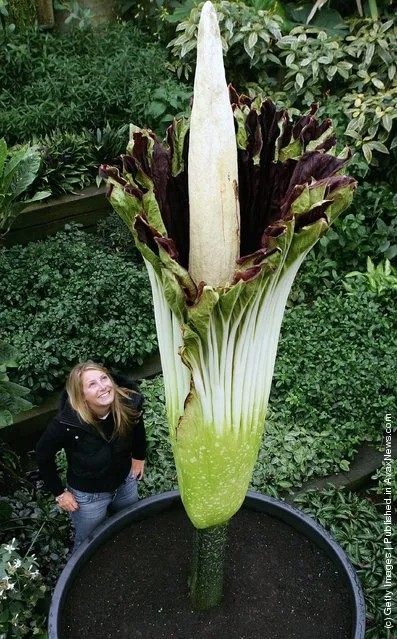
Kew Gardens employee Lauren Bird Royal examines the flowering of the Titan Arum lily at the Botanical Gardens

“The titan arum or Amorphophallus titanum (from Ancient Greek amorphos, “without form, misshapen” + phallos, “phallus”, and titan, “giant”) is a flowering plant with the largest unbranched inflorescence in the world. The titan arum's inflorescence is not as large as that of the Talipot palm, Corypha umbraculifera, but the inflorescence of the Talipot palm is branched rather than unbranched”. – Wikipedia

Photo: Kew Gardens employee Lauren Bird Royal examines the flowering of the Titan Arum lily at the Botanical Gardens at Kew on September 30, 2005 in London, England. For the first time in horticultural history, the Titan Arum lily can be seen at all three active stages in its lifecycle – in flower, fruit and leaf.The flowering corm is nearly three metres tall and weighs 91kg and is very rarely seen outside of the rainforests of Sumatra, Indonesia. (Photo by Scott Barbour/Getty Images)

Details
20 Sep 2011 11:13:00
Jennifer Lopez Gets Loud for Hillary Clinton at Get Out The Vote concert on October 29, 2016 in Miami, Florida. (Photo by Larry Marano/Rex Features/Shutterstock)

Jennifer Lopez Gets Loud for Hillary Clinton at Get Out The Vote concert on October 29, 2016 in Miami, Florida. (Photo by Larry Marano/Rex Features/Shutterstock)
Details
31 Oct 2016 11:55:00
“DC3 Wreck”. A capture of a US military DC3 plane wreck at the southern black beach in Iceland. Photo location: Iceland. (Photo and caption by Naian Feng/National Geographic Photo Contest)

“DC3 Wreck”. A capture of a US military DC3 plane wreck at the southern black beach in Iceland. Photo location: Iceland. (Photo and caption by Naian Feng/National Geographic Photo Contest)
Details
05 Nov 2014 12:37:00
Spectators pose for a selfie before the running of the Melbourne Cup at the Flemington Racecourse in Melbourne, Australia, Tuesday, November 6, 2018. (Photo by Andy Brownbill/AP Photo)

Spectators pose for a selfie before the running of the Melbourne Cup at the Flemington Racecourse in Melbourne, Australia, Tuesday, November 6, 2018. (Photo by Andy Brownbill/AP Photo)
Details
06 Nov 2018 09:50:00
The secretive indri (Indri indri) of Madagascar, the largest living lemur. It is also critically endangered and highly evolutionarily distinct with no close relatives, which makes its branch one of most precarious on the mammal evolutionary tree. In the likely event that the indri goes extinct, we will lose 19m years of unique evolutionary history from the mammal tree of life. (Photo by Pierre-Yves Babelon/Aarhus University)

The secretive indri (Indri indri) of Madagascar, the largest living lemur. It is also critically endangered and highly evolutionarily distinct with no close relatives, which makes its branch one of most precarious on the mammal evolutionary tree. In the likely event that the indri goes extinct, we will lose 19m years of unique evolutionary history from the mammal tree of life. (Photo by Pierre-Yves Babelon/Aarhus University)
Details
18 Nov 2018 00:02:00