Loading...
Done
Eco-Friendly Coffins

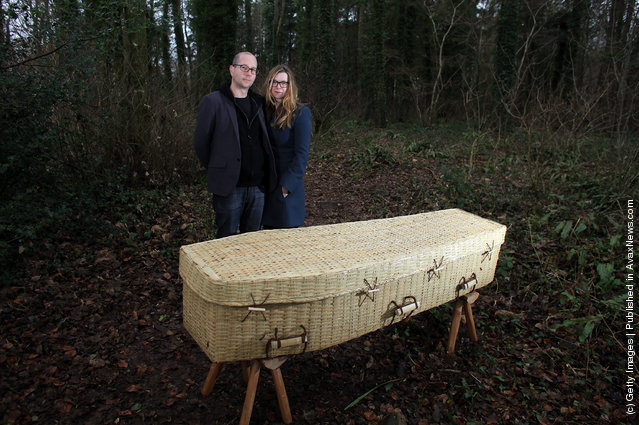
Claire and Rupert Callender of the Green Funeral Company pose for a photograph with a environmentally friendly coffin in woodland close to their office at Dartington Hall Estate on February 4, 2011 near Torquay, England. The Devon-based company operates as funeral directors and undertakers throughout the South West, offers an ecological alternative to traditional funerals, with coffins made from ecologically friendly materials such as wicker and bamboo, and can arrange funerals that encompass diverse religious and spiritual beliefs everything from a Catholic Requiem Mass, to a Pagan ritual at a stone circle on Bodmin Moor. (Photo by Matt Cardy/Getty Images)
Details
16 Aug 2011 11:04:00
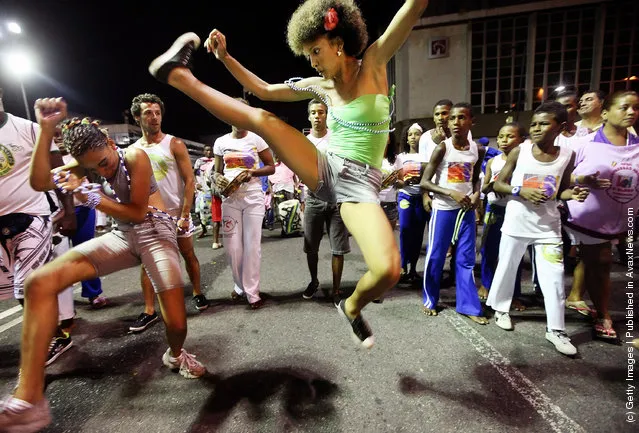
Brazil Begins Carnival Celebration

Brazilians perform capoeira on the first day of Carnival celebrations on February 16, 2012 in Salvador, Brazil. Rio de Janiero's Carnival begins tomorrow. (Photo by Mario Tama/Getty Images)
Details
17 Feb 2012 11:47:00
A competitor looses control of his pancake while racing during the Shrove Tuesday, or Mardi Gras, tradition at the National Cathedral

A competitor looses control of his pancake while racing during the Shrove Tuesday, or Mardi Gras, tradition at the National Cathedral February 21, 2012 in Washington, DC. (Photo by Chip Somodevilla/Getty Images)
Details
22 Feb 2012 11:43:00
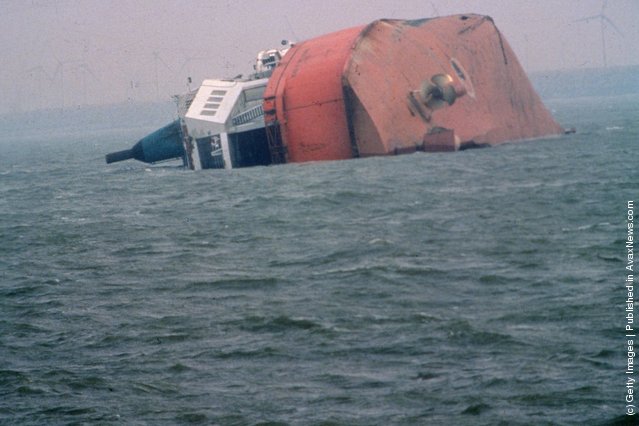
The wreck of the Herald of Free Enterprise, which capsized near Zeebrugge on the 6th of March 1987

“MS Herald of Free Enterprise was a roll-on roll-off (RORO) car and passenger ferry owned by Townsend Thoresen. She was one of three ships commissioned by the company to operate on the Dover–Calais route across the English Channel. The ferry capsized on the night of 6 March 1987, moments after leaving the Belgian port of Zeebrugge, killing 193 passengers and crew. This was the deadliest maritime disaster involving a British ship in peacetime since the sinking of the Iolaire in 1919”. – Wikipedia

Photo: The wreck of the Herald of Free Enterprise, which capsized near Zeebrugge on the 6th of March 1987. (Photo by Hulton Archive/Getty Images). 1987
Details
06 Mar 2012 13:26:00
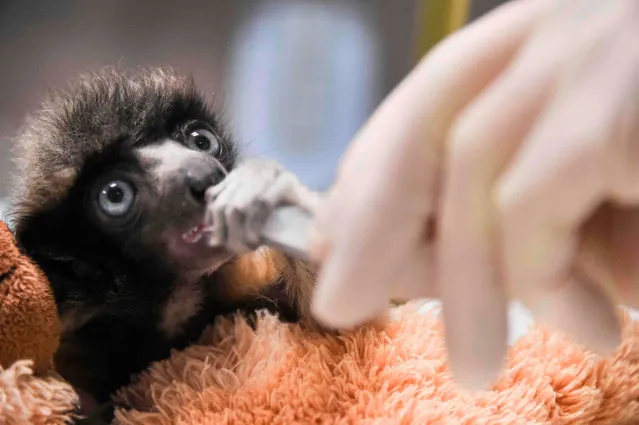
A veterinarian from the zoo of Besancon feeds “Soa”, a female crowned sifaka, in Besancon, eastern France, on February 18, 2019. The crowned sifaka is a critically endangered species from Madagascar. There were only 6 females over 20 individuals living in 7 zoos worldwide end of 2018. (Photo by Sébastien Bozon/AFP Photo)

A veterinarian from the zoo of Besancon feeds “Soa”, a female crowned sifaka, in Besancon, eastern France, on February 18, 2019. The crowned sifaka is a critically endangered species from Madagascar. There were only 6 females over 20 individuals living in 7 zoos worldwide end of 2018. (Photo by Sébastien Bozon/AFP Photo)
Details
24 Feb 2019 00:03:00
Kawakanih Yawalapiti, 9, Upper Xingu region of Mato Grosso, Brazil, 2018: Kawakanih lives with her tribe, the Yawalapiti, in Xingu national park, a preserve in the Amazon basin of Brazil. The Yawalapiti collect seeds to preserve species unique to their ecosystem, which lies between the rain forest and savannah. Kawakanih’s diet is simple, consisting mainly of fish, cassava, porridge, fruit and nuts. “It takes five minutes to catch dinner”, says Kawakanih. “When you’re hungry, you just go to the river with your net”. (Photo by Gregg Segal/The Guardian)

Photographer Gregg Segal travelled the world to document children and the food they eat in a week. Partly inspired by the increasing problems of childhood obesity, he tracked traditional regional diets as yet unaffected by globalisation, and ironically, found that the healthiest diets were often eaten by the least well off. (Photo by Gregg Segal/The Guardian)
Details
03 Jul 2019 00:03:00
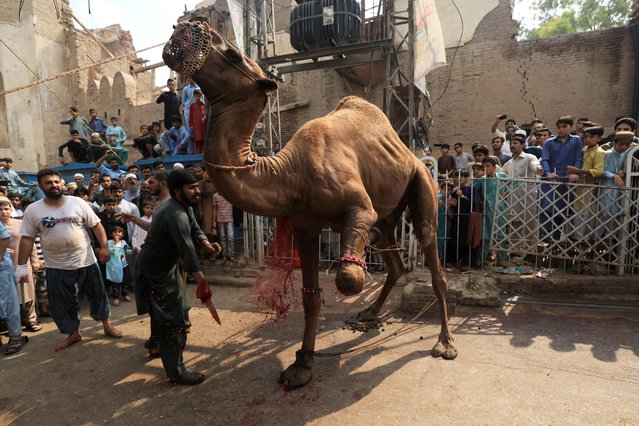
Men and children gather as a camel is being slaughtered in celebration of Eid al-Adha, in Peshawar, Pakistan on August 12, 2019. (Photo by Fayaz Aziz/Reuters)

Men and children gather as a camel is being slaughtered in celebration of Eid al-Adha, in Peshawar, Pakistan on August 12, 2019. (Photo by Fayaz Aziz/Reuters)
Details
07 Sep 2019 00:03:00
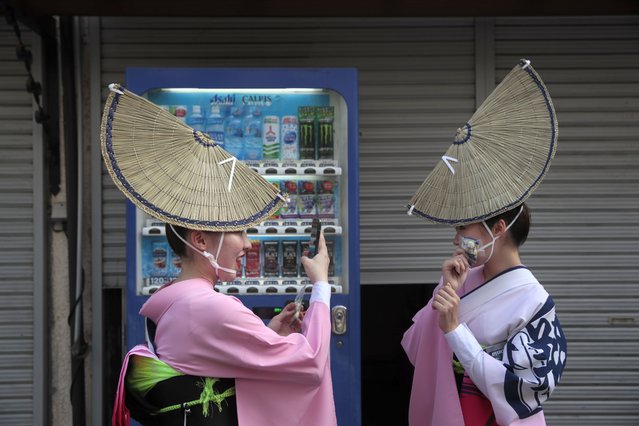
Two young dancers take pictures while waiting for the start of the Koenji Awa-Odori dance festival, in the Koenji neighborhood of Tokyo. Saturday, August 24, 2019, Started in the 1950s, the Koenji Awa-Odori has grown to be one of Tokyo's largest and most popular summer festivals an estimated 10,000 dancers participating in the dance festival. Hundreds of thousands of spectators gather in the neighborhood to watch the two-day summer spectacle. The event is held on the last weekend of August each year. (Photo by Jae C. Hong/AP Photo)

Two young dancers take pictures while waiting for the start of the Koenji Awa-Odori dance festival, in the Koenji neighborhood of Tokyo. Saturday, August 24, 2019, Started in the 1950s, the Koenji Awa-Odori has grown to be one of Tokyo's largest and most popular summer festivals an estimated 10,000 dancers participating in the dance festival. Hundreds of thousands of spectators gather in the neighborhood to watch the two-day summer spectacle. The event is held on the last weekend of August each year. (Photo by Jae C. Hong/AP Photo)
Details
20 Sep 2019 00:03:00