Loading...
Done
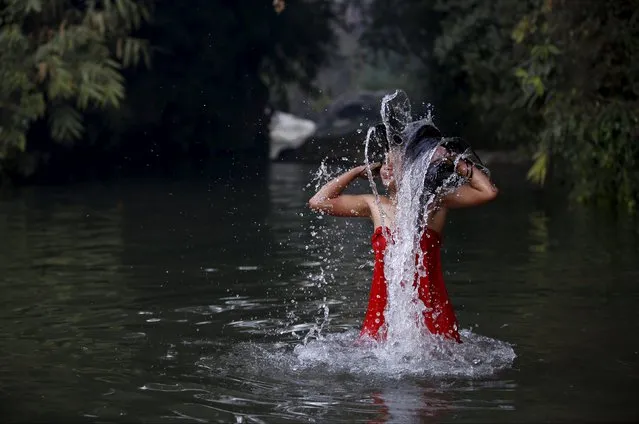
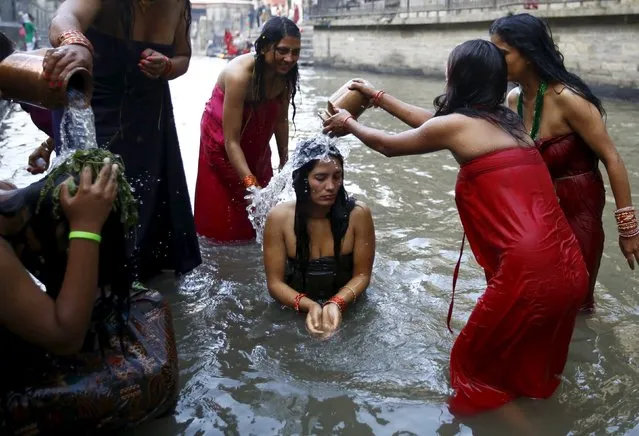
Nepalese women performs ritual as they take a holy bath in the Bagmati River, during the Rishi Panchami festival, in Kathmandu, Nepal September 18, 2015. Rishi Panchami is observed on the last day of Teej when women worship Sapta Rishi (Seven Saints) to ask for forgiveness for sins committed during their menstrual periods throughout the year. (Photo by Navesh Chitrakar/Reuters)

Nepalese women performs ritual as they take a holy bath in the Bagmati River, during the Rishi Panchami festival, in Kathmandu, Nepal September 18, 2015. Rishi Panchami is observed on the last day of Teej when women worship Sapta Rishi (Seven Saints) to ask for forgiveness for sins committed during their menstrual periods throughout the year. The Hindu religion considers menstruation as a representation of impurity and women are prohibited from taking part in religious practices during their monthly menstruations. (Photo by Navesh Chitrakar/Reuters)
Details
21 Sep 2015 12:23:00
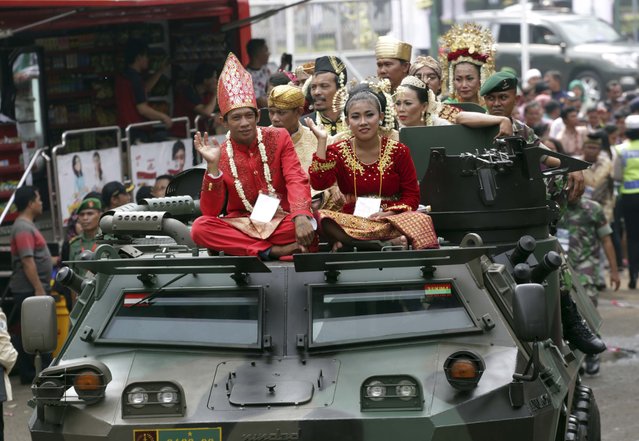
Brides and grooms sit on top of an Indonesian Army vehicle during a mass wedding ceremony organized in Jakarta, Indonesia, Wednesday, January 28, 2015. Thousands of couples registered for the mass marriage sponsored by the Indonesian Armed Forces. (Photo by Achmad Ibrahim/AP Photo)

Brides and grooms sit on top of an Indonesian Army vehicle during a mass wedding ceremony organized in Jakarta, Indonesia, Wednesday, January 28, 2015. More than 5000 couples participated on a mass wedding ceremony to legalized the previous religious marriage ceremonies. Most of the couples have not officially registered their marriage for economic reasons as it cost up to 500,000 IDR (35 euro) to legalized a marriage. The ceremony organized by Rajawali Foundation. (Photo by Achmad Ibrahim/AP Photo)
Details
29 Jan 2015 11:25:00
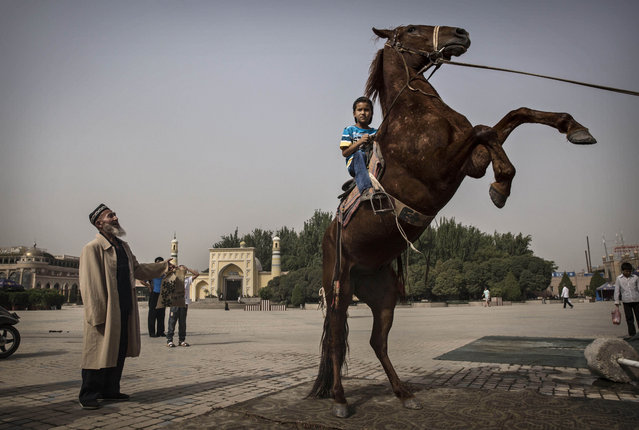
A Uyghur boy sits atop a horse as he has his picture taken outside the Id Kah Mosque before the Eid holiday  on July 28, 2014 in old Kashgar, Xinjiang Province, China. (Photo by Kevin Frayer/Getty Images)

A Uyghur boy sits atop a horse as he has his picture taken outside the Id Kah Mosque before the Eid holiday on July 28, 2014 in old Kashgar, Xinjiang Province, China. Nearly 100 people have been killed in unrest in the restive Xinjiang Province in the last week in what authorities say is terrorism but advocacy groups claim is a result of a government crackdown to silence opposition to its policies. China's Muslim Uyghur ethnic group faces cultural and religious restrictions by the Chinese government. Beijing says it is investing heavily in the Xinjiang region but Uyghurs are increasingly dissatisfied with the influx of Han Chinese and uneven economic development. (Photo by Kevin Frayer/Getty Images)
Details
10 Aug 2014 10:53:00
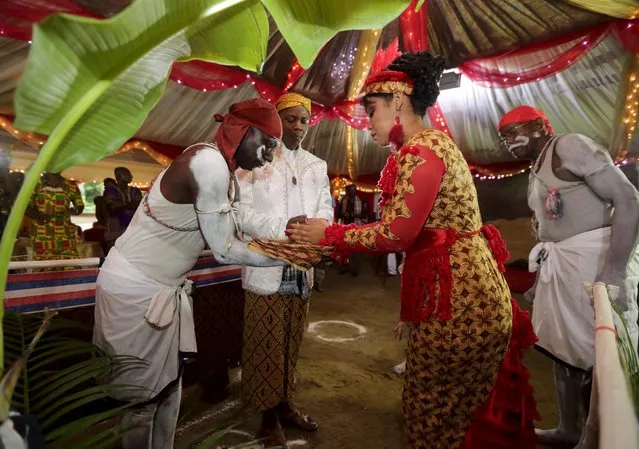
Winti spiritual leader Ramon Mac-Nack (2nd L) looks on as as his bride Melissa Karwafodi (2nd R) hands a gourd to a Maroon priest (L) as they are wedded in the first Winti marriage ever to be held in public, in district Para, Suriname, November 16, 2015. (Photo by Ranu Abhelakh/Reuters)

Winti spiritual leader Ramon Mac-Nack (2nd L) looks on as as his bride Melissa Karwafodi (2nd R) hands a gourd to a Maroon priest (L) as they are wedded in the first Winti marriage ever to be held in public, in district Para, Suriname, November 16, 2015. The Winti religion, which formed centuries ago out of elements of different religious traditions that African slaves brought with them to Suriname, was considered a form idolatry and prohibited by law since the days of slavery until it was finally officially recognized in 1971. (Photo by Ranu Abhelakh/Reuters)
Details
27 Nov 2015 05:51:00
A devotee takes a holy bath in River Saali in Sankhu during the Swasthani Brata Katha festival in Kathmandu, Nepal, January 24, 2016. (Photo by Navesh Chitrakar/Reuters)

A devotee takes a holy bath in River Saali in Sankhu during the Swasthani Brata Katha festival in Kathmandu, Nepal, January 24, 2016. During the month long festival, devotees recite one chapter of a Hindu tale daily from the 31-chapter sacred Swasthani Brata Katha book that is dedicated to God Madhavnarayan and Goddess Swasthani, alongside various other gods and goddess and the miraculous feats performed by them. The devotees also go on pilgrimages to various temples, perform religious rituals, take a holy bath in the rivers and fast for a month, especially among women who believe fasting helps in their family's well-being or in getting them a good husband. (Photo by Navesh Chitrakar/Reuters)
Details
25 Jan 2016 12:05:00
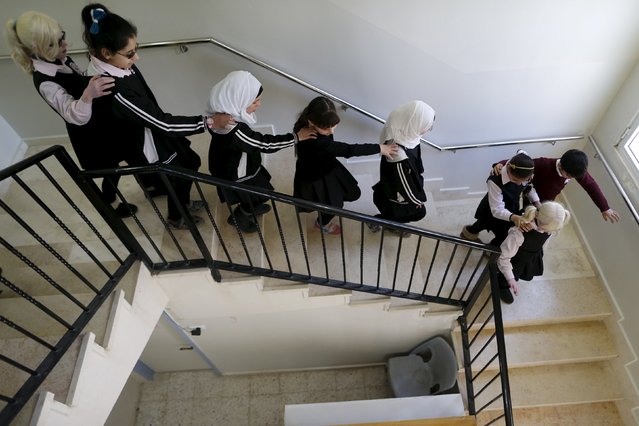
Blind and visually impaired Palestinian students walk down the stairs at a school, where they are taught English through song and music, at a school in the West Bank city of Hebron March 2, 2016. (Photo by Ammar Awad/Reuters)

Blind and visually impaired Palestinian students walk down the stairs at a school, where they are taught English through song and music, at a school in the West Bank city of Hebron March 2, 2016. Palestinian students at a school for the blind in the West Bank are learning English through song, a welcome departure from using braille and memorising grammar rules. While students are delighted with the change, some parents in the religiously conservative town of Hebron are concerned that using music in the classroom jars with Islamic tradition. (Photo by Ammar Awad/Reuters)
Details
03 Mar 2016 11:20:00
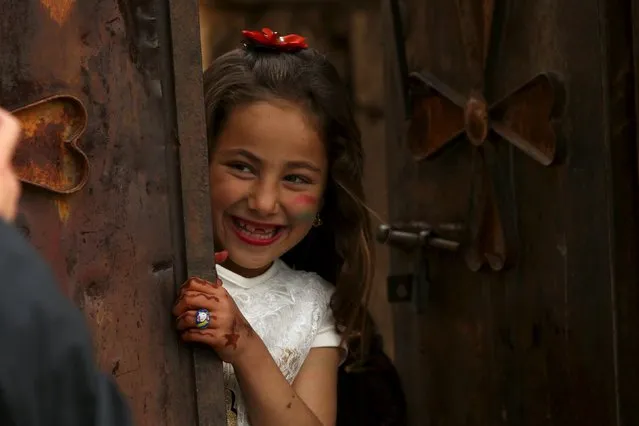
A Kurdish girl celebrates Newroz Day, a festival marking spring and the new year, in Akra, Iraq March 20, 2016. (Photo by Ari Jalal/Reuters)

A Kurdish girl celebrates Newroz Day, a festival marking spring and the new year, in Akra, Iraq March 20, 2016. Nowruz is the name of the Iranian New Year also referred to as Persian New Year which is celebrated worldwide by Iranian peoples, along with some other ethno-linguistic groups. Nowruz is the day of the vernal equinox, and marks the beginning of spring in the Northern Hemisphere. It usually occurs on March 21 or the previous/following day, depending on where it is observed. Although having Persian and religious Zoroastrian origins, Nowruz has been celebrated by people from diverse ethno-linguistic communities for thousands of years. (Photo by Ari Jalal/Reuters)
Details
21 Mar 2016 12:47:00
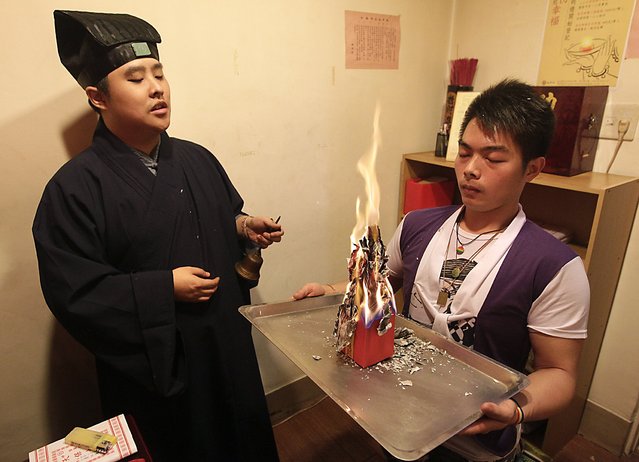
Lu Wei-ming (L), priest of the Wei-ming temple, and a worshipper burn a Taoist paper amulet during a prayer ritual at the temple in New Taipei city January 8, 2015. The shrine, down a narrow alleyway in a bustling district of the city, is dedicated to a deity who has watched over homosexuals for four centuries. (Photo by Pichi Chuang/Reuters)

Lu Wei-ming (L), priest of the Wei-ming temple, and a worshipper burn a Taoist paper amulet during a prayer ritual at the temple in New Taipei city January 8, 2015. The shrine, down a narrow alleyway in a bustling district of the city, is dedicated to a deity who has watched over homosexuals for four centuries. Priest Lu founded the temple in 2006, at a time gays were excluded from most religious ceremonies. (Photo by Pichi Chuang/Reuters)
Details
21 Jan 2015 13:06:00