Loading...
Done
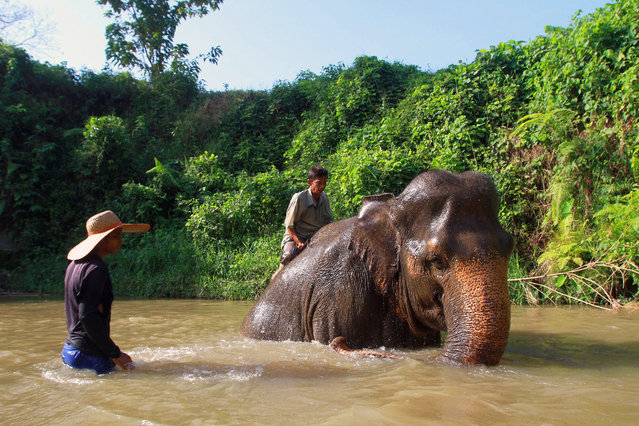
Indonesian mahouts clean their Sumatran elephant in a river near the zoo in Medan, North Sumatra, Indonesia, 12 December 2014. According media reports, the smallest of the Asian elephants, Sumatran elephant (Elephas maximus sumatrensis) is facing serious pressures arising from illegal logging and associated habitat loss and fragmentation in Indonesia. The population has come under increasing threat from rapid forest conversion to plantations. (Photo by Dedi Sahputra/EPA)

Indonesian mahouts clean their Sumatran elephant in a river near the zoo in Medan, North Sumatra, Indonesia, 12 December 2014. According media reports, the smallest of the Asian elephants, Sumatran elephant (Elephas maximus sumatrensis) is facing serious pressures arising from illegal logging and associated habitat loss and fragmentation in Indonesia. The population has come under increasing threat from rapid forest conversion to plantations. (Photo by Dedi Sahputra/EPA)
Details
13 Dec 2014 13:23:00
A Filipino worker arranges roasted pigs which they sell in suburban Quezon city, Philippines on Tuesday, December 23, 2014. Roasted pig is popular during Filipino celebrations and traditionally served during a Christmas eve dinner called “Noche Buena” in this predominantly Roman Catholic nation. (Photo by Aaron Favila/AP Photo)

A Filipino worker arranges roasted pigs which they sell in suburban Quezon city, Philippines on Tuesday, December 23, 2014. Roasted pig is popular during Filipino celebrations and traditionally served during a Christmas eve dinner called “Noche Buena” in this predominantly Roman Catholic nation. (Photo by Aaron Favila/AP Photo)
Details
27 Dec 2014 11:49:00
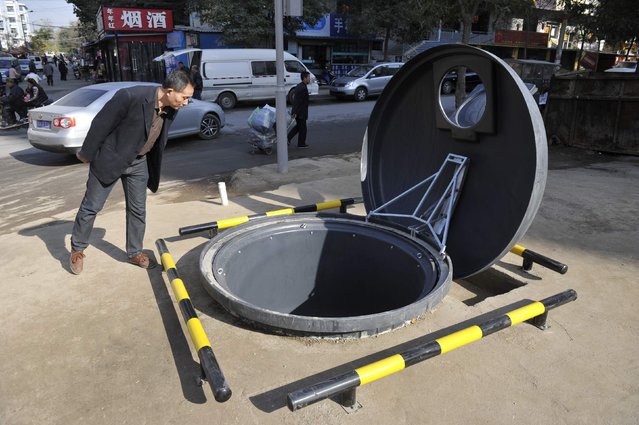
A resident looks into a newly-built giant trash can, partially buried underground, next to a street in Taiyuan, Shanxi province November 6, 2014. The trash can, which has a diameter of 1.9 meters and a depth of 2.8 meters, could contain approximately 10 cubic metres of garbage. It was built to replace an open-air garbage dump site, local media reported. (Photo by Reuters/Stringer)

A resident looks into a newly-built giant trash can, partially buried underground, next to a street in Taiyuan, Shanxi province November 6, 2014. The trash can, which has a diameter of 1.9 meters and a depth of 2.8 meters, could contain approximately 10 cubic metres of garbage. It was built to replace an open-air garbage dump site, local media reported. (Photo by Reuters/Stringer)
Details
08 Nov 2014 12:40:00
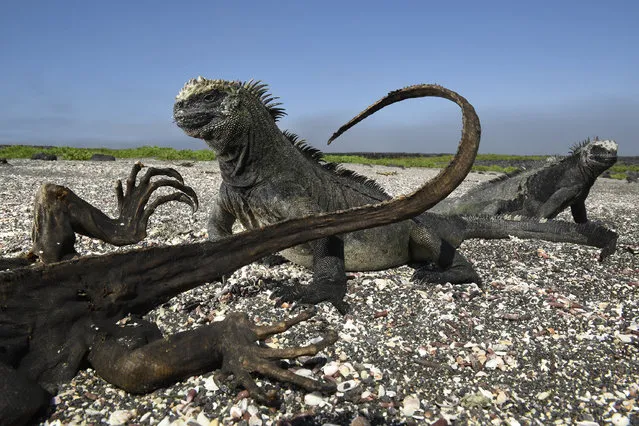
Galapagos – Rocking the Cradle: Four major ocean currents converge along the Galapagos archipelago, creating the conditions for an extraordinary diversity of animal life, April 25, 2016. The islands are home to at least 7,000 flora and fauna species, of which 97 percent of the reptiles, 80 percent of the land birds, 50 percent of the insects and 30 percent of the plants are endemic. The local ecosystem is highly sensitive to the changes in temperature, rainfall and ocean currents that characterize the climatic events known as El Niño and La Niña. These changes cause marked fluctuations in weather and food availability. Many scientists expect the frequency of El Niño and La Niña to increase as a result of climate change, making the Galapagos a possible early-warning location for its effects. (Photo by Thomas P. Peschak for National Geographic/World Press Photo)

Galapagos – Rocking the Cradle: Four major ocean currents converge along the Galapagos archipelago, creating the conditions for an extraordinary diversity of animal life, April 25, 2016. The islands are home to at least 7,000 flora and fauna species, of which 97 percent of the reptiles, 80 percent of the land birds, 50 percent of the insects and 30 percent of the plants are endemic. (Photo by Thomas P. Peschak for National Geographic/World Press Photo)
Details
16 Apr 2018 00:01:00
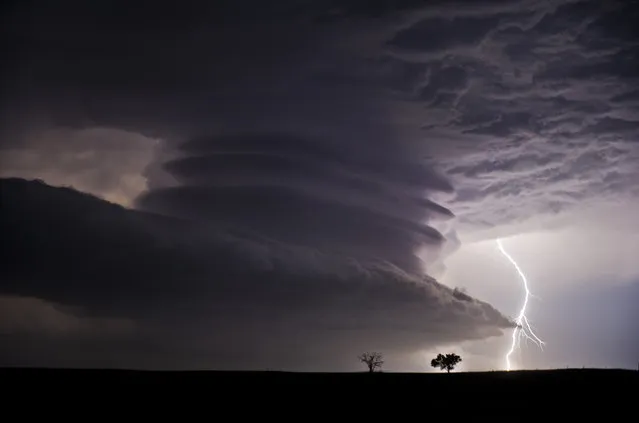
“Stacked Supercell with Lightning”. This huge mesocyclone supercell was near the Nebraska / Kansas border on the night of June 22nd, 2012. What a stunning structure! (Photo and caption by Jennifer Brindley/National Geographic Traveler Photo Contest)

“Stacked Supercell with Lightning”. This huge mesocyclone supercell was near the Nebraska / Kansas border on the night of June 22nd, 2012. What a stunning structure! (Photo and caption by Jennifer Brindley/National Geographic Traveler Photo Contest)

ATTENTION! All pictures are presented in high resolution. To see Hi-Res images – just TWICE click on any picture. In other words, click small picture – opens the BIG picture. Click BIG picture – opens VERY BIG picture.
Details
25 Jun 2013 13:12:00
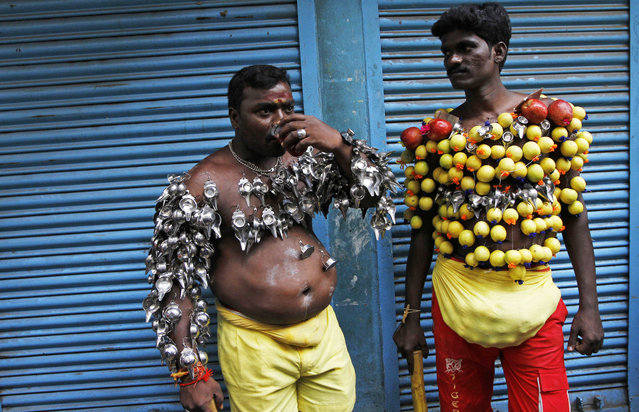
Hindu devotees, their bodies pierced with lemon and paladai, or bowl with a spout mainly used to feed milk to infants, wait to participate in a procession to mark Shivratri, or the night of Shiva, in Chennai, India, Wednesday, February 18, 2015. (Photo by Arun Sankar K./AP Photo)

Hindu devotees, their bodies pierced with lemon and paladai, or bowl with a spout mainly used to feed milk to infants, wait to participate in a procession to mark Shivratri, or the night of Shiva, in Chennai, India, Wednesday, February 18, 2015. Such processions are held as an offering and show of devotion by devotees on the day dedicated to the worship of Lord Shiva, the Hindu god of destruction. (Photo by Arun Sankar K./AP Photo)
Details
21 Feb 2015 11:41:00
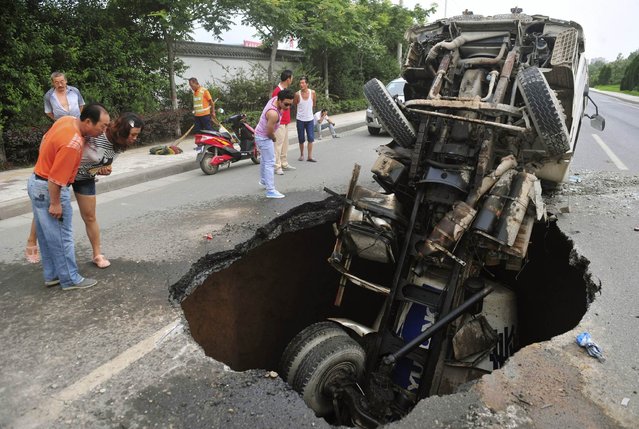
People look at a tanker after it fell into a caved-in area on a road in Xi'an, Shaanxi province, July 27, 2013. No casualty was reported in the accident, according to local media. (Photo by Reuters/Stringer)

People look at a tanker after it fell into a caved-in area on a road in Xi'an, Shaanxi province, July 27, 2013. No casualty was reported in the accident, according to local media. (Photo by Reuters/Stringer)
Details
03 Aug 2013 11:22:00
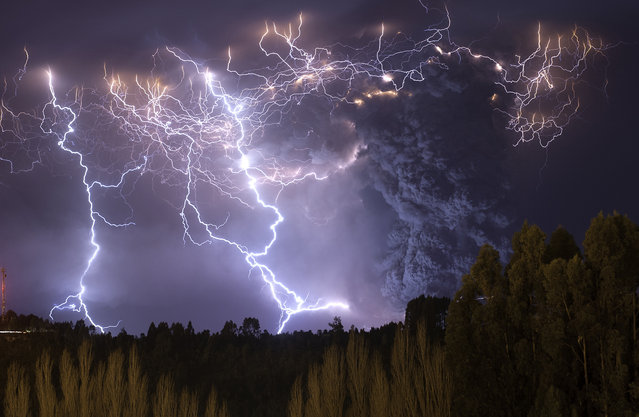
The eruption of Cordon Caulle began on June 4, 2011, located in the Region of Los Rios in Chile. For about 12 months, people and animals became accustomed to living with the daily fall of ash, which also caused problems in the air traffic in South America. The explosions and lightning during first days of the eruption could be seen from hundreds of miles around. This photograph was taken on the second night of eruption from the town of Lago Ranco. (Photo and caption by Francisco Negroni/National Geographic Traveler Photo Contest)

The eruption of Cordon Caulle began on June 4, 2011, located in the Region of Los Rios in Chile. For about 12 months, people and animals became accustomed to living with the daily fall of ash, which also caused problems in the air traffic in South America. The explosions and lightning during first days of the eruption could be seen from hundreds of miles around. This photograph was taken on the second night of eruption from the town of Lago Ranco. (Photo and caption by Francisco Negroni/National Geographic Traveler Photo Contest)

ATTENTION! All pictures are presented in high resolution. To see Hi-Res images – just TWICE click on any picture. In other words, click small picture – opens the BIG picture. Click BIG picture – opens VERY BIG picture.
Details
23 Jun 2013 11:24:00