Loading...
Done
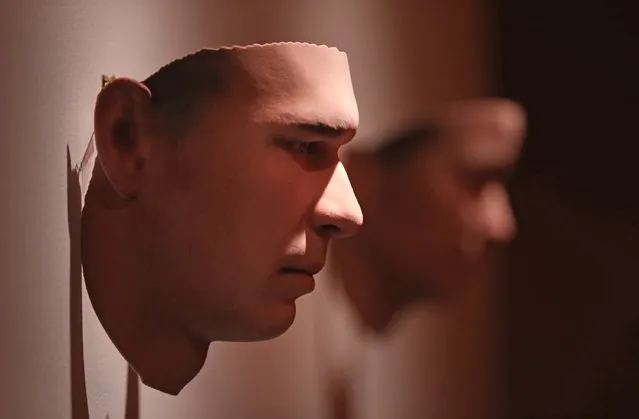
Artist Heather Dewey-Hagborg's 'Stranger Visions', comprising of 3D printed faces extracted from DNA taken from discarded cigarette butts and chewing gum, is displayed at the Big Bang Data exhibition at Somerset House on December 2, 2015 in London, England. (Photo by Peter Macdiarmid/Getty Images for Somerset House)

Artist Heather Dewey-Hagborg's 'Stranger Visions', comprising of 3D printed faces extracted from DNA taken from discarded cigarette butts and chewing gum, is displayed at the Big Bang Data exhibition at Somerset House on December 2, 2015 in London, England. The show highlights the data explosion that's radically transforming our lives. It opens on December 3, 2015 and runs until February 28, 2016 at Somerset House. (Photo by Peter Macdiarmid/Getty Images for Somerset House)
Details
04 Dec 2015 08:03:00
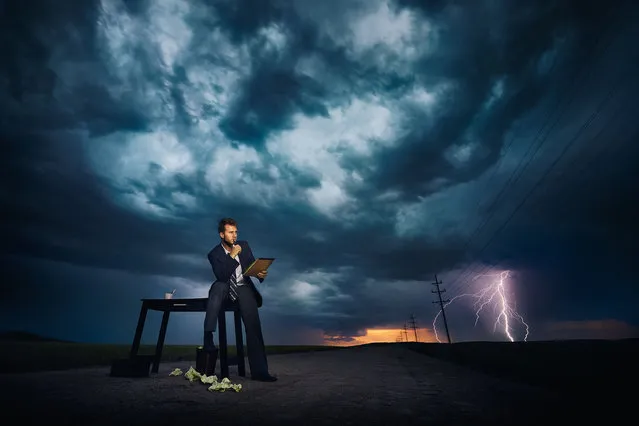
A thrill-seeking snapper has shot a powerful series of images featuring people carrying out everyday chores in front of giant storms. Benjamin Von Wong's surreal scenes include individuals ironing, barbecuing, playing video games and even sitting on the toilet – seemingly unaware of the threatening situations approaching. Here: Models pose in front of a storm in Cheyenne Wyoming. (Photo by Benjamin Von Wongs/Caters News)

A thrill-seeking snapper has shot a powerful series of images featuring people carrying out everyday chores in front of giant storms. Benjamin Von Wong's surreal scenes include individuals ironing, barbecuing, playing video games and even sitting on the toilet – seemingly unaware of the threatening situations approaching. The project was initiated to raise awareness about climate change, and the the storms appearing across six different states in the U.S. Von Wong, 29, started the project in Colorado, before traveling to South Dakota, Wyoming, Montana, North Dakota and Nebraska for the unusual images. Here: Models pose in front of a storm in Cheyenne Wyoming. (Photo by Benjamin Von Wongs/Caters News)
Details
08 Dec 2015 08:02:00
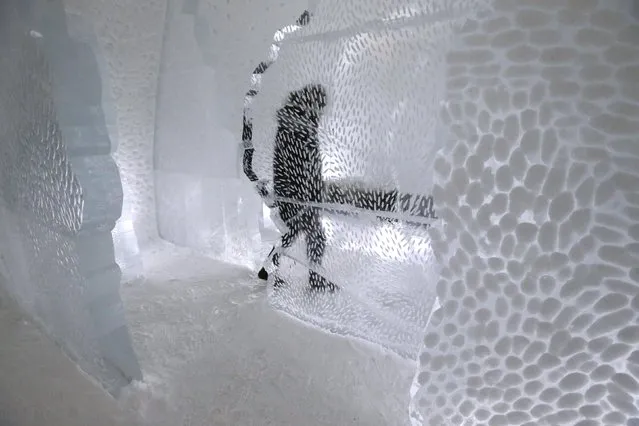
A man walks into a room in the Ice hotel in Jukkasjarvi, Sweden, December 16, 2015. (Photo by Ints Kalnins/Reuters)

In Jukkasjärvi, a village a few miles east of Kiruna, the proprietors of one hotel begin planning for a winter ice festival in March. That’s when they begin collecting some 5,000 tons of ice from the River Torne in order to prepare the Icehotel, the world’s coolest place to stay. Options for overnight stay include snow rooms, ice rooms, art suites, and the Northern Lights room, all of which range from about $300 to $900 per night. But the deluxe suite’s the only way to go. These rooms come with a critical amenity: heated ensuite bathrooms and saunas. Here: A man walks into a room in the Ice hotel in Jukkasjarvi, Sweden, December 16, 2015. (Photo by Ints Kalnins/Reuters)
Details
18 Dec 2015 08:02:00
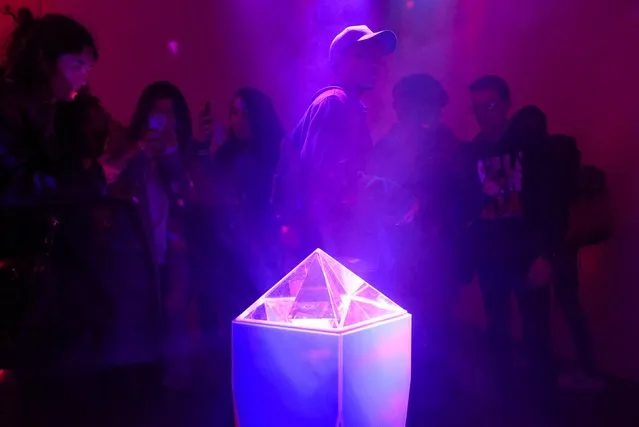
The Museum of Feelings doesn't really have “exhibits" in the conventional sense; rather, visitors move from one themed alcove to another, five in total, each with its own distinctive aroma.  (Photo by Stephanie Keith/Reuters)

The Museum of Feelings doesn't really have “exhibits" in the conventional sense; rather, visitors move from one themed alcove to another, five in total, each with its own distinctive aroma. The “Optimistic Room," bathed in vivid pink and purple light, is little more than a lightshow, with patrons using small reflective panels to bounce light around the room. Here: People interact in the “optimistic” room at the Museum of Feelings, a pop-up installation in New York, December 15, 2015. (Photo by Stephanie Keith/Reuters)
Details
19 Dec 2015 08:00:00
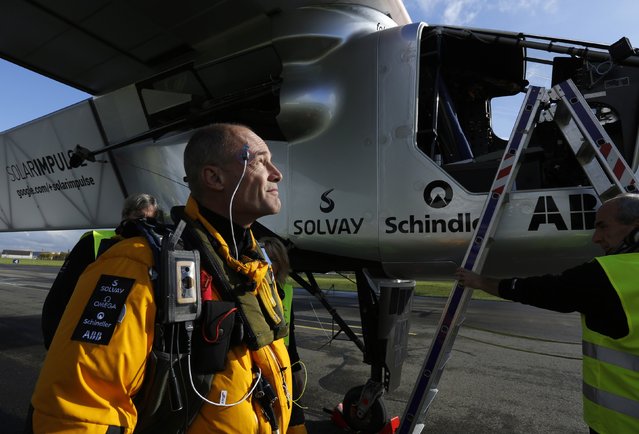
Swiss pilot Bertrand Piccard prepares for a test flight of the solar-powered Solar Impulse 2 experimental aircraft in Payerne November 13, 2014. The aircraft, weighing 2.4 tons with a wingspan of 72 meters, is fitted with more than 17,000 solar cells. An attempt to fly around the world in stages using only solar energy will be made in 2015. (Photo by Ruben Sprich/Reuters)

Swiss pilot Bertrand Piccard prepares for a test flight of the solar-powered Solar Impulse 2 experimental aircraft in Payerne November 13, 2014. The aircraft, weighing 2.4 tons with a wingspan of 72 meters, is fitted with more than 17,000 solar cells. An attempt to fly around the world in stages using only solar energy will be made in 2015. (Photo by Ruben Sprich/Reuters)
Details
14 Nov 2014 14:26:00
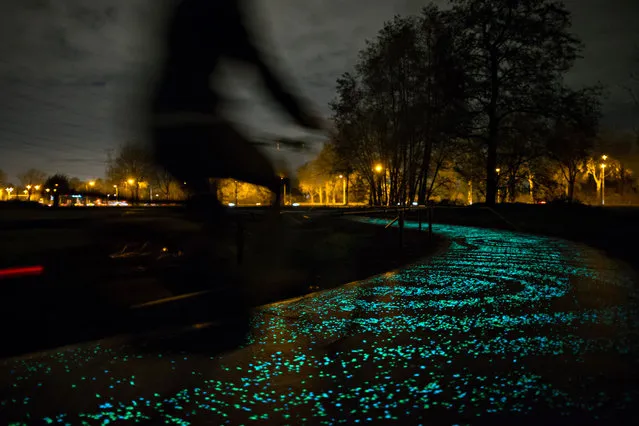
Dutch artist Daan Roosegaarde paid homage to Vincent Van Gogh's famous “Starry Night” painting by creating a glowing bike path relying on solar-powered LED lights. The 650-yard route  which opened November 12, 2014 extends between Eindhoven and Neunen, Netherlands, where Van Gogh spent part of his life. Its the first event marking the 125th anniversary of Van Gogh's death July 29, 2015. (Photo by Pim Hendriksen/Studio Roosegaarde)

Dutch artist Daan Roosegaarde paid homage to Vincent Van Gogh's famous “Starry Night” painting by creating a glowing bike path relying on solar-powered LED lights. The 650-yard route which opened November 12, 2014 extends between Eindhoven and Neunen, Netherlands, where Van Gogh spent part of his life. Its the first event marking the 125th anniversary of Van Gogh's death July 29, 2015. (Photo by Pim Hendriksen/Studio Roosegaarde)
Details
23 Nov 2014 13:31:00
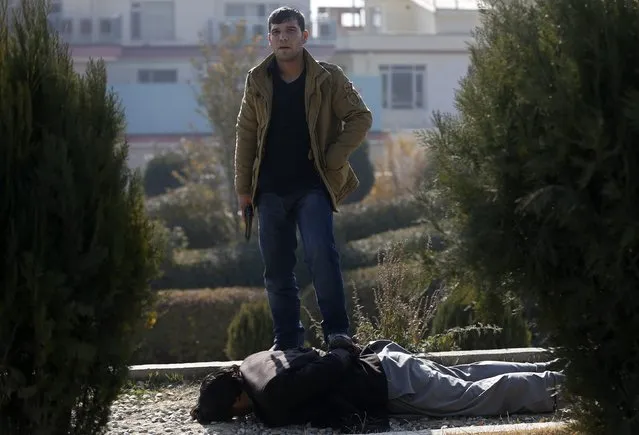
A security personnel detains a suspect after a blast in Kabul, November 25, 2014. A powerful explosion shook houses in the diplomatic quarter of Kabul on Tuesday, but there were no casualties in the second such incident in the Afghan capital in a single day, officials said. “Someone threw a hand grenade and he was apprehended”, said Sediq Sediqqi, a spokesman for the interior ministry. (Photo by Omar Sobhani/Reuters)

A security personnel detains a suspect after a blast in Kabul, November 25, 2014. A powerful explosion shook houses in the diplomatic quarter of Kabul on Tuesday, but there were no casualties in the second such incident in the Afghan capital in a single day, officials said. “Someone threw a hand grenade and he was apprehended”, said Sediq Sediqqi, a spokesman for the interior ministry. The suspect was being interrogated but his motive and target were still unclear, he added. (Photo by Omar Sobhani/Reuters)
Details
26 Nov 2014 14:35:00
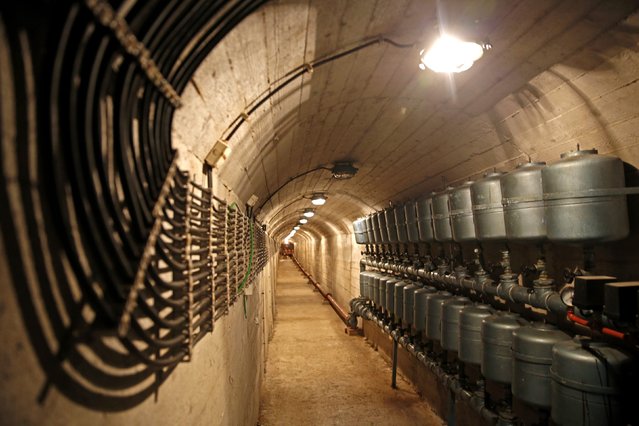
A tunnel with electric switches are seen in Josip Broz Tito's underground secret bunker (ARK) in Konjic, October 16, 2014. (Photo by Dado Ruvic/Reuters)

A tunnel with electric switches are seen in Josip Broz Tito's underground secret bunker (ARK) in Konjic, October 16, 2014. In the early 1950s, Josip Broz Tito, the late leader of the former Yugoslavia, ordered the building of the secret bunker, located 900 feet (270 m) underground and near the Bosnian town of Konjic, to safeguard the country's ruling class in case of a nuclear attack. Construction at the complex, which had a cost equivalent price tag of $4.6 billion, continued until 1979, the year before Tito died. (Photo by Dado Ruvic/Reuters)
Details
28 Nov 2014 12:14:00