Loading...
Done
A young boy plugs his ears as his sister (C) and nanny (L) watch from Gravelly Point Park as planes land at Reagan National Airport in Arlington, Virginia on June 29, 2017. President Donald Trump' s travel ban on people from six mostly Muslim countries will come into force late Thursday, as controversy swirls over who qualifies for an exemption based on family ties. (Photo by Jim Watson/AFP Photo)

A young boy plugs his ears as his sister (C) and nanny (L) watch from Gravelly Point Park as planes land at Reagan National Airport in Arlington, Virginia on June 29, 2017. President Donald Trump' s travel ban on people from six mostly Muslim countries will come into force late Thursday, as controversy swirls over who qualifies for an exemption based on family ties. (Photo by Jim Watson/AFP Photo)
Details
01 Jul 2017 07:52:00
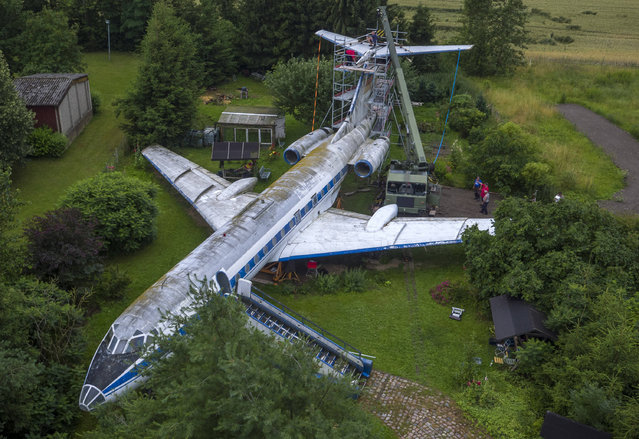
Cottbus Aviation Museum specialists prepare a Soviet Tupolev 134 A passenger plane for dismantlement in Gruenz, Germany, 10 July 2017. The team is preparing the 29 ton plane for transport from a garden in Gruenz to the Aviation Museum in Cottbus. The plane' s owner acquired it in 1991 and transported it with nine tractors and numerous helpers to his vegetable garden where he planned to open a cafe. The plane, formerly used by the East German Stasi for anti- terror operations training, is 30 metres long. (Photo by Jens Büttner/Zentralbild/DPA)

Cottbus Aviation Museum specialists prepare a Soviet Tupolev 134 A passenger plane for dismantlement in Gruenz, Germany, 10 July 2017. The team is preparing the 29 ton plane for transport from a garden in Gruenz to the Aviation Museum in Cottbus. The plane' s owner acquired it in 1991 and transported it with nine tractors and numerous helpers to his vegetable garden where he planned to open a cafe. The plane, formerly used by the East German Stasi for anti- terror operations training, is 30 metres long. (Photo by Jens Büttner/Zentralbild/DPA)
Details
12 Jul 2017 07:50:00
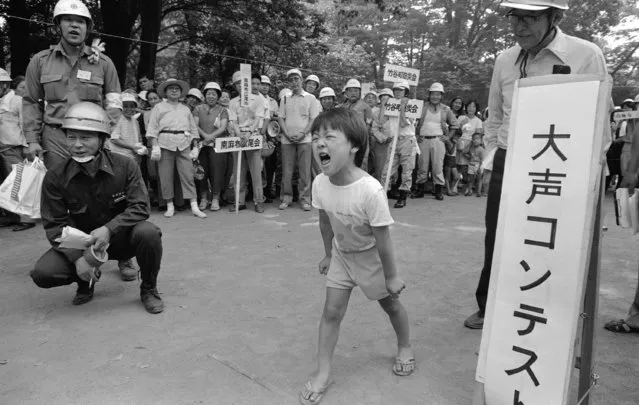
A little boy shouts “Earthquake!” during a shouting contest, part of the annual evacuation drill on the National Disaster Prevention Day on September 1, 1986. The contest was aimed at teaching youngsters the importance of telling neighbors quickly and loudly of a disaster when it hits. The drill is annually conducted through out the country on the day marking the anniversary of the Great Kanto Earthquake that hit the Japanese capital and its vicinity on September 1, 1923, killing more than 104,000 people. (Photo by Sadayuki Mikami/AP Photo)

A little boy shouts “Earthquake!” during a shouting contest, part of the annual evacuation drill on the National Disaster Prevention Day on September 1, 1986. The contest was aimed at teaching youngsters the importance of telling neighbors quickly and loudly of a disaster when it hits. The drill is annually conducted through out the country on the day marking the anniversary of the Great Kanto Earthquake that hit the Japanese capital and its vicinity on September 1, 1923, killing more than 104,000 people. (Photo by Sadayuki Mikami/AP Photo)
Details
02 Sep 2015 11:58:00
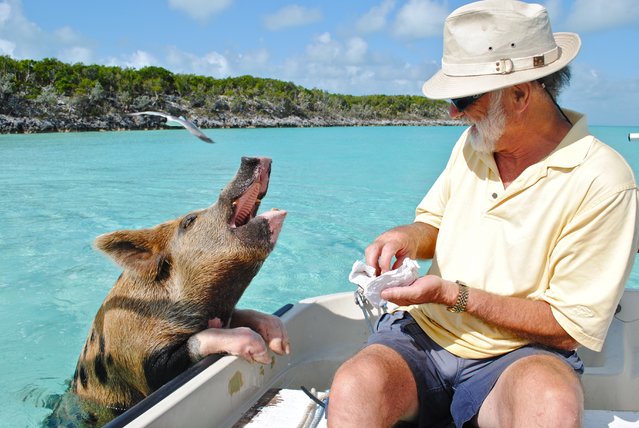
“So you're on a boat in Bahamas and then this pig swims by begging for food”. (Photo and caption by Lisa Larsen/Public Domain)

The Bahamas, the Commonwealth nation of hundreds of islands roughly the size of Connecticut and with population of just a bit over Anaheim, is known for its crystal waters and pristine beaches. This is possibly one of the world’s most beautiful havens of nature, yet people are coming here to see pigs. It is unclear when the pigs first appeared on Exuma Island or where they come from. There’s talk about a daring escape from a shipwreck, or sailors releasing the swine on purpose. In all probability, there were no pigs on this tropical paradise before European settlers came, so their mere presence is the work of human. The intriguing feat of nature, however, is that this population of pigs developed a fine aptitude for swimming. Here: “So you're on a boat in Bahamas and then this pig swims by begging for food”. (Photo and caption by Lisa Larsen/Public Domain)
Details
03 Sep 2015 11:53:00
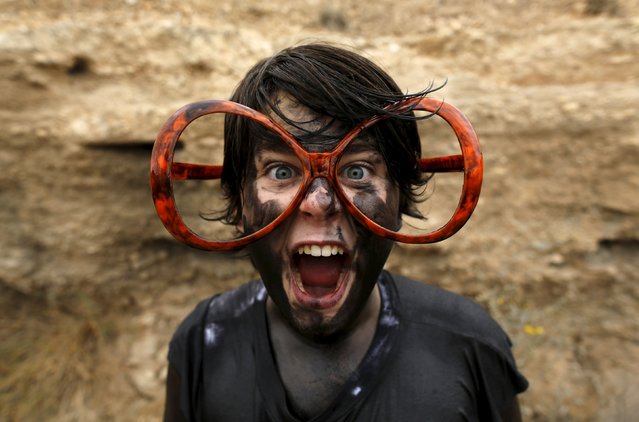
Jose, a reveller covered in grease, poses for a photo as he takes part in the annual Cascamorras festival in Baza, southern Spain September 6, 2015. The festival was inspired by a dispute between the town of Baza and Guadix over the possession of an icon of the Virgin of Piedad. The Cascamorras refers to representatives from Guadix, who were sent to Baza to recover the statue. As the Cascamorras had to stay perfectly clean to gain possession of the statue, Baza residents attempt to make them as “dirty” as possible. (Photo by Marcelo del Pozo/Reuters)

Jose, a reveller covered in grease, poses for a photo as he takes part in the annual Cascamorras festival in Baza, southern Spain September 6, 2015. The festival was inspired by a dispute between the town of Baza and Guadix over the possession of an icon of the Virgin of Piedad. The Cascamorras refers to representatives from Guadix, who were sent to Baza to recover the statue. As the Cascamorras had to stay perfectly clean to gain possession of the statue, Baza residents attempt to make them as “dirty” as possible. (Photo by Marcelo del Pozo/Reuters)
Details
07 Sep 2015 14:11:00
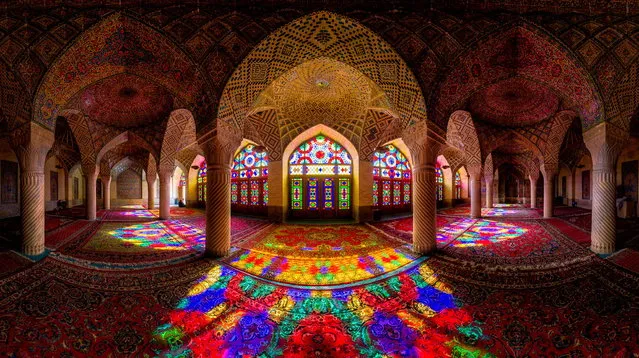
The Nasir Al-Mulk Mosque

The Nasīr al-Mulk Mosque or Pink Mosque is a traditional mosque in Shiraz, Iran, located in Goade-e-Araban place (near the famous Shah Cheragh mosque). The mosque was built during the Qājār era, and is still in use under protection by Nasir al Mulk's Endowment Foundation. It was built by the order of Mirza Hasan Ali Nasir al Molk, one of the lords of the Qajar Dynasty, in 1876 and was finished in 1888. The designers were Muhammad Hasan-e-Memar and Muhammad Reza Kashi Paz-e-Shirazi. The mosque extensively uses colored glass in its facade, and displays other traditional elements such as panj kāseh-i (five concaves) in its design, it is also named in popular culture as Pink Mosque due to the usage of beautiful pink color tiles for its interior design.
Details
26 Mar 2014 14:04:00
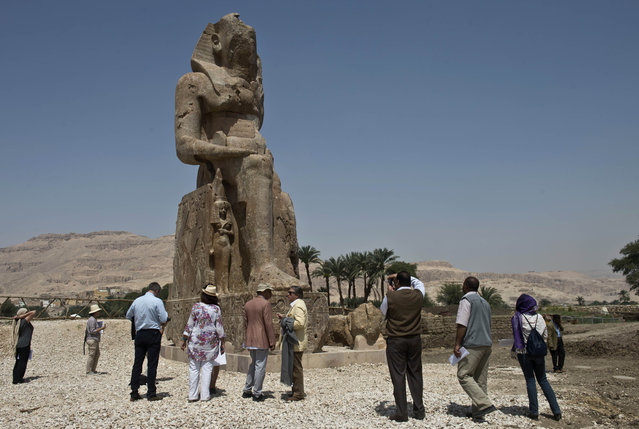
Tourists and journalists stand next to a newly displayed statue of pharaoh Amenhotep III and his wife Tiye (Down) in Egypt's temple city of Luxor on March 23, 2014. Two colossal statues of pharaoh Amenhotep III were unveiled by archaeologists today in their original sites in the funerary temple of the king, on the west bank of the Nile in Luxor, adding to the existing two famous ancient Memnon colossi. (Photo by Khaled Desouki/AFP Photo)

Tourists and journalists stand next to a newly displayed statue of pharaoh Amenhotep III and his wife Tiye (Down) in Egypt's temple city of Luxor on March 23, 2014. Two colossal statues of pharaoh Amenhotep III were unveiled by archaeologists today in their original sites in the funerary temple of the king, on the west bank of the Nile in Luxor, adding to the existing two famous ancient Memnon colossi. (Photo by Khaled Desouki/AFP Photo)
Details
25 Mar 2014 09:02:00
The workers begin to search for gold at 10 am and work until sunset, often working second jobs in the day in order to survive. (Photo by Borja Sanchez-Trillo/Getty Images)

Two workers shovel mud from the river as they look for gold on March 25, 2014 in Lampang, Thailand. Thai villagers from Wang Nuea, North of Thailand, look for gold in the river every year during the drought season. They are able to make an average around USD 15 per day, however two years ago they reached USD 200 in one day due to the river level dropping so much. The workers begin to search for gold at 10 AM and work until sunset, often working second jobs in the day in order to survive. (Photo by Borja Sanchez-Trillo/Getty Images)
Details
27 Mar 2014 06:09:00