Loading...
Done
French twins Thomas and Vincent (L) Seris take the tram in Bordeaux, November 12, 2014. Born with Xeroderma Pigmentosum (XP), the twins cannot be exposed to the sun and its ultraviolet (UV) light, which could provoke precocious cancers due to an autosomal recessive genetic disorder of DNA repair. (Photo by Regis Duvignau/Reuters)

French twins Thomas and Vincent (L) Seris take the tram in Bordeaux, November 12, 2014. Born with Xeroderma Pigmentosum (XP), the twins cannot be exposed to the sun and its ultraviolet (UV) light, which could provoke precocious cancers due to an autosomal recessive genetic disorder of DNA repair. Colloquially referred to as Children of the Night (Les Enfants de la Lune) the Seris twins are among 70 to 80 people in France who suffer from the genetic defect. The French association “Les Enfants de la Lune” reports that there are between five and ten thousand such cases in the world. Thomas and Vincent have been testing a new protective mask for the last year which is transparent and ventilated and developed by several hospitals in France. (Photo by Regis Duvignau/Reuters)
Details
01 Feb 2015 10:27:00
In this Thursday, January 29, 2015 photo, the backseat of a rented 1957 Buick is packed to the brim with flowers, to be transported to Havana from San Antonio de los Banos, Cuba. Every Monday and Thursday morning, self-employed flower vendor Yaima Gonzalez Matos leaves her home to visit a dozen farmers who sell her sunflowers, roses, lilies and other blooms. She loads the flowers into the rented American classic and delivers to customers in the capital. (Photo by Ramon Espinosa/AP Photo)

In this Thursday, January 29, 2015 photo, the backseat of a rented 1957 Buick is packed to the brim with flowers, to be transported to Havana from San Antonio de los Banos, Cuba. Every Monday and Thursday morning, self-employed flower vendor Yaima Gonzalez Matos leaves her home to visit a dozen farmers who sell her sunflowers, roses, lilies and other blooms. She loads the flowers into the rented American classic and delivers to customers in the capital. (Photo by Ramon Espinosa/AP Photo)
Details
04 Feb 2015 11:24:00
A Hindu devotee girl stands after getting her tongue pierced with a metal rod during the Thaipusam festival in Kuala Lumpur, Malaysia, Tuesday, February 3, 2015. Thaipusam, which is celebrated in honor of Hindu god Lord Murugan, is an annual procession by Hindu devotees seeking blessings, fulfilling vows and offering thanks. (Photo by Joshua Paul/AP Photo)

A Hindu devotee girl stands after getting her tongue pierced with a metal rod during the Thaipusam festival in Kuala Lumpur, Malaysia, Tuesday, February 3, 2015. Thaipusam, which is celebrated in honor of Hindu god Lord Murugan, is an annual procession by Hindu devotees seeking blessings, fulfilling vows and offering thanks. (Photo by Joshua Paul/AP Photo)
Details
04 Feb 2015 12:48:00
Norwegian Trolls By Ivar Rodningen Part 2

Some people think of trolls as nothing but savage beast, yet others realize that beneath their rock-hard skin hides a gentle kind heart. Ivar Rodningem is one of the people who knows the true nature of trolls. Though these creatures look unruly, it is just the way they were born. Trolls come in all shapes and sizes. Some are small, some are large, and some are simply enormous. They help each other out, though elders tend to be loners, preferring the company of their own thoughts to anybody else. You shouldn’t run for your life if you ever meet a troll, though we wouldn’t recommend pestering them, as they are mighty strong, even the little ones.


See also:Part 1
Details
07 Mar 2015 12:05:00
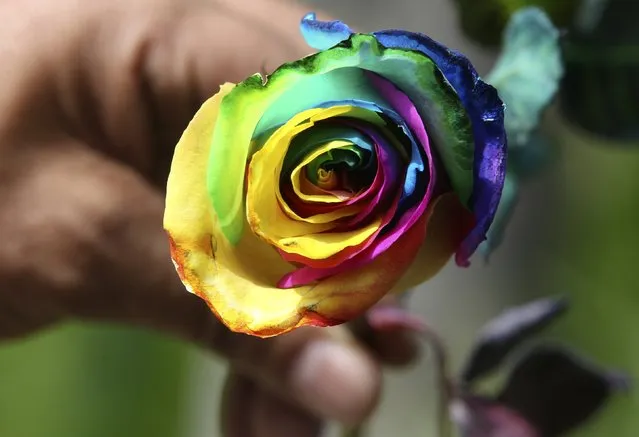
A Colombian flower grower selects a rose for a bouquet ahead of Valentine's Day in Subachoque, February 2, 2015. Colombia is the world's second-largest flower exporter behind the Netherlands. The Andean country exports around 500 million flowers to the U.S. for Valentine's Day, according to the Colombia Flower Growers Association. (Photo by John Vizcaino/Reuters)

A Colombian flower grower selects a rose for a bouquet ahead of Valentine's Day in Subachoque, February 2, 2015. Colombia is the world's second-largest flower exporter behind the Netherlands. The Andean country exports around 500 million flowers to the U.S. for Valentine's Day, according to the Colombia Flower Growers Association. (Photo by John Vizcaino/Reuters)
Details
12 Feb 2015 12:34:00
Opposition students march against Venezuelan President Nicolas Maduro's government in Caracas February 12, 2015. Venezuelan troops blocked students during marches against Maduro on Thursday as pro-government supporters also rallied on the anniversary of 2014 protests that led to 43 deaths. (Photo by Jorge Silva/Reuters)

Opposition students march against Venezuelan President Nicolas Maduro's government in Caracas February 12, 2015. Venezuelan troops blocked students during marches against Maduro on Thursday as pro-government supporters also rallied on the anniversary of 2014 protests that led to 43 deaths. In Caracas, troops cordoned off scores of students on an unauthorized march to a church where they planned a mass in honour of demonstrators who died. (Photo by Jorge Silva/Reuters)
Details
13 Feb 2015 12:59:00
Hindu holy man, or sadhu, applies paint to his forehead at his ashram on the premises of Pashupatinath Temple in Kathmandu February 15, 2015. Hindu holy men from Nepal and India come to this temple to take part in the Maha Shivaratri festival. Celebrated by Hindu devotees all over the world, Shivaratri is dedicated to Lord Shiva. (Photo by Navesh Chitrakar/Reuters)

Hindu holy man, or sadhu, applies paint to his forehead at his ashram on the premises of Pashupatinath Temple in Kathmandu February 15, 2015. Hindu holy men from Nepal and India come to this temple to take part in the Maha Shivaratri festival. Celebrated by Hindu devotees all over the world, Shivaratri is dedicated to Lord Shiva, and holy men mark the occasion by praying, smoking marijuana or smearing their bodies with ashes. (Photo by Navesh Chitrakar/Reuters)
Details
16 Feb 2015 13:12:00
Kagome Co's employee Shigenori Suzuki tries to eat a tomato which is fed to him by the newly-developed “Wearable Tomato” device for runners, during its unveiling event ahead of the weekend's Tokyo Marathon in Tokyo February 19, 2015. (Photo by Toru Hanai/Reuters)

Kagome Co's employee Shigenori Suzuki tries to eat a tomato which is fed to him by the newly-developed “Wearable Tomato” device for runners, during its unveiling event ahead of the weekend's Tokyo Marathon in Tokyo February 19, 2015. The eight-kilo (17.6-pound) contraption fits on a runner like a rucksack. It can distribute a total of seven medium-sized tomatoes, one by one, at the click of a button and supplies the runner with much needed nutrients during a long jog or race. (Photo by Toru Hanai/Reuters)
Details
20 Feb 2015 13:23:00