Loading...
Done
Nose to Nose; Human/Nature winner. “Doug Gimesy was documenting work at the Joey and Bat Sanctuary near Melbourne when he met a wombat (Vombatus ursinus) whose mother had been killed by a car. Gimesy watched as a young veterinary student bottle-fed the orphaned joey, then touched her nose to the joey’s in a tender moment of interspecies bonding”. (Photo by Doug Gimesy/BigPicture)

Nose to Nose; Human/Nature winner. “Doug Gimesy was documenting work at the Joey and Bat Sanctuary near Melbourne when he met a wombat (Vombatus ursinus) whose mother had been killed by a car. Gimesy watched as a young veterinary student bottle-fed the orphaned joey, then touched her nose to the joey’s in a tender moment of interspecies bonding”. (Photo by Doug Gimesy/BigPicture)
Details
25 Jun 2023 05:33:00


“Snowflake (c. 1964 – November 24, 2003) was an albino gorilla. He was the only known albino gorilla so far, and the most popular resident of the Barcelona Zoo in Catalonia, Spain. Originally named Nfumu Ngui in Fang language ("white gorilla") by his captor, he was then nicknamed Floquet de Neu (Catalan for little snowflake) by his keeper Jordi Sabater Pi. On his arrival to Barcelona where he was given an official reception by the then Mayor of Barcelona, Josep Maria de Porcioles, in November 1966, he was called Blancanieves (“Snow White”) in the newspaper Tele/Exprés. But he became famous with the name given to him by Sabater when National Geographic Magazine featured him on the main page in March 1967, with the English name Snowflake. This name spread among the press (Stern, Life, Paris-Match) and was later translated to Spanish as Copito de Nieve. Sabater himself called the gorilla Floquet or Copi, and in the later years Nfumu. The asteroid 95962 Copito, discovered by Catalan astronomer J. Manteca, is named in his honour”.

Details
07 Mar 2011 15:50:00
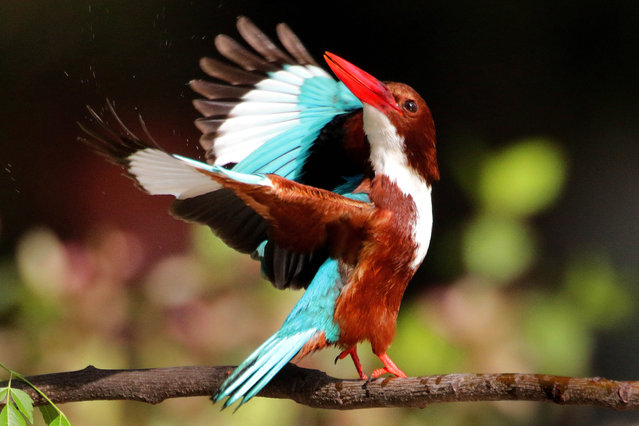
A white-throated kingfisher (Halcyon smyrnensis) sits over a tree in a field in Lahore, Pakistan, 26 March 2021. The most familiar Kingfisher species can be observed perched on branches or walls while on the lookout for grubs, insects and even fish in streams or garden ponds. (Photo by Rahat Dar/EPA/EFE)

A white-throated kingfisher (Halcyon smyrnensis) sits over a tree in a field in Lahore, Pakistan, 26 March 2021. The most familiar Kingfisher species can be observed perched on branches or walls while on the lookout for grubs, insects and even fish in streams or garden ponds. (Photo by Rahat Dar/EPA/EFE)
Details
18 Dec 2021 06:05:00
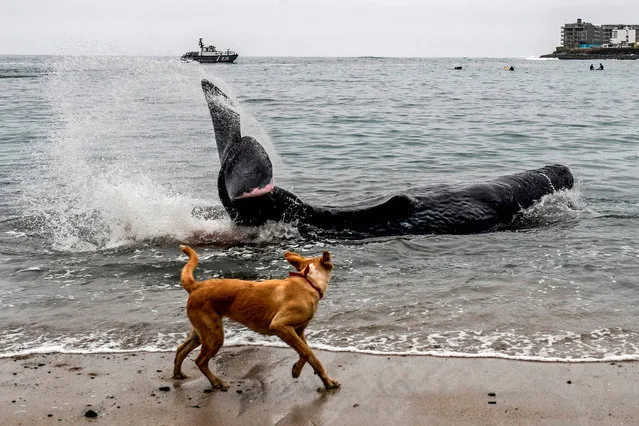
A dog looks at a five-meter-long sperm whale stranded at San Bartolo beach, in Lima, on August 20, 2019. Surfers and policemen saved Tuesday an injured whale which remained stranded some hours at a beach in southern Lima, police informed. (Photo by Ernesto Benavides/AFP Photo)

A dog looks at a five-meter-long sperm whale stranded at San Bartolo beach, in Lima, on August 20, 2019. Surfers and policemen saved Tuesday an injured whale which remained stranded some hours at a beach in southern Lima, police informed. (Photo by Ernesto Benavides/AFP Photo)
Details
25 Aug 2019 00:03:00
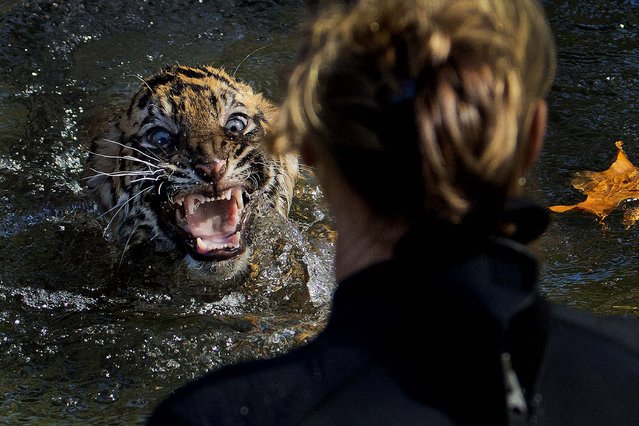
A three-month-old Sumatran tiger cub named “Bandar” shows his displeasure after being dunked in the tiger exhibit moat for a swim reliability test at the National Zoo in Washington, on November 6, 2013. All cubs born at the zoo must take a swim test before being allowed to roam in the exhibit. Bandar passed his test. (Photo by Manuel Balce Ceneta/Associated Press)

A three-month-old Sumatran tiger cub named “Bandar” shows his displeasure after being dunked in the tiger exhibit moat for a swim reliability test at the National Zoo in Washington, on November 6, 2013. All cubs born at the zoo must take a swim test before being allowed to roam in the exhibit. Bandar passed his test. (Photo by Manuel Balce Ceneta/Associated Press)
Details
09 Nov 2013 12:51:00
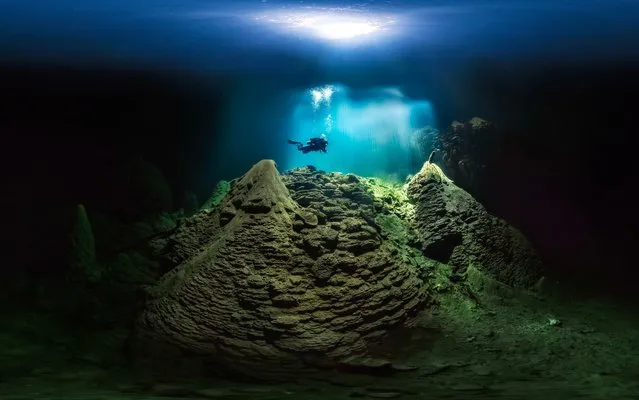
Cave Diver, Anhumas Abyss, Bonito, Brazil: The Anhumas Abyss is an underground cavern with a crystal-clear lake below, more than 260 feet (79 m) deep. A visitor must enter through a narrow opening at the top of the chamber and rappel into the cave. Snorkeling and scuba diving in the lake reveal amazing scenery. Distinctive, conical limestone stalagmites and stalactites occupy the lake and the surrounding area, some reaching 65 feet (20 m) high. “One must rappel about 235 feet (72 m) to get down into this deep lake. The photo was taken at a depth of 50 feet (15 m). It was a challenge to create the image because of the high contrast, plus the diver could not see into the darkness, making communication impossible”. (Photo by Marcio Cabral/Nature’s Best Photography Awards 2017)

Cave Diver, Anhumas Abyss, Bonito, Brazil: The Anhumas Abyss is an underground cavern with a crystal-clear lake below, more than 260 feet (79 m) deep. A visitor must enter through a narrow opening at the top of the chamber and rappel into the cave. Snorkeling and scuba diving in the lake reveal amazing scenery. Distinctive, conical limestone stalagmites and stalactites occupy the lake and the surrounding area, some reaching 65 feet (20 m) high. (Photo by Marcio Cabral/Nature’s Best Photography Awards 2017)
Details
26 Oct 2017 08:10:00
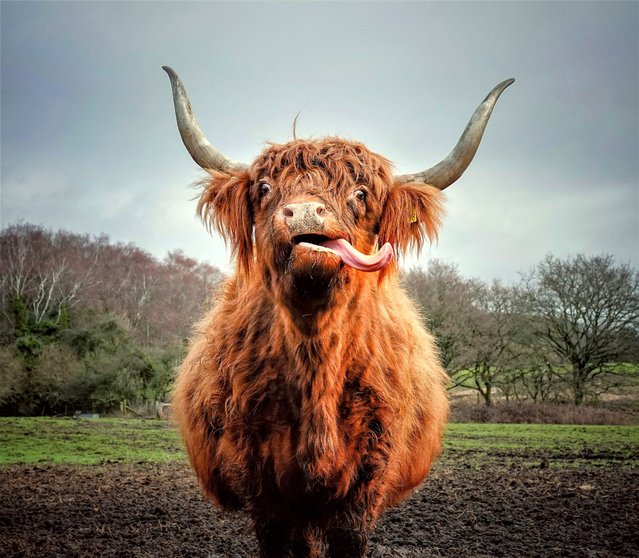
A highland cow in Purbeck, Dorset shows off for the camera in the second decade of February 2023. (Photo by Kate Fry/Bournemouth News)

A highland cow in Purbeck, Dorset shows off for the camera in the second decade of February 2023. (Photo by Kate Fry/Bournemouth News)
Details
27 Feb 2023 05:15:00
A member of the Unidos do Viradouro samba school performs during the last night of the Carnival parade at the Marques de Sapucai Sambadrome in Rio de Janeiro, Brazil, on February 13, 2024. (Photo by Pablo Porciuncula/AFP Photo)

A member of the Unidos do Viradouro samba school performs during the last night of the Carnival parade at the Marques de Sapucai Sambadrome in Rio de Janeiro, Brazil, on February 13, 2024. (Photo by Pablo Porciuncula/AFP Photo)
Details
04 Jun 2025 02:27:00