Loading...
Done
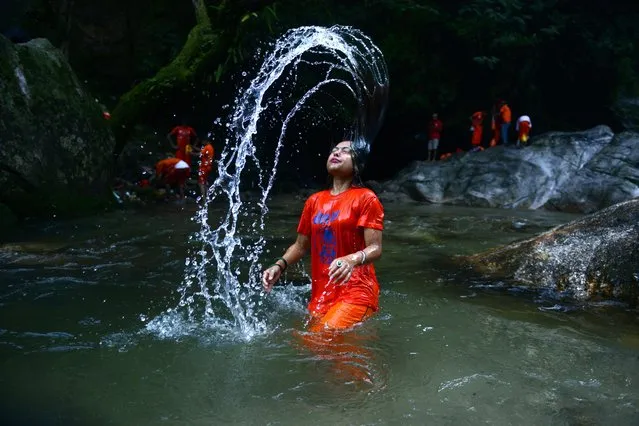
A Nepalese Hindu devotee bathes in the Bagmati River on her way to the Pashupatinath Temple to offer prayers to Lord Shiva, Hindu god of destruction during Shravan festivities in Sundarijal, on the outskirts of Kathmandu on August 3, 2015. According to the Nepali calendar, Shravan is considered the holiest month of the year with each Monday of the month known as Shravan Somvar when worshippers offer prayers for a happy and prosperous life. (Photo by Prakash Mathema/AFP Photo)

A Nepalese Hindu devotee bathes in the Bagmati River on her way to the Pashupatinath Temple to offer prayers to Lord Shiva, Hindu god of destruction during Shravan festivities in Sundarijal, on the outskirts of Kathmandu on August 3, 2015. According to the Nepali calendar, Shravan is considered the holiest month of the year with each Monday of the month known as Shravan Somvar when worshippers offer prayers for a happy and prosperous life. (Photo by Prakash Mathema/AFP Photo)
Details
04 Aug 2015 12:46:00
A model poses at Checkpoint Charlie, a historic place in the German capital to promote the fashion magazine Sous on June 12, 2012

A model poses at Checkpoint Charlie, a historic place in the German capital to promote the fashion magazine “Sous” on June 12, 2012. (Photo by Maurizio Gambarini)
Details
19 Jun 2012 13:47:00
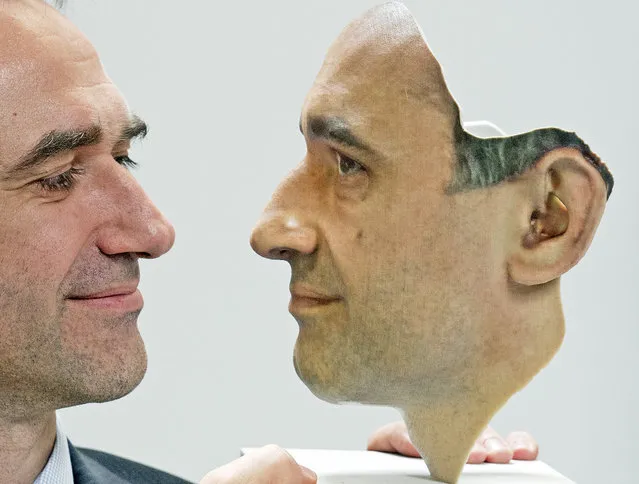
Mario Huettenhofer, chief of the German company 3D Fab, presents his own face as 3d print during the international fairs FabCon 3.D and Rapid.Tech in Erfurt, Germany, Thursday, May 15, 2014. 130 exhibitors from all over the world present the entire world of 3D printing. (Photo by Jens Meyer/AP Photo)

Mario Huettenhofer, chief of the German company 3D Fab, presents his own face as 3d print during the international fairs FabCon 3.D and Rapid.Tech in Erfurt, Germany, Thursday, May 15, 2014. 130 exhibitors from all over the world present the entire world of 3D printing. The trade fairs are accompanied by specialist programs featuring 80 scientists, practitioners and trend analysts from ten countries, who will explain the latest findings, trends and applications for additive processes in industry and for 3D printing in the private sector to newcomers, experts and consumers alike. (Photo by Jens Meyer/AP Photo)
Details
17 May 2014 13:06:00
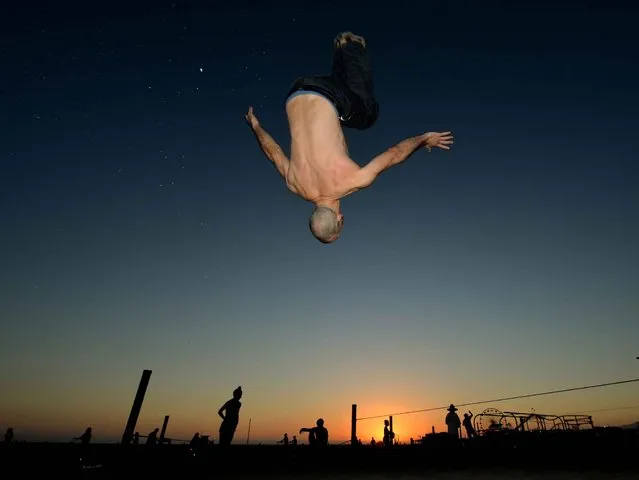
Dhruva Aliman does a back somersault as he dismounts from a slackline on the beach at Santa Monica, California on October 19, 2014. Slackline is a balance sport where a line of webbing is adjusted at different levels of tension between two anchor points and participants (called slackers) perform tricks and stunts including somersaults. (Photo by Mark Ralston/AFP Photo)

Dhruva Aliman does a back somersault as he dismounts from a slackline on the beach at Santa Monica, California on October 19, 2014. Slackline is a balance sport where a line of webbing is adjusted at different levels of tension between two anchor points and participants (called slackers) perform tricks and stunts including somersaults. (Photo by Mark Ralston/AFP Photo)
Details
25 Oct 2014 13:49:00
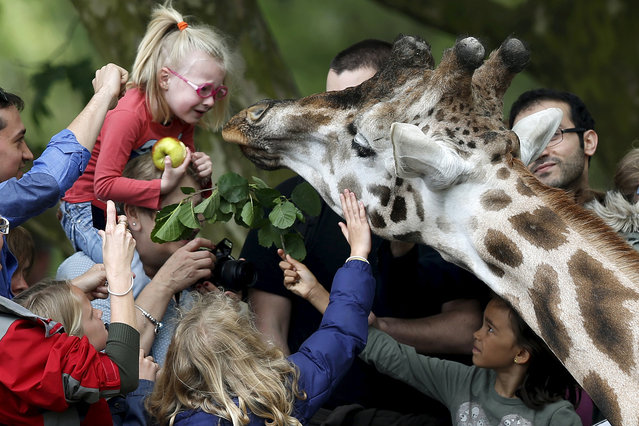
Children feed a giraffe at Pairi Daiza wildlife park, a zoo and botanical garden in Brugelette, Belgium, May 25, 2015. (Photo by Francois Lenoir/Reuters)

Children feed a giraffe at Pairi Daiza wildlife park, a zoo and botanical garden in Brugelette, Belgium, May 25, 2015. (Photo by Francois Lenoir/Reuters)
Details
26 May 2015 11:19:00
Galapagos – Rocking the Cradle: Four major ocean currents converge along the Galapagos archipelago, creating the conditions for an extraordinary diversity of animal life, April 25, 2016. The islands are home to at least 7,000 flora and fauna species, of which 97 percent of the reptiles, 80 percent of the land birds, 50 percent of the insects and 30 percent of the plants are endemic. The local ecosystem is highly sensitive to the changes in temperature, rainfall and ocean currents that characterize the climatic events known as El Niño and La Niña. These changes cause marked fluctuations in weather and food availability. Many scientists expect the frequency of El Niño and La Niña to increase as a result of climate change, making the Galapagos a possible early-warning location for its effects. (Photo by Thomas P. Peschak for National Geographic/World Press Photo)

Galapagos – Rocking the Cradle: Four major ocean currents converge along the Galapagos archipelago, creating the conditions for an extraordinary diversity of animal life, April 25, 2016. The islands are home to at least 7,000 flora and fauna species, of which 97 percent of the reptiles, 80 percent of the land birds, 50 percent of the insects and 30 percent of the plants are endemic. (Photo by Thomas P. Peschak for National Geographic/World Press Photo)
Details
16 Apr 2018 00:01:00
A picture taken with slow shutter speed shows members of the group “The Kattfiller” from Attendorn taking part during the Norddeutsche Championship carnivalesque dance sport in Kassel (Hessen), Germany, 28 February 2016. About 1,100 qualified dancers show in different disciplines their skills. (Photo by Swen Pfoertner/EPA)

A picture taken with slow shutter speed shows members of the group “The Kattfiller” from Attendorn taking part during the Norddeutsche Championship carnivalesque dance sport in Kassel (Hessen), Germany, 28 February 2016. About 1,100 qualified dancers show in different disciplines their skills. (Photo by Swen Pfoertner/EPA)
Details
29 Feb 2016 12:00:00
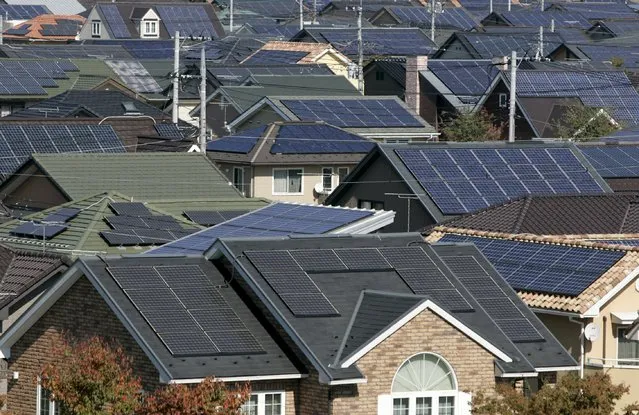
Rooftops of solar powered houses are pictured in Ota, 80 km northwest of Tokyo in this October 28, 2008 file photo. One by one, Japan is turning off the lights at the giant oil-fired power plants that propelled it to the ranks of the world's top industrialised nations. With nuclear power in the doldrums after the Fukushima disaster, it's solar energy that is becoming the alternative. (Photo by Yuriko Nakao/Reuters)

Rooftops of solar powered houses are pictured in Ota, 80 km northwest of Tokyo in this October 28, 2008 file photo. One by one, Japan is turning off the lights at the giant oil-fired power plants that propelled it to the ranks of the world's top industrialised nations. With nuclear power in the doldrums after the Fukushima disaster, it's solar energy that is becoming the alternative. Solar power is set to become profitable in Japan as early as this quarter, according to the Japan Renewable Energy Foundation (JREF), freeing it from the need for government subsidies and making it the last of the G7 economies where the technology has become economically viable. (Photo by Yuriko Nakao/Reuters)
Details
24 Nov 2015 08:04:00