Loading...
Done
Kyaiktiyo, Burma, 1978. The Golden Rock at Shwe Pyi Daw (the Golden Country), the Buddhist holy place. Hiroji Kubota writes: “I was desperate to keep a distance from America for a while; luckily, I found Burma and its gentle and compassionate people. In the spring of 1978, on the top of the hill where I took this photo, I had two Leica bodies: the one with Tri-X and the other with Kodachrome 64. Soon after, I realised that the colour one looked very colourful and was more powerful. That was my decisive moment, to become a colour photographer”. (Photo by Hiroji Kubota/Magnum Photos)

Kyaiktiyo, Burma, 1978. The Golden Rock at Shwe Pyi Daw (the Golden Country), the Buddhist holy place. Hiroji Kubota writes: “I was desperate to keep a distance from America for a while; luckily, I found Burma and its gentle and compassionate people. In the spring of 1978, on the top of the hill where I took this photo, I had two Leica bodies: the one with Tri-X and the other with Kodachrome 64. Soon after, I realised that the colour one looked very colourful and was more powerful. That was my decisive moment, to become a colour photographer”. (Photo by Hiroji Kubota/Magnum Photos)
Details
10 Jun 2016 13:30:00
“I’m not scared of breaking the fourth wall”, Wallace has said of the photos where the subject is clearly aware of him taking the shot. “If they are looking at you in a photograph most photographers will think, oh, that’s not a good image. (But) people like to be involved and in the picture. You can see what they are thinking, see them talking”. (Photo by Dougie Wallace/The Guardian)

In Dougie Wallace’s photos of Mumbai taxis, the chatter, yelling, and constant horns of the city are almost audible. A selection of his images is on show at Gayfield Creative Spaces, Edinburgh, as part of the Retina photography festival until 30 July. For four years, the Glasgow-born Wallace focused his photos on one kind of taxi in particular: the Premier Padmini, a 1960s workhorse painted in black and yellow. Locally known as “Kaali-Peeli”, there were once more than 60,000 of them in the Indian city. But thanks to laws restricting pollution, the cars now are fast disappearing from Mumbai’s streets. (Photo by Dougie Wallace/The Guardian)
Details
13 Jul 2016 13:50:00
Model Helen Kwok displays the nail art completed by a competitor at the Canada Nail Cup in Vancouver, Monday, February 16, 2015. (Photo by Darryl Dyck/AP Photo/The Canadian Press)

Model Helen Kwok displays the nail art completed by a competitor at the Canada Nail Cup in Vancouver, Monday, February 16, 2015. Nail artists competed in multiple categories at the event, which according to organizers is the only nail competition in the country. (Photo by Darryl Dyck/AP Photo/The Canadian Press)
Details
18 Feb 2015 12:39:00
Dramatic changes spotted in HD 189733b exoplanet atmosphere

This artist's rendering illustrates the evaporation of HD 189733b's atmosphere in response to a powerful eruption from its host star. NASA's Hubble Space Telescope detected the escaping gases and NASA's Swift satellite caught the stellar flare. (Credit: NASA's Goddard Space Flight Center)
Details
29 Jun 2012 09:45:00
In a military base in the Thai province of Chon Buri February 20 U.S. Marines Navy with Thailand began their studies in jungle survival. The event is held in joint military exercises “Cobra Gold 2013”. During a jungle survival program February 20, 2013 taught by Royal Thai Special Forces in Sannapit, Thailand, U.S. Marines learned to catch cobras and drink their fresh blood, not to mention eat forest insects and pull the heads off of chicken. The training was part of Operation Cobra Gold 13, the 32nd edition of international military exercises hosted by the Thai. According to a U.S. Marines press release, Cobra Gold is the largest exercise of its kind in Asia and incorporates troops from five other nations in addition to the U.S. and Thailand. The Daily Mail reports that the Marines were invited to experience the local custom of drinking cobra blood after being taught to catch and kill cobras in the wild. As CNN notes, Cobra blood is believed to be a panacea and aphrodiasic in parts of Southeast Asia. In Jakarta, vendors can earn over $100 a night selling shots of cobra blood mixed with liquor. (Photo by Pornchai Kittiwongsakul/AFP Photo)

During a jungle survival program February 20, 2013 taught by Royal Thai Special Forces in Sannapit, Thailand, U.S. Marines learned to catch cobras and drink their fresh blood, not to mention eat forest insects and pull the heads off of chicken. The training was part of Operation Cobra Gold 13, the 32nd edition of international military exercises hosted by the Thai. According to a U.S. Marines press release, Cobra Gold is the largest exercise of its kind in Asia and incorporates troops from five other nations in addition to the U.S. and Thailand. The Daily Mail reports that the Marines were invited to experience the local custom of drinking cobra blood after being taught to catch and kill cobras in the wild. As CNN notes, Cobra blood is believed to be a panacea and aphrodiasic in parts of Southeast Asia. In Jakarta, vendors can earn over $100 a night selling shots of cobra blood mixed with liquor. (Photo by Pornchai Kittiwongsakul/AFP Photo)
Details
23 Feb 2013 11:52:00
Contestants of a tattoo competition pose for photographs at the China TATTOO convention in Nanning, Guangxi Zhuang Autonomous Region, China, October 24, 2015. (Photo by Reuters/Stringer)

Contestants of a tattoo competition pose for photographs at the China TATTOO convention in Nanning, Guangxi Zhuang Autonomous Region, China, October 24, 2015. The annual convention was held in Nanning from October 23 to 25 this year. (Photo by Reuters/Stringer)
Details
27 Oct 2015 08:07:00
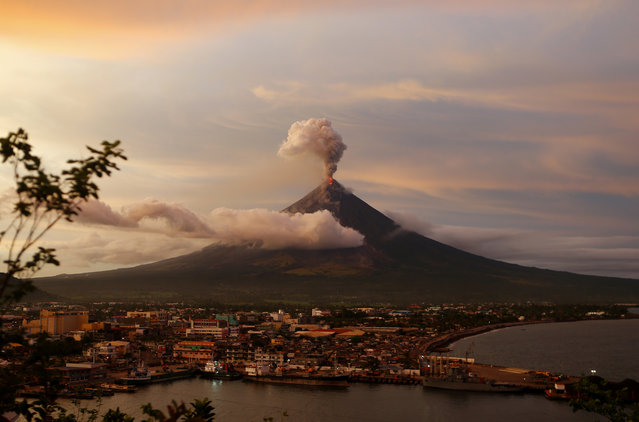
The Mayon volcano continues to erupt as the sun sets behind Legazpi city, Thursday, January 25, 2018 in Albay province, roughly 340 kilometers, (200 miles) southeast of Manila, Philippines. (Photo by Bullit Marquez/AP Photo)

The Mayon volcano continues to erupt as the sun sets behind Legazpi city, Thursday, January 25, 2018 in Albay province, roughly 340 kilometers, (200 miles) southeast of Manila, Philippines. (Photo by Bullit Marquez/AP Photo)
Details
27 Sep 2018 00:03:00
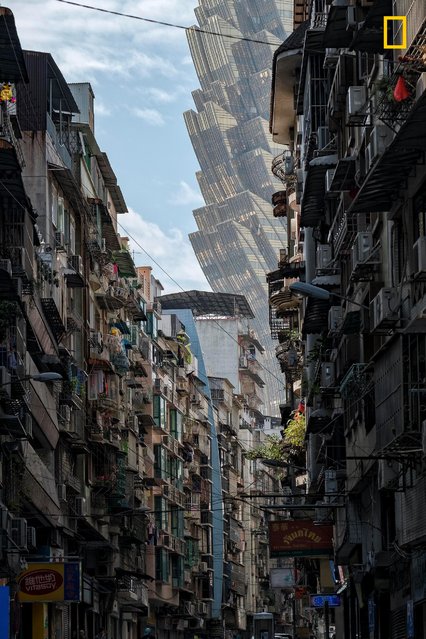
The Invasion. A quiet street in Macau. Modernization around is quickly changing the city, as documented by Paul Tsui. (Photo by Paul Tsui/National Geographic Travel Photographer of the Year Contest)

The Invasion. A quiet street in Macau. Modernization around is quickly changing the city, as documented by Paul Tsui. (Photo by Paul Tsui/National Geographic Travel Photographer of the Year Contest)
Details
30 Jun 2018 00:03:00