Loading...
Done
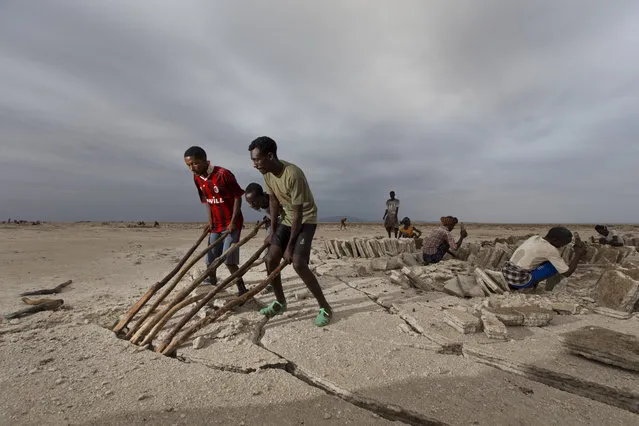
February 8, 2014 – Danakil Desert, Ethiopia: Workers mining salt at the quarry. (Photo by Ziv Koren/Polaris)

Inside the Afar Triangle in Ethiopia’s Danakil desert, camel caravans are used to carry salt. For centuries, the essential mineral has been mined by the Afar people, known for their ability to withstand extremes. The terrain is rugged, travelers are scarce and so are motor vehicles, where the average annual temperature is the highest in the world, and can rise to 122 degrees Fahrenheit, 50 degrees Celsius. (Photo by Ziv Koren/Polaris)
Details
30 Apr 2014 08:17:00
Festival-goers enjoy the mud during the annual Boryeong Mud Festival at Daecheon Beach on July 18, 2015 in Boryeong, South Korea. (Photo by Chung Sung-Jun/Getty Images)

Festival-goers enjoy the mud during the annual Boryeong Mud Festival at Daecheon Beach on July 18, 2015 in Boryeong, South Korea. The mud, which is believed to have benefical effects on the skin due to its mineral content, is sourced from mud flats near Boryeong and transported to the beach by truck. (Photo by Chung Sung-Jun/Getty Images)
Details
19 Jul 2015 10:05:00
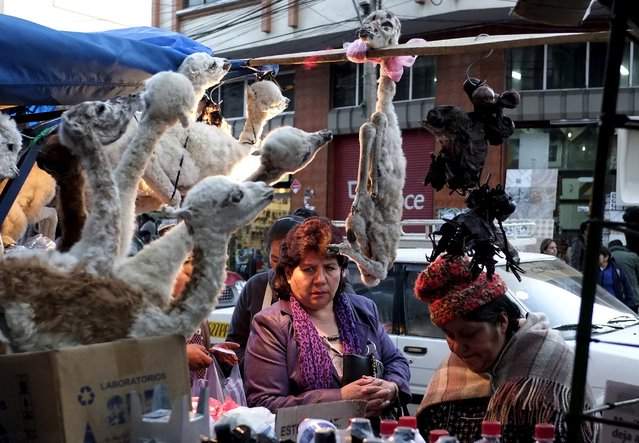
A woman (C) shops for an offering at the witch doctor's street in La Paz, July 31, 2015. (Photo by David Mercado/Reuters)

A woman (C) shops for an offering at the witch doctor's street in La Paz, July 31, 2015. According to Andean culture, the all the month of August is a time to give offerings to “Pachamama” to give thanks for their farms and health. The Aymaras use coca leaves, candies, animal fat, llama fetuses, some dried fruits, powdered minerals and alcohol during these rituals. (Photo by David Mercado/Reuters)
Details
02 Aug 2015 12:27:00
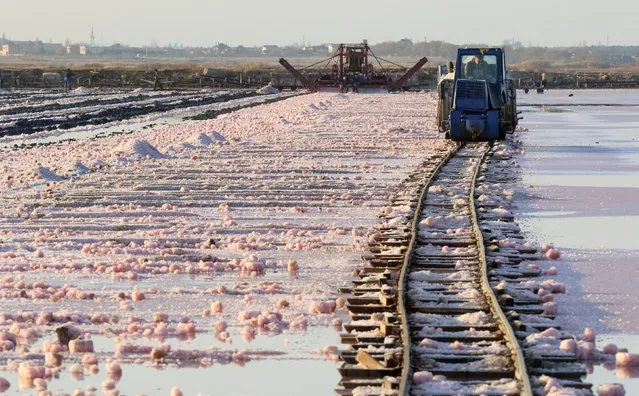
A train drives along a field at a salt production site at the Sasyk-Sivash lake near the city of Yevpatoria, Crimea, November 14, 2017. (Photo by Pavel Rebrov/Reuters)

A train drives along a field at a salt production site at the Sasyk-Sivash lake near the city of Yevpatoria, Crimea, November 14, 2017. A saltwater lagoon known as Lake Sasyk-Sivash on Ukraine's Crimea peninsula is the source of a rare resource: pink salt. The mineral is tinted by tiny algae that produce the pigment beta-carotene. Each autumn, seasonal workers collect thousands of tons of pink salt for processing and export. (Photo by Pavel Rebrov/Reuters)
Details
16 Nov 2017 08:18:00
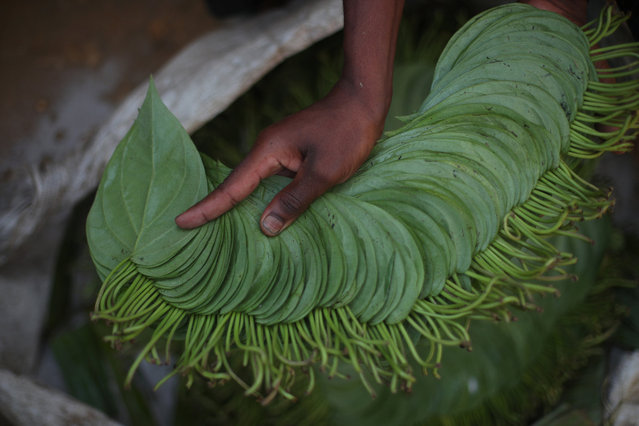
Faruk, 17, a Rohingya refugee trader holds betel leaves which are on sale at a stall in Palong Khali refugee camp near Cox's Bazar, Bangladesh, November 3, 2017. He left his village in Myanmar when the military opened fire towards the Rohingya. “I buy this betel leaf from Palong Khali market, in one bundle there are 160 pieces, I buy it for 80 taka and I sell it for 100 taka. Bangladeshi's and I sell for the same rate in the camp. Outside in the local market it is 80 taka per bundle. My problem is that I don't have money so I can't buy anything to eat, I can't buy fish to eat”, he said. (Photo by Hannah McKay/Reuters)

Faruk, 17, a Rohingya refugee trader holds betel leaves which are on sale at a stall in Palong Khali refugee camp near Cox's Bazar, Bangladesh, November 3, 2017. He left his village in Myanmar when the military opened fire towards the Rohingya. “I buy this betel leaf from Palong Khali market, in one bundle there are 160 pieces, I buy it for 80 taka and I sell it for 100 taka (1 Bangladeshi Taka = 0.012 US Dollar). Bangladeshi's and I sell for the same rate in the camp. Outside in the local market it is 80 taka per bundle. My problem is that I don't have money so I can't buy anything to eat, I can't buy fish to eat”, he said. (Photo by Hannah McKay/Reuters)
Details
27 Nov 2017 08:54:00


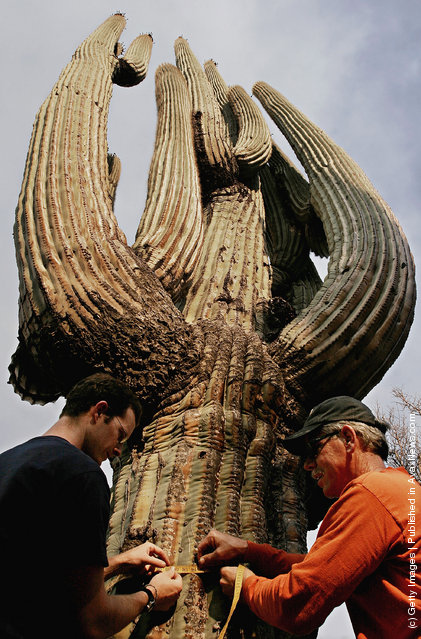
“The saguaro (scientific name Carnegiea gigantea) is a large, tree-sized cactus species in the monotypic genus Carnegiea. It is native to the Sonoran Desert in the U.S. state of Arizona, the Mexican state of Sonora, a small part of Baja California in the San Felipe Desert and an extremely small area of California, U.S. The saguaro blossom is the State Wildflower of Arizona”. – Wikipedia

Photo: Daniel Appel (L), a firefighter with Engine 84 from the Lassen National Forest in California and Mike Hallen, (R), Arizona representative of the National Register of Big Trees, measure the circumference of this Saguaro cactus called the "Grand One," in the Tonto National Forest on July 1, 2005 35 miles north of Phoenix, near Carefree, Arizona. The cactus, estimated to be more than 200 years old, measures a circumference of 7 feet, 10 inches (2.4 meters) and stands 46 feet high (14 meters). The cactus was burned in the Cave Creek Complex fire and may not survive. It was once the largest Saguaro in the world, two others have been found recently that have tied it's measurements. The fire has burned more than 214,000 acres of the Sonoran desert. (Photo by Jeff Topping/Getty Images)
Details
26 Jul 2011 12:27:00
Sikorsky H-5 helicopters

“Igor Sikorsky (May 25, 1889 – October 26, 1972), born Igor Ivanovich Sikorsky was a Russian American pioneer of aviation in both helicopters and fixed-wing aircraft. He designed and flew the world's first multi-engine fixed-wing aircraft, the Russky Vityaz in 1913, and the first airliner, Ilya Muromets, in 1914. After immigrating to the United States in 1919, Sikorsky founded the Sikorsky Aircraft Corporation in 1923, and developed the first of Pan American Airways' ocean-conquering flying boats in the 1930s. In 1939 Sikorsky designed and flew the Vought-Sikorsky VS-300, the first viable American helicopter, which pioneered the rotor configuration used by most helicopters today. Sikorsky would modify the design into the Sikorsky R-4, which became the world's first mass-produced helicopter in 1942”. – Wikipedia

Photo: Westland Sikorsky H-5's, used by British European Airways Helicopters, which fly between London and Birmingham. The Sikorsky H-5, (aka R-5, S-51, HO3S-1, or Horse) (R-5 until 1948; company designation VS-327) is a helicopter built by Sikorsky Aircraft Corporation, formerly used by the United States Air Force, and its predecessor, the United States Army Air Forces, as well as the United States Navy and United States Coast Guard (with the designations HO2S and HO3S). (Photo by Harrison /Topical Press Agency/Getty Images). 22nd May 1951

Details
06 Sep 2011 10:18:00
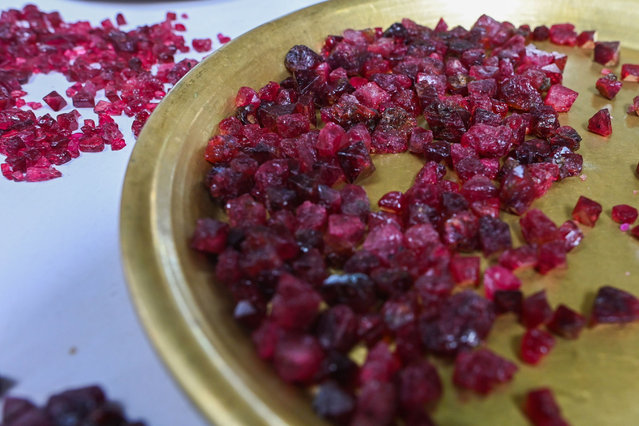
This photo taken on May 17, 2019 shows rough rubies displayed at the gems market in Mogok town, north of Mandalay. (Photo by Ye Aung Thu/AFP Photo)

This photo taken on May 17, 2019 shows rough rubies displayed at the gems market in Mogok town, north of Mandalay. Burrowing deep underground, thousands of informal miners risk their lives to find gleaming red gems as a law change spurs opportunity in Myanmar's “land of rubies”. (Photo by Ye Aung Thu/AFP Photo)
Details
29 May 2019 00:01:00