Loading...
Done
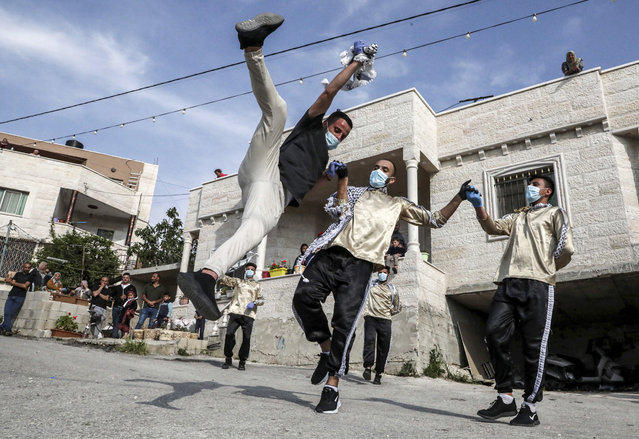
Dancers of the Palestinian Jafra Dabke Team perform a traditional dabke dance while wearing latex gloves and surgical masks for people confined due to a COVID-19 coronavirus pandemic lockdown in the village of Tarqumia northwest of Hebron in the occupied West Bank, on April 15, 2020. (Photo by Hazem Bader/AFP Photo)

Dancers of the Palestinian Jafra Dabke Team perform a traditional dabke dance while wearing latex gloves and surgical masks for people confined due to a COVID-19 coronavirus pandemic lockdown in the village of Tarqumia northwest of Hebron in the occupied West Bank, on April 15, 2020. (Photo by Hazem Bader/AFP Photo)
Details
06 Jan 2021 00:05:00
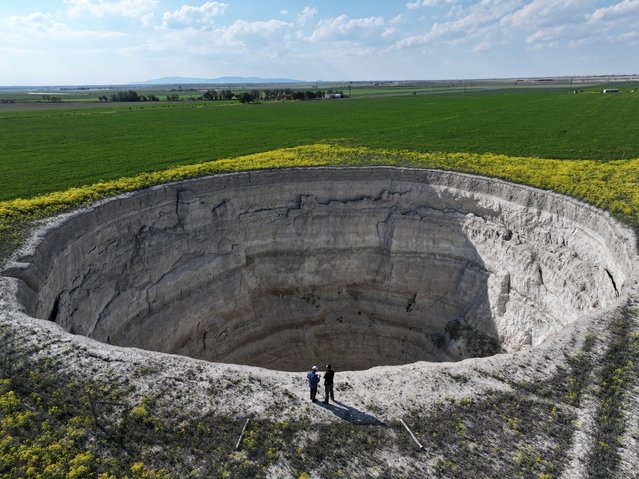
A view of Yarimoglu sinkhole (obruk), caused by some form of collapse of the surface layer in 2009, in Konya province, Turkiye on May 15, 2025. The gigantic pit formed between the fields where intensive irrigation activities are carried out is expanding and growing every year. (Photo by Abdullah Dogan/Anadolu via Getty Images)

A view of Yarimoglu sinkhole (obruk), caused by some form of collapse of the surface layer in 2009, in Konya province, Turkiye on May 15, 2025. The gigantic pit formed between the fields where intensive irrigation activities are carried out is expanding and growing every year. (Photo by Abdullah Dogan/Anadolu via Getty Images)
Details
19 Jul 2025 02:09:00
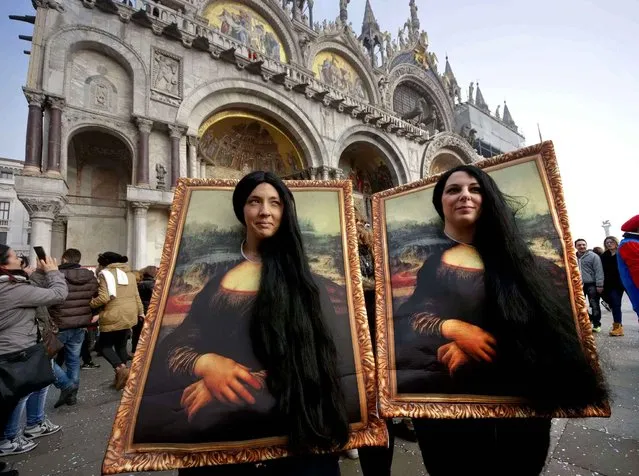
Two carnival revellers masquerade as Leonardo da Vinci's painting “Mona Lisa” pose in St. Mark's Square in Venice, Italy, Sunday, January 31, 2016. Carnival-goers in Venice are being asked by police to momentarily lift their masks as part of new anti-terrorism measures for the annual festivities. (Photo by Domenico Stinellis/AP Photo)

Two carnival revellers masquerade as Leonardo da Vinci's painting “Mona Lisa” pose in St. Mark's Square in Venice, Italy, Sunday, January 31, 2016. Carnival-goers in Venice are being asked by police to momentarily lift their masks as part of new anti-terrorism measures for the annual festivities. (Photo by Domenico Stinellis/AP Photo)
Details
02 Feb 2016 14:02:00
Ocean voyage

Do you think that history is a science? Well, not exactly. First, and foremost, history is the state's “legend of wars”, it’s official regalia. Of course, public historians are not interested in scientific truth – quite the opposite. In this respect, any attempt to present a state’s history as altruistic and benevolent as possible is welcomed and encouraged – as opposed to any revisionism attempts that may be more accurate. In this matter, Chinese have surpassed us all – they revised in highly creative manner (but rather shamelessly) the technology already invented by Europeans, a process that resulted in oldest state on the planet. Here is an interesting paradox: ask any sinologist about the Middle Kingdom during second century B.C., and he will describe it to you in such a vivid manner as if he has been living there all his life – but as soon as you will ask him to describe Chinese history in the 19-20th centuries… let's say, his eagerness will be greatly diminished. However, we will discuss China in a different article, and in the meantime we will try to understand how exactly historic “legend of wars” is formed and functions – based on a specific and well-known example. A great example is Ferdinand Magellan's first voyage around the world.

Details
14 Nov 2011 09:11:00
Faruk, 17, a Rohingya refugee trader holds betel leaves which are on sale at a stall in Palong Khali refugee camp near Cox's Bazar, Bangladesh, November 3, 2017. He left his village in Myanmar when the military opened fire towards the Rohingya. “I buy this betel leaf from Palong Khali market, in one bundle there are 160 pieces, I buy it for 80 taka and I sell it for 100 taka. Bangladeshi's and I sell for the same rate in the camp. Outside in the local market it is 80 taka per bundle. My problem is that I don't have money so I can't buy anything to eat, I can't buy fish to eat”, he said. (Photo by Hannah McKay/Reuters)

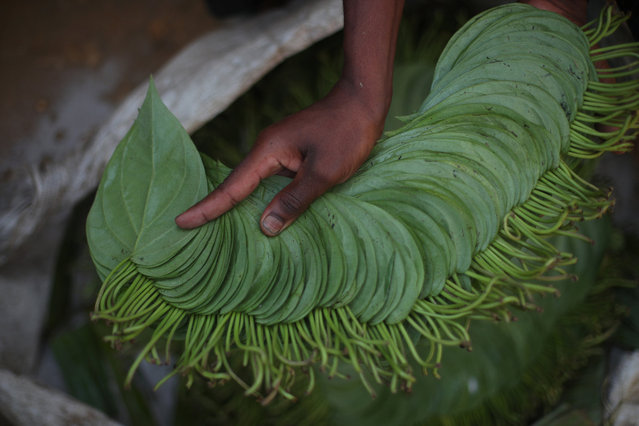
Faruk, 17, a Rohingya refugee trader holds betel leaves which are on sale at a stall in Palong Khali refugee camp near Cox's Bazar, Bangladesh, November 3, 2017. He left his village in Myanmar when the military opened fire towards the Rohingya. “I buy this betel leaf from Palong Khali market, in one bundle there are 160 pieces, I buy it for 80 taka and I sell it for 100 taka (1 Bangladeshi Taka = 0.012 US Dollar). Bangladeshi's and I sell for the same rate in the camp. Outside in the local market it is 80 taka per bundle. My problem is that I don't have money so I can't buy anything to eat, I can't buy fish to eat”, he said. (Photo by Hannah McKay/Reuters)
Details
27 Nov 2017 08:54:00
A woman looks towards part of an artwork called “Lichen! Libido! (London!) Chastity!” by Anthea Hamilton, one of the four artists shortlisted for the Turner Prize 2016, as it is displayed at the Tate Britain gallery in London, Monday, September 26, 2016. The Turner Prize aims to promote public debate around new developments in contemporary British art. (Photo by Kirsty Wigglesworth/AP Photo)

A woman looks towards part of an artwork called “Lichen! Libido! (London!) Chastity!” by Anthea Hamilton, one of the four artists shortlisted for the Turner Prize 2016, as it is displayed at the Tate Britain gallery in London, Monday, September 26, 2016. The Turner Prize aims to promote public debate around new developments in contemporary British art. (Photo by Kirsty Wigglesworth/AP Photo)
Details
27 Sep 2016 09:51:00
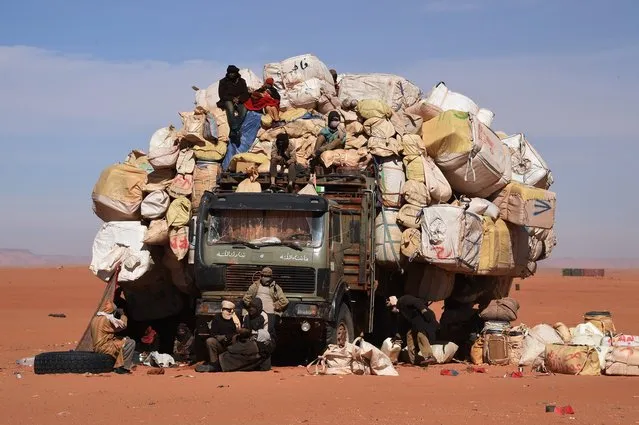
People sit near a fully loaded in Madama near the border with Lybia on January 1, 2015. French Defence Minister Jean-Yves Le Drian paid a surprise visit to northern Niger on January 1, to visit a base being built to combat the growing flow of weapons and jihadists from neighbouring Libya. Le Drian travelled from Chad to Madama, a desert outpost about 100 kilometres from Libya, where he saw in the New Year with troops at a French base. (Photo by Dominique Faget/AFP Photo)

People sit near a fully loaded in Madama near the border with Lybia on January 1, 2015. French Defence Minister Jean-Yves Le Drian paid a surprise visit to northern Niger on January 1, to visit a base being built to combat the growing flow of weapons and jihadists from neighbouring Libya. Le Drian travelled from Chad to Madama, a desert outpost about 100 kilometres from Libya, where he saw in the New Year with troops at a French base. Madama is situated on the route used by jihadists and arms smugglers in southern Libya to reach northern Mali and Niger. (Photo by Dominique Faget/AFP Photo)
Details
03 Jan 2015 13:27:00
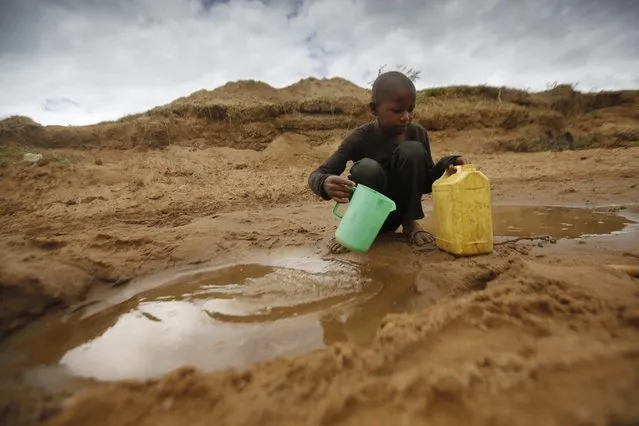
A young boy scoops water from a hand-dug well in the dry riverbed near Matinyani, in the semi-arid Kitui County in southeastern Kenya, 22 March 2015, the World Water Day. Residents of Kitui County and other arid and semi-arid areas of the country have been hard-hit by extremely poor rainfall this year while the government said in previous month that some 1.6 million people countrywide are facing acute starvation due to the drought and will need relief food over the next six months. (Photo by Dai Kurokawa/EPA)

A young boy scoops water from a hand-dug well in the dry riverbed near Matinyani, in the semi-arid Kitui County in southeastern Kenya, 22 March 2015, the World Water Day. Residents of Kitui County and other arid and semi-arid areas of the country have been hard-hit by extremely poor rainfall this year while the government said in previous month that some 1.6 million people countrywide are facing acute starvation due to the drought and will need relief food over the next six months. Residents of Matinyani say they haven't seen a drop of rain in nearly four months. Thousands of Kenyans in rural areas walk tens of kilometers just to fetch water to drink and to be used in their homes. According to an estimate by UNESCO (United Nations Educational, Scientific and Cultural Organization), 17 million people lack access to safe water in Kenya, where the drought is a perennial problem. (Photo by Dai Kurokawa/EPA)
Details
23 Mar 2015 11:01:00