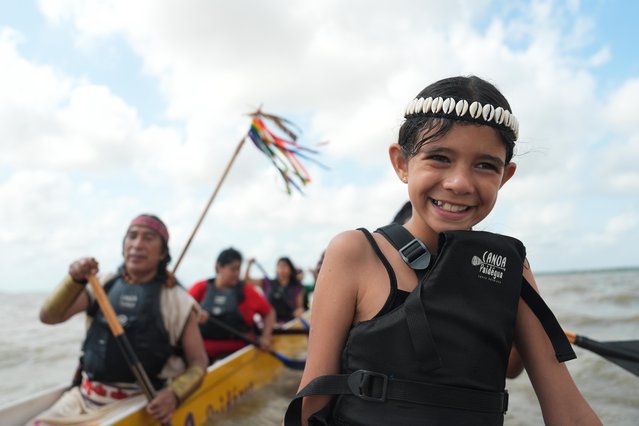
Moana Mason, 8, participates in the People's Summit event on Guajara Bay during the COP30 U.N. Climate Summit, Wednesday, November 12, 2025, in Belem, Brazil. (Photo by Joshua A. Bickel/AP Photo)
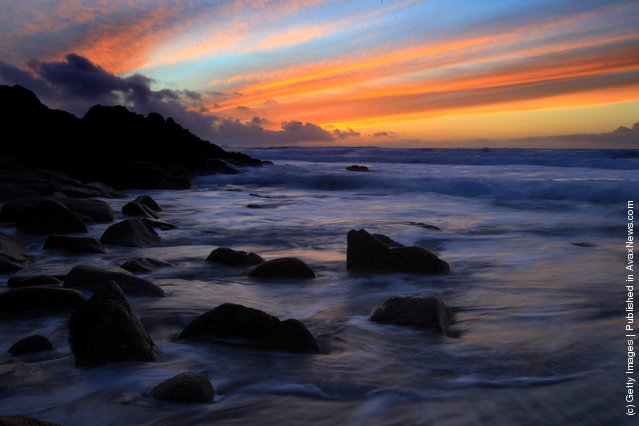
The sun sets over the sea looking towards Lands End viewed from Gwenver beach near Sennen Cove on February 7, 2011 in Cornwall, England. (Photo by Matt Cardy/Getty Images)
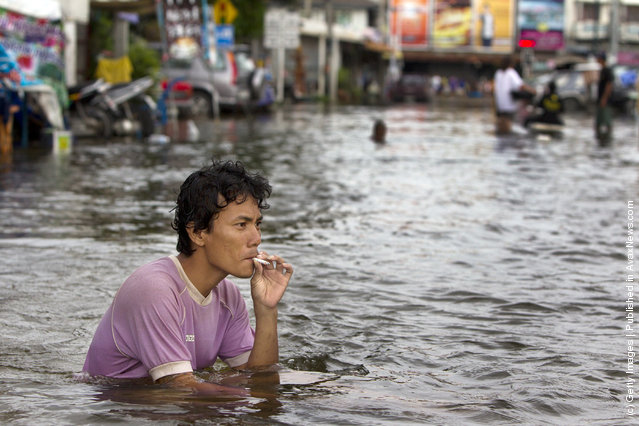
A Thai man smokes a cigarette as he sits in the flooded streets October 10, 2011 in Ayutthaya, Thailand. Around 200 factories closed in the central Thai province of Ayutthaya because of flooding, which is posing a threat to Bangkok as well. Over 260 people have died in flood-related incidents since late July according to the Department of Disaster Prevention and Mitigation. Some areas of the country are experiencing the worst flooding in 50 years, mainly in the centre, north and northeast. (Photo by Paula Bronstein /Getty Images)
A devotee of the Hare Krishna faith poses for a photograph during the festival of Rathayatra on June 12, 2011 in London, England. Rathayatra, or Chariot festival, features three huge, wooden chariots pulled by hand across Central London accompanied by constant singing, chanting, drums, cymbals and dancing. (Photo by Matthew Lloyd/Getty Images)
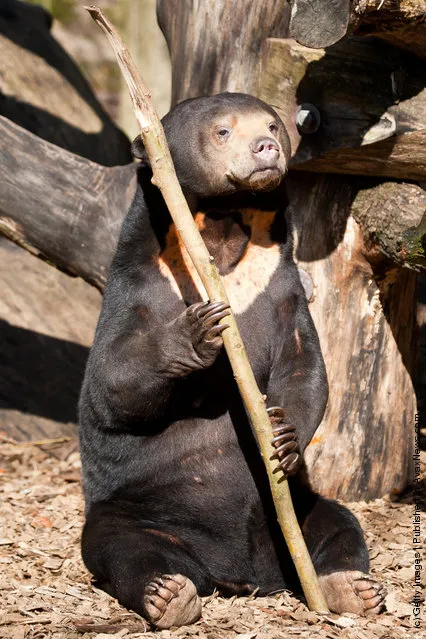
The sun bear (Ursus malayanus), also known as the honey bear, is a bear found primarily in the tropical rainforest (the dense lowland forests) in Southeast Asia; North-East India, Bangladesh, Myanmar, Thailand, Laos, Cambodia, Vietnam, Southern China, Peninsular Malaysia, and the islands of Sumatra and Borneo.
A YouTube video of a chainsmoking Indonesian toddler inspired me to create this series, "Smoking Kids". The video highlighted the cultural differences between the east and west, and questioned notions of smoking being a mainly adult activity. Adult smokers are the societal norm, so I wanted to isolate the viewer's focus upon the issue of smoking itself. I felt that children smoking would have a surreal impact upon the viewer and compel them to truly see the acts of smoking rather than making assumptions about the person doing the act. ... ~Frieke Janssen
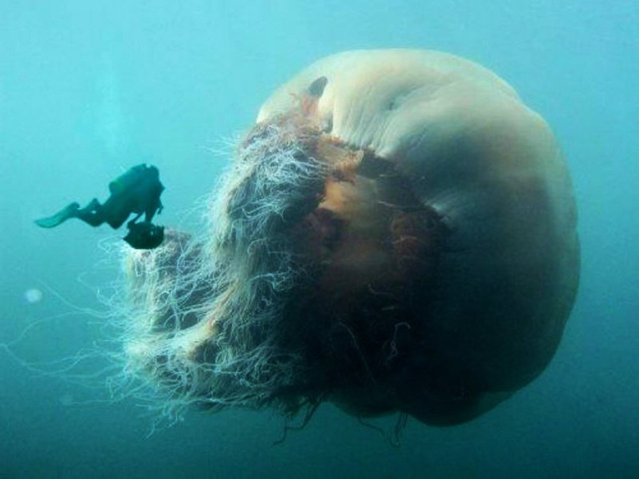
Cyanea capillata is the largest known species of jellyfish. Its range is confined to cold, boreal waters of the Arctic, northern Atlantic, and northern Pacific Oceans, seldom found farther south than 42°N latitude. Similar jellyfish, which may be the same species, are known to inhabit seas near Australia and New Zealand. The largest recorded specimen found, washed up on the shore of Massachusetts Bay in 1870, had a bell (body) with a diameter of 7 feet 6 inches (2.29 m) and tentacles 120 feet (37 m) long.Lion's mane jellyfish have been observed below 42°N latitude for some time—specifically in the larger bays of the east coast of the United States.