Loading...
Done
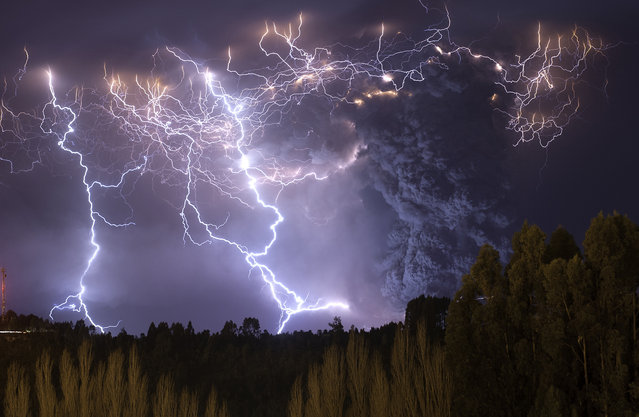
The eruption of Cordon Caulle began on June 4, 2011, located in the Region of Los Rios in Chile. For about 12 months, people and animals became accustomed to living with the daily fall of ash, which also caused problems in the air traffic in South America. The explosions and lightning during first days of the eruption could be seen from hundreds of miles around. This photograph was taken on the second night of eruption from the town of Lago Ranco. (Photo and caption by Francisco Negroni/National Geographic Traveler Photo Contest)

The eruption of Cordon Caulle began on June 4, 2011, located in the Region of Los Rios in Chile. For about 12 months, people and animals became accustomed to living with the daily fall of ash, which also caused problems in the air traffic in South America. The explosions and lightning during first days of the eruption could be seen from hundreds of miles around. This photograph was taken on the second night of eruption from the town of Lago Ranco. (Photo and caption by Francisco Negroni/National Geographic Traveler Photo Contest)

ATTENTION! All pictures are presented in high resolution. To see Hi-Res images – just TWICE click on any picture. In other words, click small picture – opens the BIG picture. Click BIG picture – opens VERY BIG picture.
Details
23 Jun 2013 11:24:00
A woman has her hair blown by the wind during a snowstorm in Quebec City, on December 22, 2013. (Photo by Mathieu Belanger/Reuters)

A woman has her hair blown by the wind during a snowstorm in Quebec City, on December 22, 2013. (Photo by Mathieu Belanger/Reuters)
Details
28 Dec 2013 12:50:00
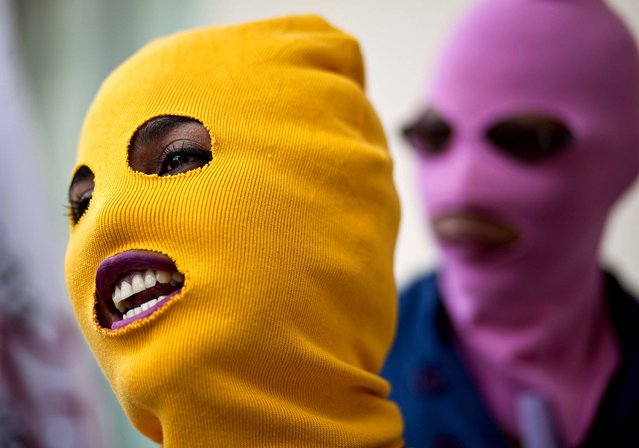
Masked women shout slogans during a demonstration marking the Latin American Day for Decriminalization of Therapeutic Abortion in Managua, Nicaragua, where abortions are illegal, on September 28, 2012. (Photo by Esteban Felix/Associated Press)

Masked women shout slogans during a demonstration marking the Latin American Day for Decriminalization of Therapeutic Abortion in Managua, Nicaragua, where abortions are illegal, on September 28, 2012. (Photo by Esteban Felix/Associated Press)
Details
03 Oct 2012 09:01:00
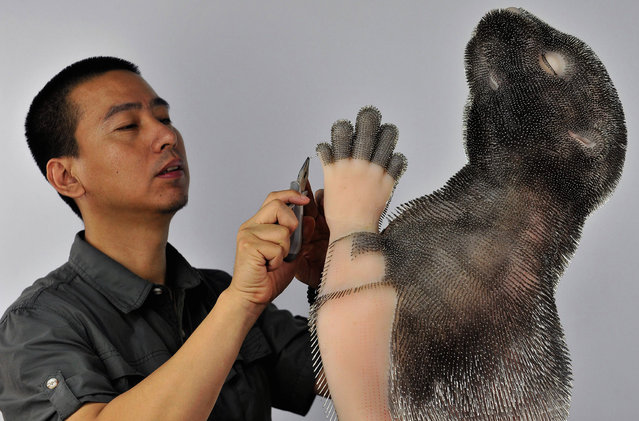
Professor Xie Yong works on an art installation of a beaver, which is made out of plastic and around 300,000 needles, in Shenyang, Liaoning province, July 23, 2013. The needles, according to Xie, represent the pain felt by animals when their fur is taken off to produce clothing. (Photo by Reuters/Stringer)

Professor Xie Yong works on an art installation of a beaver, which is made out of plastic and around 300,000 needles, in Shenyang, Liaoning province, July 23, 2013. The needles, according to Xie, represent the pain felt by animals when their fur is taken off to produce clothing. (Photo by Reuters/Stringer)
Details
27 Jul 2013 09:15:00