Loading...
Done
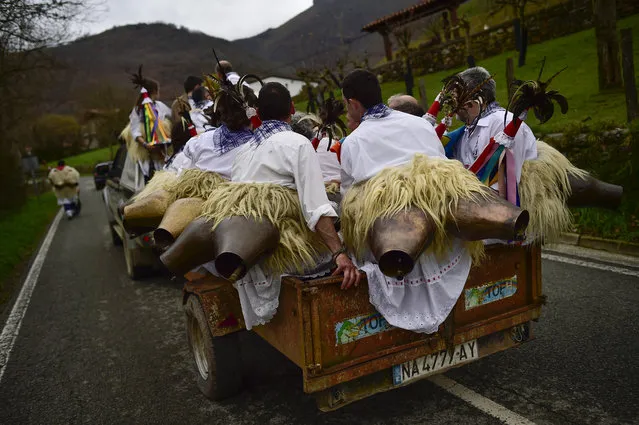
Joaldunaks return in a trailer to their town at the end of Carnival between of the Pyrenees villages of Ituren and Zubieta, northern Spain, Monday, February 1, 2016. In one of the most ancient carnivals in Europe, dating from before the Roman empire, companies of Joaldunak (cowbells) made up of residents of two towns, Ituren and Zubieta, parade the streets costumed in sandals, lace petticoats, sheepskins around the waist and shoulders, coloured neckerchiefs, conical caps with ribbons and a hyssop of horsehair in their right hands and cowbells hung across their lower back. (Photo by Alvaro Barrientos/AP Photo)

Joaldunaks return in a trailer to their town at the end of Carnival between of the Pyrenees villages of Ituren and Zubieta, northern Spain, Monday, February 1, 2016. In one of the most ancient carnivals in Europe, dating from before the Roman empire, companies of Joaldunak (cowbells) made up of residents of two towns, Ituren and Zubieta, parade the streets costumed in sandals, lace petticoats, sheepskins around the waist and shoulders, coloured neckerchiefs, conical caps with ribbons and a hyssop of horsehair in their right hands and cowbells hung across their lower back. (Photo by Alvaro Barrientos/AP Photo)
Details
02 Feb 2016 13:07:00
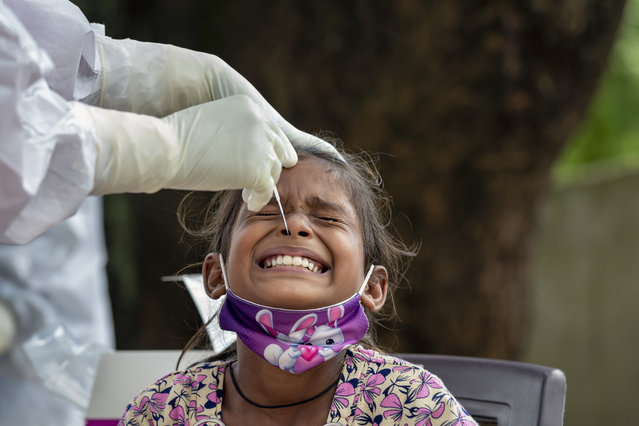
An Indian girl cries as a medical worker collect her swab sample for COVID-19 test at a rural health center in Bagli, outskirts of Dharmsala, India, Monday, September 7, 2020. India's coronavirus cases are now the second-highest in the world and only behind the United States. (Photo by Ashwini Bhatia/AP Photo)

An Indian girl cries as a medical worker collect her swab sample for COVID-19 test at a rural health center in Bagli, outskirts of Dharmsala, India, Monday, September 7, 2020. India's coronavirus cases are now the second-highest in the world and only behind the United States. (Photo by Ashwini Bhatia/AP Photo)
Details
09 Sep 2020 00:07:00
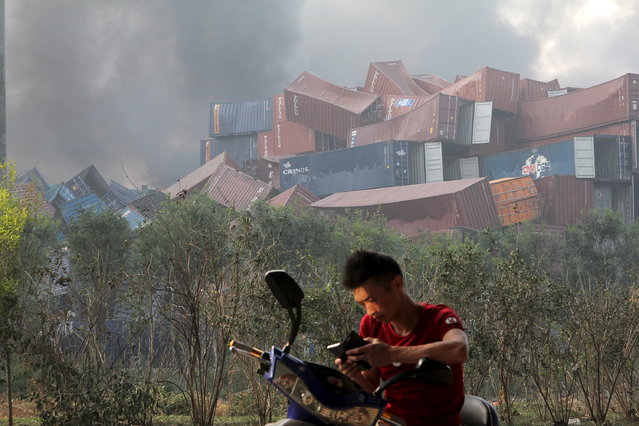
A man checks his mobile phone near overturned shipping containers after explosions hit the Binhai new district, Tianjin, August 13, 2015. (Photo by Reuters/Stringer)

A man checks his mobile phone near overturned shipping containers after explosions hit the Binhai new district, Tianjin, August 13, 2015. A huge explosion hit an industrial area in the northeastern Chinese city of Tianjin late on Wednesday evening, triggering a blast wave felt several kilometres away and injuring at least 50 people, domestic media reported. (Photo by Reuters/Stringer)
Details
13 Aug 2015 11:22:00
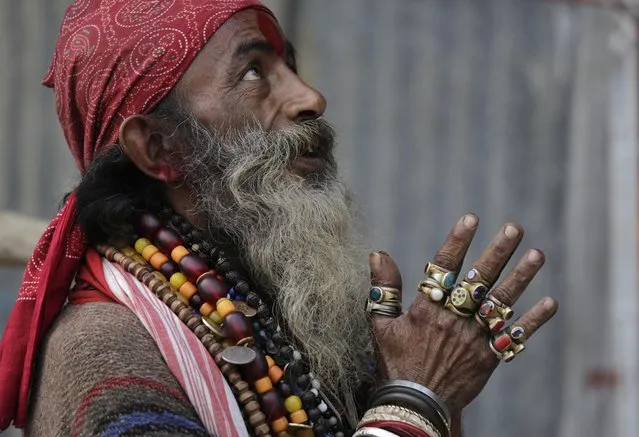
A Hindu holy man on his way to the annual holy dip at Gangasagar, gestures towards a visitor as he rests at a transit camp in Kolkata, India, Wednesday, January 6, 2016. (Photo by Bikas Das/AP Photo)

A Hindu holy man on his way to the annual holy dip at Gangasagar, gestures towards a visitor as he rests at a transit camp in Kolkata, India, Wednesday, January 6, 2016. Thousands of Hindu pilgrims are expected to take the annual holy dip at Gangasagar, where the Ganges River reaches the Bay of Bengal, on the auspicious Makar Sankranti festival day that falls on Jan.14. (Photo by Bikas Das/AP Photo)
Details
10 Jan 2016 08:06:00
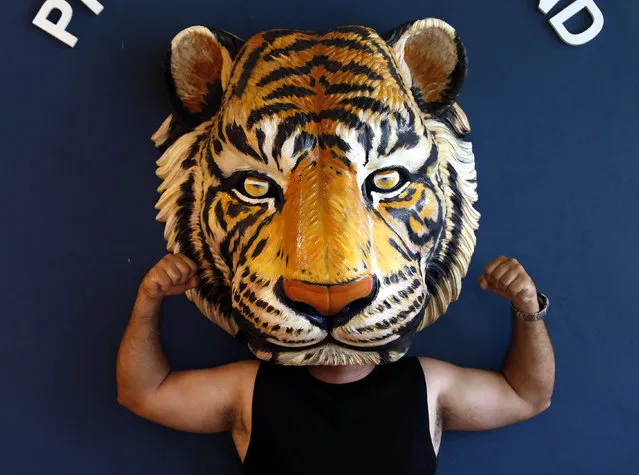
A picture made available on 20 October 2015 shows a foreign tourist posing for a souvenir photograph with a figure of a tiger head at a private zoo on Phuket Island, Thailand, 17 October 2015. Each day hundreds of tourists, including young children, visit the private tiger zoo where visitors are allowed to touch and pose for photographs with unchained tigers inside their enclosures. (Photo by Rungroj Yongrit/EPA)

A picture made available on 20 October 2015 shows a foreign tourist posing for a souvenir photograph with a figure of a tiger head at a private zoo on Phuket Island, Thailand, 17 October 2015. Each day hundreds of tourists, including young children, visit the private tiger zoo where visitors are allowed to touch and pose for photographs with unchained tigers inside their enclosures. (Photo by Rungroj Yongrit/EPA)
Details
22 Oct 2015 09:05:00
A young woman wearing no trousers hits the ski slopes at a ski resort in Xuzhou, in east China's Jiangsu province on January 13, 2015 in a promotional effort to equal “No Pants Subway Ride”, which was marked on January 11 this year. (Photo by AFP Photo)

A young woman wearing no trousers hits the ski slopes at a ski resort in Xuzhou, in east China's Jiangsu province on January 13, 2015 in a promotional effort to equal “No Pants Subway Ride”, which was marked on January 11 this year. The promotional “No Pants Subway Ride” stunt on January 11 was held as commuters in some 60 cities around the world braved public transportation in their undies, which has gone global since its first staging by US group Improv Everywhere in New York in 2002. (Photo by AFP Photo)
Details
17 Jan 2015 12:46:00
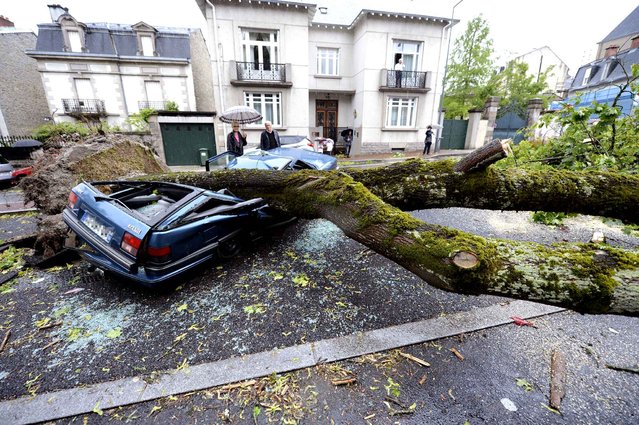
People walk by a car destroyed by a tree which fell during a storm and strong winds, in Limoges, on May 21, 2014. High winds upto 120 km/h and storms have caused at least one death and cut off some 42 000 homes from electricity today in the Midi-Pyrenees region of France. (Photo by Pascal Lachenaud/AFP Photo)

People walk by a car destroyed by a tree which fell during a storm and strong winds, in Limoges, on May 21, 2014. High winds upto 120 km/h and storms have caused at least one death and cut off some 42 000 homes from electricity today in the Midi-Pyrenees region of France. (Photo by Pascal Lachenaud/AFP Photo)
Details
24 May 2014 12:42:00
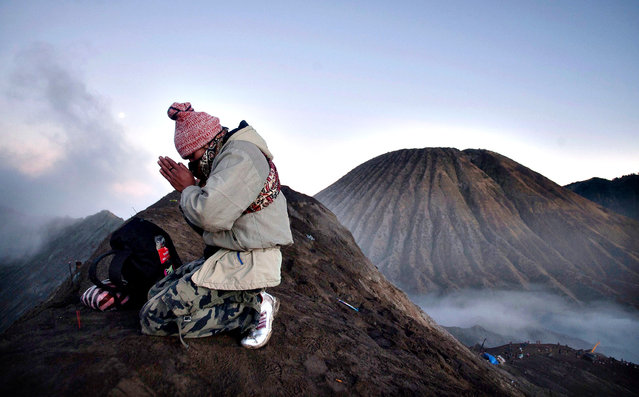
A Tengger tribesman prays at Mount Bromo during the annual Kasada ceremony in East Java on August 12, 2014. The Kasada ceremony is a festival held every 14th day of the Kasada month in the traditional Hindu lunar calender to honour Sang Hyang Widhi (God Almighty) and is based on the legend of Roro Anteng and Joko Seger from the Majapahit Kingdom, from which their Tengger tribe name originates. (Photo by Juni Kriswanto/AFP Photo)

A Tengger tribesman prays at Mount Bromo during the annual Kasada ceremony in East Java on August 12, 2014. The Kasada ceremony is a festival held every 14th day of the Kasada month in the traditional Hindu lunar calender to honour Sang Hyang Widhi (God Almighty) and is based on the legend of Roro Anteng and Joko Seger from the Majapahit Kingdom, from which their Tengger tribe name originates. Hundreds of worshippers from the Tengger tribe offer food and livestock as a symbolic sacrifice which they throw into the crater for the blessings of safety and prosperity to their familyies and community. (Photo by Juni Kriswanto/AFP Photo)
Details
16 Aug 2014 11:19:00