A group of Japanese schoolgirls marching in formation during a school visit to the third regiment to experience the soldier's way of life. (Photo by Fox Photos/Getty Images). Circa 1938
Mud-covered tourists pretend to be trapped inside a mud prison at the Daecheon Beach Mud Plaza in the city of Boryeong on South Korea's west coast, July 17, as they take part in the Boryeong Mud Festival, which opened that day and runs through July 26. Boryeong mud is rich in natural mineral component and is considered to prevent skin aging. (Photo by EPA/Yonhap)
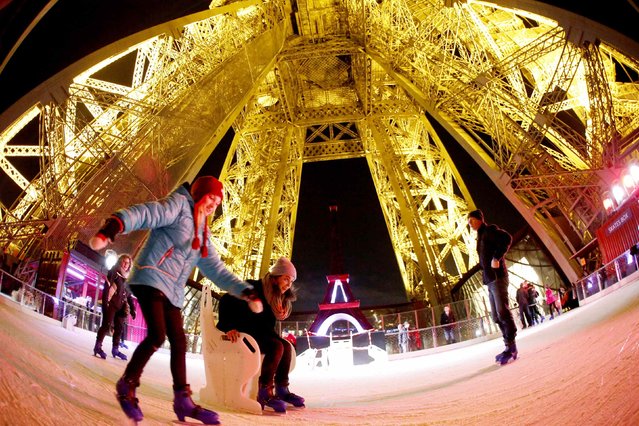
Tourists ice skate at night on the Eiffel Tower's skating rink in Paris December 9, 2014. The skating rink, located on the first level of the Eiffel Tower, opens to the public as part of the Christmas holiday season. (Photo by Charles Platiau/Reuters)
A man falls from an ox cart as he competes during an ox cart competition near U Bein bridge, in Mandalay March 22, 2015. (Photo by Soe Zeya Tun/Reuters)
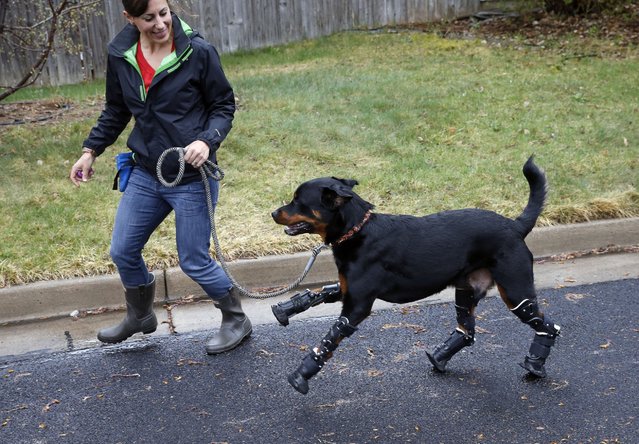
In this April 2, 2015 photo, dog owner Laura Aquilina strolls with her two year old Rottweiler Brutus, who was recently fitted with prosthetics on all four paws, and is currently learning to use them, near Aquilina's home in Loveland, Colo. Brutus lost all four paws to frostbite as a puppy while under care of a breeder, and Aquilina began caring for him about a year ago. (Photo by Brennan Linsley/AP Photo)
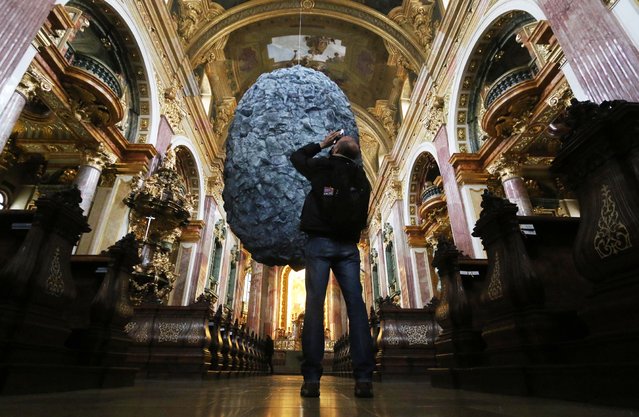
A visitor takes a photo of a boulder plastic made of synthetic material called “To be in Limbo” hangs from the ceiling of the 20 meter high Jesuit Church in Vienna, Austria, Tuesday, November 25, 2014. The eight meter high, hollow and 700 kilogram heavy sculpture from the artists group Steinbrener/Dempf and Huber is supposed to symbolize faith and its threatening moments. The installation will remain until April 19, 2015 and then move to a church in Hamburg, Germany. (Photo by Ronald Zak/AP Photo)
On August 31, 2012, a long filament of solar material that had been hovering in the sun's atmosphere, the corona, erupted out into space at 4:36 p.m. EDT. The coronal mass ejection, or CME, traveled at over 900 miles per second. The CME did not travel directly toward Earth, but did connect with Earth's magnetic environment, or magnetosphere, causing aurora to appear on the night of Monday, September 3. (Photo by NASA/GSFC/SDO via The Atlantic)