Loading...
Done
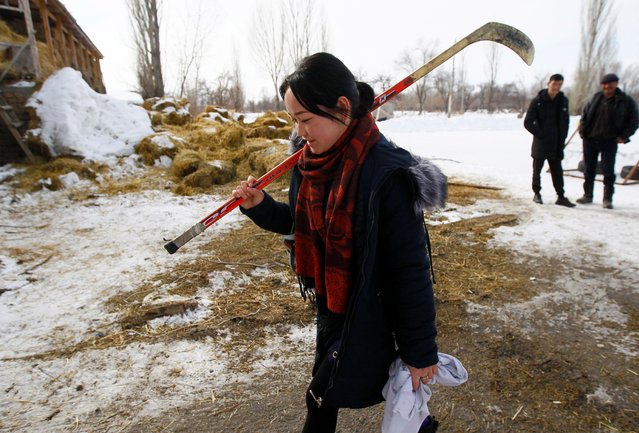
A member of Kyrgyzstan's first female hockey team arrives for a training session in the village of Otradnoye, Kyrgyzstan on February 4, 2020. Based in the remote village of Otradnoe, 249 miles (400 kilometres) east of the country's capital Bishkek, the team comprises of around 15 girls from a local school and uses a flooded allotment to train on during the winter months. (Photo by Vladimir Pirogov/Reuters)

A member of Kyrgyzstan's first female hockey team arrives for a training session in the village of Otradnoye, Kyrgyzstan on February 4, 2020. Based in the remote village of Otradnoe, 249 miles (400 kilometres) east of the country's capital Bishkek, the team comprises of around 15 girls from a local school and uses a flooded allotment to train on during the winter months. (Photo by Vladimir Pirogov/Reuters)
Details
12 Feb 2020 00:01:00
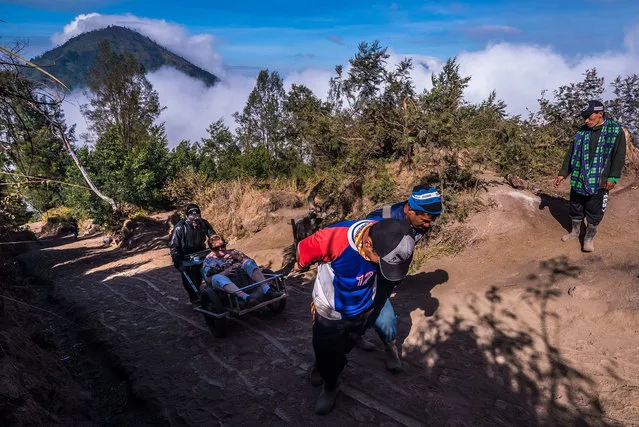
Miners pulling up lazy tourists to the rim of Kawah Ijen (Ijen Volcano), East Java, Indonesia on September 21, 2017. They will earn as much as they would bring down a load of sulfur. Nomadic Explorer, Cultural Lifestyle Photographer Claudio Sieber captured striking images of miners working at Ijen volcanic range in East Java, Indonesia. The sulphur miners risk their lives daily as they climb the active volcano carrying heavy loads, which they sell to sugar refineries. Shortly after midnight curious tourists are flocking in hundreds through the gate of Ijen's foothills to be right on time, driven by the images others took before them. Kawah Ijen is the one of the world's largest acidic volcanic crater lake; famous for its turquoise color as well as the unreal atmosphere it offers during darkness. A dusty path zigzags 3 kilometers up to the crater rim. This doesn't mean anything challenging; in particular, special sights have to be deserved anyway. The irritating smell of sulfur announces the near of the crater's existence. Arriving on the crater's rim the reward for the torture becomes visible. Blue fire darts its tongues through the fumes of sulfur dioxide. Somehow, the spectacle isn't as romantic as expected, since it is also the rough working space of approx. 150 sulfur miners who start their shift at 1 am. Lately, harvesting the abundance of devil's gold received international attention. This did obviously not really improve a miner's lifestyle; neither did it contribute to a better wage. (Photo by Claudio Sieber/Barcroft Images)

Miners pulling up lazy tourists to the rim of Kawah Ijen (Ijen Volcano), East Java, Indonesia on September 21, 2017. They will earn as much as they would bring down a load of sulfur. Nomadic Explorer, Cultural Lifestyle Photographer Claudio Sieber captured striking images of miners working at Ijen volcanic range in East Java, Indonesia. The sulphur miners risk their lives daily as they climb the active volcano carrying heavy loads, which they sell to sugar refineries. (Photo by Claudio Sieber/Barcroft Images)
Details
02 Oct 2017 08:31:00
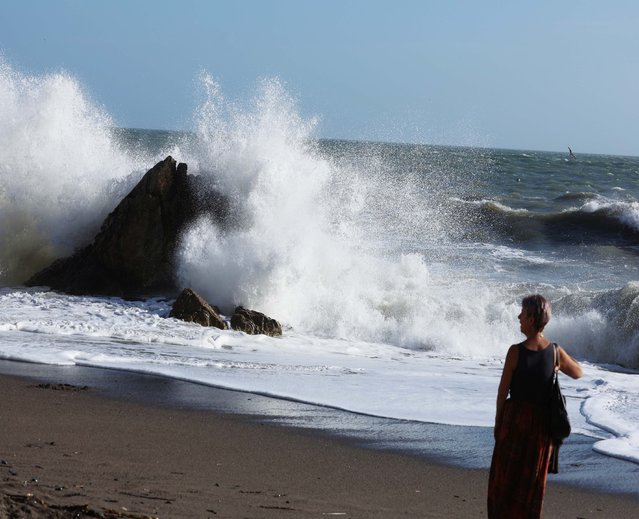
Waves breaking at Killiney Beach, Co Dublin, Ireland on Sunday, October 20, 2024. (Photo by Stephen Collins/Collins Photos)

Waves breaking at Killiney Beach, Co Dublin, Ireland on Sunday, October 20, 2024. (Photo by Stephen Collins/Collins Photos)
Details
21 Dec 2024 03:41:00
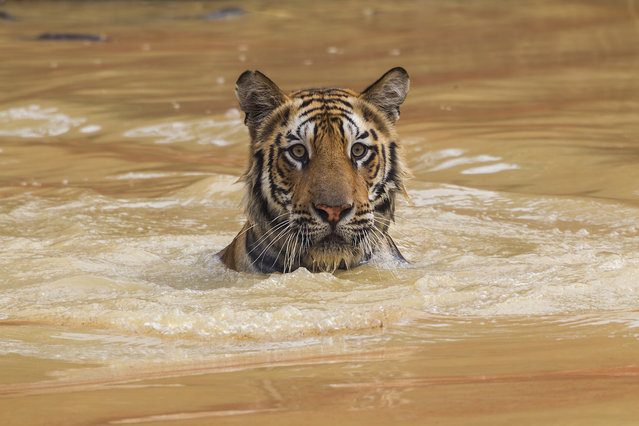
A 14-month-old cub, cooling off in a pond, is riveted by a deer that appeared near the shore. Tigers are powerful swimmers; they can easily cross rivers four to five miles wide and have been known to swim distances of up to 18 miles. (Photo by Steve Winter/National Geographic)

National Geographic photographer Steve Winter has spent most of his adult life shooting wild cats. Photo: A 14-month-old cub, cooling off in a pond, is riveted by a deer that appeared near the shore. Tigers are powerful swimmers; they can easily cross rivers four to five miles wide and have been known to swim distances of up to 18 miles. (Photo by Steve Winter/National Geographic)
Details
08 Apr 2014 11:52:00


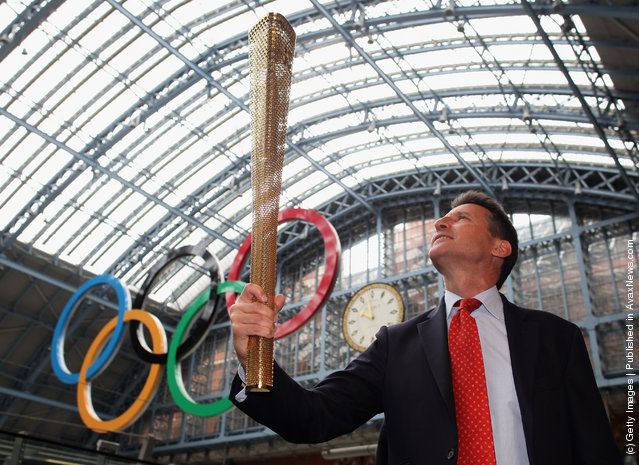
LOCOG Chair and former Olympian Lord Sebastian Coe holds a prototype design of the new golden Olympic Torch during its unveiling at St Pancras Station on June 8, 2011 in London, England. (Photo by Dan Kitwood/Getty Images)
Details
09 Jun 2011 09:40:00
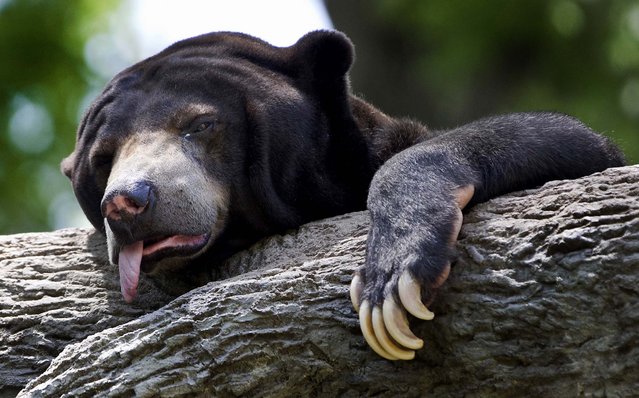
A sun bear reacts to triple-digit temperatures at the Henry Doorly Zoo in Omaha, Nebraska, where the temperature reached 103 degrees Fahrenheit

A sun bear reacts to triple-digit temperatures at the Henry Doorly Zoo in Omaha, Nebraska, where the temperature reached 103 degrees Fahrenheit on July 6, 2012. (Photo by Nati Harnik/Associated Press)
Details
15 Jul 2012 07:15:00
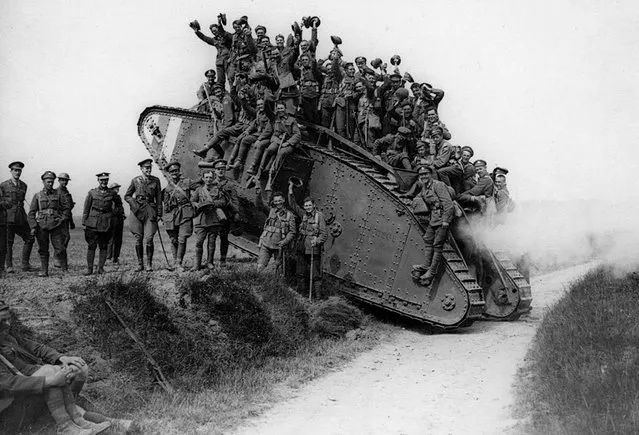
These black-and-white photos are taken from the new book “Armoured Warfare in the First World War 1916 – 1918” by Anthony Tucker-Jones and published by Pen & Sword Military. “Interestingly the British, French and Germans took completely different approaches with varying results”. The British military produced “Little Willie” in Autumn 1915 weighing 18 tonnes, which had a crew of two plus four gunners. “Inspired by a tracked artillery tractor “Little Willie” was referred to as a water tank – hence the name tank – to ensure secrecy”, said Anthony. “This led to the strange looking Mark I with its peculiar rhomboid shape, designed to cross trenches with guns in sponsons on either side. The Germans saw the tank as unchivalrous and were slow to grasp its utility. They favoured the Stormtrooper (specialist soldiers used to infiltrate enemy trenches) and artillery, not the tank”, said Anthony. “However, they didn’t hesitate to make use of captured British tanks. Although the tank helped secure victory and German soldiers dubbed it “Germany’s Downfall” the country was ultimately brought to its knees by the Allies blockade”. Here: British troops hitch a ride on a Mark IV after the massed tank fleet spearheading attack at Cambrai on November 20, 1917. (Photo by Anthony Tucker-Jones/Mediadrumworld.com)

These black-and-white photos are taken from the new book “Armoured Warfare in the First World War 1916 – 1918” by Anthony Tucker-Jones and published by Pen & Sword Military. Here: British troops hitch a ride on a Mark IV after the massed tank fleet spearheading attack at Cambrai on November 20, 1917. (Photo by Anthony Tucker-Jones/Mediadrumworld.com)
Details
23 Feb 2017 00:02:00
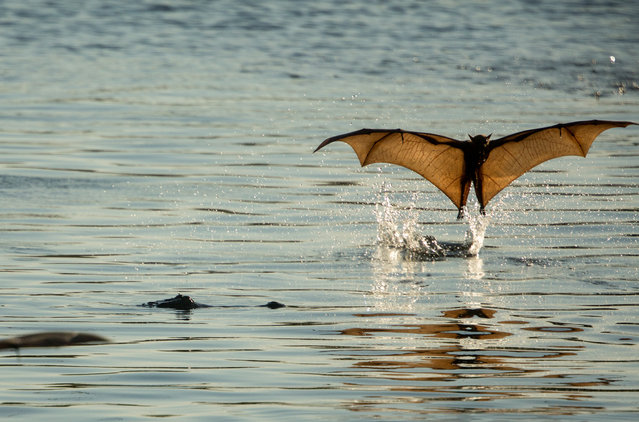
A little red flying fox dips a toe in a lake at the mouth of Katherine gorge in the Northern Territory, Nitmiluk national park, Australia on September 20, 2017. (Photo by Glenn Campbell/AAP)

A little red flying fox dips a toe in a lake at the mouth of Katherine gorge in the Northern Territory, Nitmiluk national park, Australia on September 20, 2017. (Photo by Glenn Campbell/AAP)
Details
24 Sep 2017 06:28:00