Loading...
Done
Malaysian firemen make their way to a designated area to spray disinfectant, in an effort to combat coronavirus and COVID-19, at the entrance to a school in Kuala Lumpur, Malaysia, 14 April 2020. According to media reports, Malaysia has confirmed over 4,000 cases of coronavirus and COVID-19. (Photo by Ahmad Yusni/EPA/EFE/Rex Features/Shutterstock)

Malaysian firemen make their way to a designated area to spray disinfectant, in an effort to combat coronavirus and COVID-19, at the entrance to a school in Kuala Lumpur, Malaysia, 14 April 2020. According to media reports, Malaysia has confirmed over 4,000 cases of coronavirus and COVID-19. (Photo by Ahmad Yusni/EPA/EFE/Rex Features/Shutterstock)
Details
16 Apr 2020 00:07:00
Medical personnel jump in the COVID-19 unit at the CHR Centre Hospitalier Regional de la Citadelle Hospital, during the coronavirus disease (COVID-19) outbreak, in Liege, Belgium, April 22, 2020. (Photo by Yves Herman/Reuters)

Medical personnel jump in the COVID-19 unit at the CHR Centre Hospitalier Regional de la Citadelle Hospital, during the coronavirus disease (COVID-19) outbreak, in Liege, Belgium, April 22, 2020. (Photo by Yves Herman/Reuters)
Details
24 Apr 2020 00:07:00
Youths cover their faces with plastic bags while pushing a handcart during rainfall in Peshawar, Pakistan, Sunday, July 12, 2020. (Photo by Muhammad Sajjad/AP Photo)

Youths cover their faces with plastic bags while pushing a handcart during rainfall in Peshawar, Pakistan, Sunday, July 12, 2020. (Photo by Muhammad Sajjad/AP Photo)
Details
14 Jul 2020 00:07:00
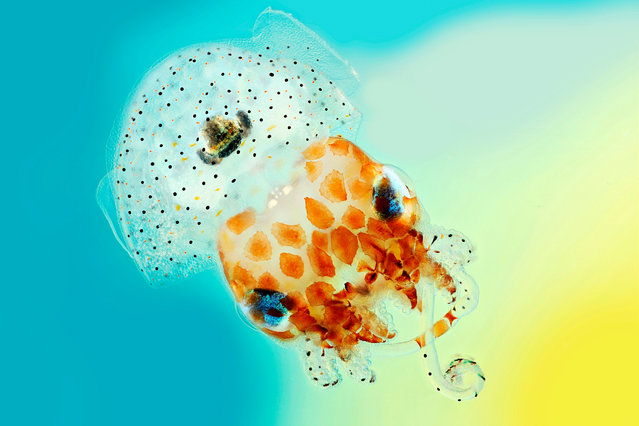
With its huge eyes, comical name and diminutive size, Mark R. Smith’s image of a baby Hawaiian bobtail squid can’t help but raise a smile. A curiously endearing creature, the cephalopod is just 1.5cm across, its mantle cavity bearing more than a passing resemblance to a rather natty shower cap. But it is also a beautiful example of symbiosis – nature’s version of “I’ll scratch your back if you scratch mine” – for on the underside of the squid is a light organ which houses bioluminescent bacteria. The squid offers the bacteria protection and food, while the bacteria emit a glow – a handy trait that the squid uses to offset its silhouette, helping it to evade predators in the depths below. Mark R. Smith’s entry combines several images of a Hawaiian bobtail squid with different focus lengths to create a final picture with greater depth of field than normal. (Photo by Mark R. Smith/Wellcome Images/Macroscopic Solutions)

With its huge eyes, comical name and diminutive size, Mark R. Smith’s image of a baby Hawaiian bobtail squid can’t help but raise a smile. A curiously endearing creature, the cephalopod is just 1.5cm across, its mantle cavity bearing more than a passing resemblance to a rather natty shower cap. But it is also a beautiful example of symbiosis – nature’s version of “I’ll scratch your back if you scratch mine” – for on the underside of the squid is a light organ which houses bioluminescent bacteria. The squid offers the bacteria protection and food, while the bacteria emit a glow – a handy trait that the squid uses to offset its silhouette, helping it to evade predators in the depths below. Mark R. Smith’s entry combines several images of a Hawaiian bobtail squid with different focus lengths to create a final picture with greater depth of field than normal. (Photo by Mark R. Smith/Wellcome Images/Macroscopic Solutions)
Details
08 Mar 2017 00:05:00
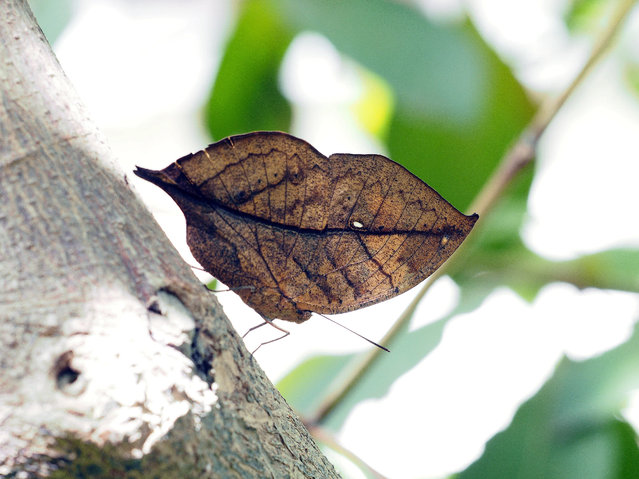
A Dead Leaf butterfly (Kallima inachu formosana, also called Orange Oakleaf Butterfly) rests on a tree trunk at the Taipei Zoo in Taipei, Tawian, 03 August 2019. Dead Leaf butterfly can be found in Tropical Asia from India to Japan. When its wings close, it resembles a dead leaf, providing camouflage against predators including birds, ants, spiders and wasps. (Photo by David Chang/EPA/EFE)

A Dead Leaf butterfly (Kallima inachu formosana, also called Orange Oakleaf Butterfly) rests on a tree trunk at the Taipei Zoo in Taipei, Tawian, 03 August 2019. Dead Leaf butterfly can be found in Tropical Asia from India to Japan. When its wings close, it resembles a dead leaf, providing camouflage against predators including birds, ants, spiders and wasps. (Photo by David Chang/EPA/EFE)
Details
18 Aug 2019 00:01:00
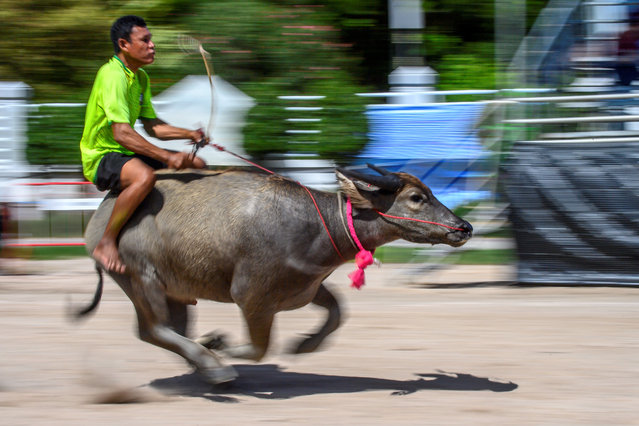
A jockey rides a water buffalo during the annual Chonburi Buffalo Race in Chonburi on October 1, 2020. (Photo by Mladen Antonov/AFP Photo)

A jockey rides a water buffalo during the annual Chonburi Buffalo Race in Chonburi on October 1, 2020. (Photo by Mladen Antonov/AFP Photo)
Details
08 Oct 2020 00:05:00
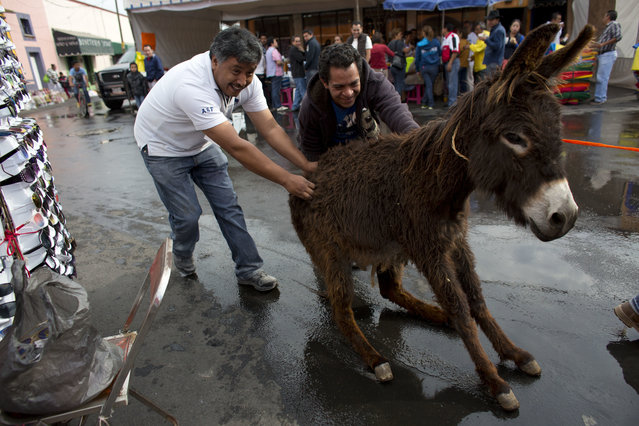
In this May 1, 2016 photo, a reluctant donkey is alternately pushed and pulled and enticed with carrots toward town hall in order to be dressed for the costume competition at the annual donkey festival in Otumba, Mexico state, Mexico. Otumba was an important donkey market during Spanish colonial times, standing at the crossroads of major roads leading to Mexico City, where the beasts pulled heavy loads and carried travelers. Today, however, farmers use tractors and pickup trucks, and the donkey population is in decline. (Photo by Rebecca Blackwell/AP Photo)

In this May 1, 2016 photo, a reluctant donkey is alternately pushed and pulled and enticed with carrots toward town hall in order to be dressed for the costume competition at the annual donkey festival in Otumba, Mexico state, Mexico. Otumba was an important donkey market during Spanish colonial times, standing at the crossroads of major roads leading to Mexico City, where the beasts pulled heavy loads and carried travelers. Today, however, farmers use tractors and pickup trucks, and the donkey population is in decline. (Photo by Rebecca Blackwell/AP Photo)
Details
04 May 2016 11:55:00
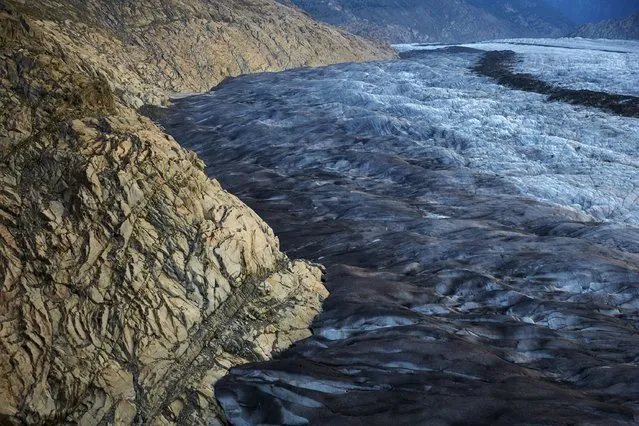
The Aletsch Glacier is pictured at dusk in Fiesch, Switzerland, August 11, 2015. (Photo by Denis Balibouse/Reuters)

The Aletsch Glacier is pictured at dusk in Fiesch, Switzerland, August 11, 2015. One of Europe's biggest glaciers, the Great Aletsch coils 23 km (14 miles) through the Swiss Alps – and yet this mighty river of ice could almost vanish in the lifetimes of people born today because of climate change. The glacier, 900 metres (2,950 feet) thick at one point, has retreated about 3 km (1.9 miles) since 1870 and that pace is quickening. (Photo by Denis Balibouse/Reuters)
Details
18 Oct 2015 08:05:00