Loading...
Done
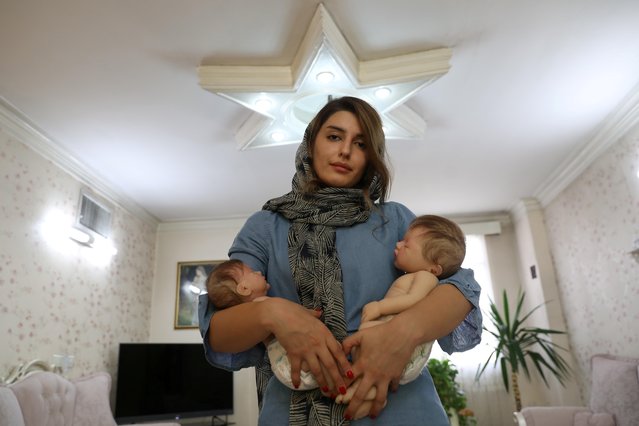
Twenty-four-year-old Maryam Aghayee makes hyper-realistic baby dolls acting as surrogates for some Iranian families who are apprehensive of having more children. “It has been about three or four months since I started this work”, says Maryam in Tehran, Iran on October 7, 2020. “After making my second doll, many orders have been coming in. The second doll was much more realistic than the previous one. After making my second doll, I said that from now on I can take customer orders. I did not intend to start a business from the beginning because it was a hobby, but after the second doll, the demand for these kinds of dolls increased, customers want to have such dolls”. (Photo by Majid Asgaripour/WANA (West Asia News Agency) via Reuters)

Twenty-four-year-old Maryam Aghayee makes hyper-realistic baby dolls acting as surrogates for some Iranian families who are apprehensive of having more children. “It has been about three or four months since I started this work”, says Maryam in Tehran, Iran on October 7, 2020. “After making my second doll, many orders have been coming in. The second doll was much more realistic than the previous one. After making my second doll, I said that from now on I can take customer orders. I did not intend to start a business from the beginning because it was a hobby, but after the second doll, the demand for these kinds of dolls increased, customers want to have such dolls”. (Photo by Majid Asgaripour/WANA (West Asia News Agency) via Reuters)
Details
25 Oct 2020 00:01:00
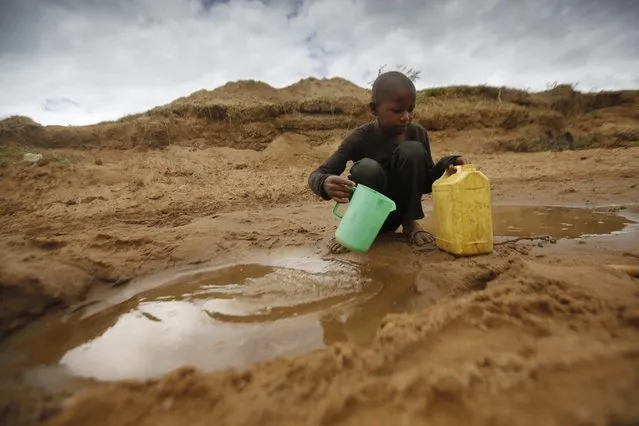
A young boy scoops water from a hand-dug well in the dry riverbed near Matinyani, in the semi-arid Kitui County in southeastern Kenya, 22 March 2015, the World Water Day. Residents of Kitui County and other arid and semi-arid areas of the country have been hard-hit by extremely poor rainfall this year while the government said in previous month that some 1.6 million people countrywide are facing acute starvation due to the drought and will need relief food over the next six months. (Photo by Dai Kurokawa/EPA)

A young boy scoops water from a hand-dug well in the dry riverbed near Matinyani, in the semi-arid Kitui County in southeastern Kenya, 22 March 2015, the World Water Day. Residents of Kitui County and other arid and semi-arid areas of the country have been hard-hit by extremely poor rainfall this year while the government said in previous month that some 1.6 million people countrywide are facing acute starvation due to the drought and will need relief food over the next six months. Residents of Matinyani say they haven't seen a drop of rain in nearly four months. Thousands of Kenyans in rural areas walk tens of kilometers just to fetch water to drink and to be used in their homes. According to an estimate by UNESCO (United Nations Educational, Scientific and Cultural Organization), 17 million people lack access to safe water in Kenya, where the drought is a perennial problem. (Photo by Dai Kurokawa/EPA)
Details
23 Mar 2015 11:01:00
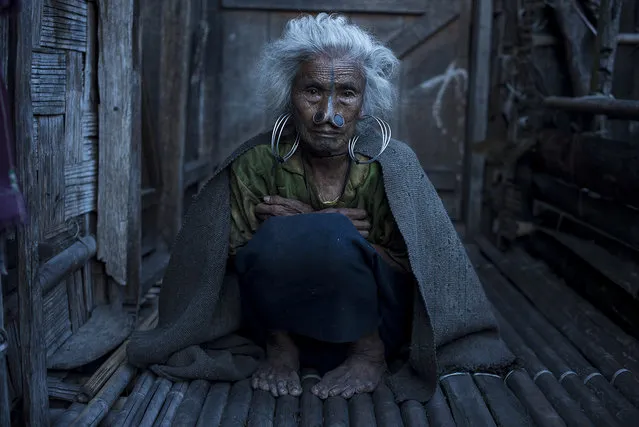
“YagYang”. The Apatani are tribal people living in north east of India in the region of Arunachal Pradesh. Tattooing and stuffing of large nose plugs is the particularity of these women. YagYang 75 years old, her husband passed away few months ago and she feels very alone, during my visit I was very fond of this woman and I wanted to spend some more time with her, so I asked her which was her favorite dish. Photo location: India. (Photo and caption by Passarini Mattia/National Geographic Photo Contest)

“YagYang”. The Apatani are tribal people living in north east of India in the region of Arunachal Pradesh. Tattooing and stuffing of large nose plugs is the particularity of these women. YagYang 75 years old, her husband passed away few months ago and she feels very alone, during my visit I was very fond of this woman and I wanted to spend some more time with her, so I asked her which was her favorite dish. The next day i returned with the fresh fish, as she mentioned, and when she saw me she was very happy and welcomed me with a big smile. Photo location: India. (Photo and caption by Passarini Mattia/National Geographic Photo Contest)
Details
05 Nov 2014 11:55:00
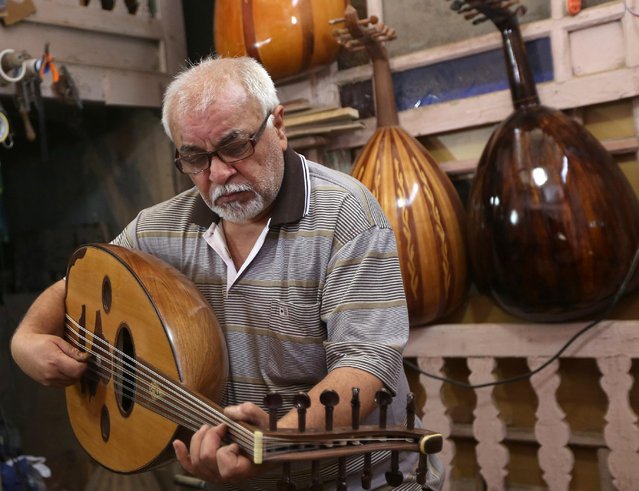
In this photo taken Saturday, June 20, 2015, Mahmoud Abdulnabi tries out an oud, an Arabic instrument related to the lute, at his workshop in Baghdad, Iraq. “The oud is different than other musical instruments”, said Abdulnabi, who has crafted ouds played by some of Iraq's best known musicians, many of whom look down from headshots on the walls. “If you feel joyful, it can play your joy. If the circumstances are sad it can play your sorrow and... help to empty whatever is in your chest”. (Photo by Hadi Mizban/AP Photo)

In this photo taken Saturday, June 20, 2015, Mahmoud Abdulnabi tries out an oud, an Arabic instrument related to the lute, at his workshop in Baghdad, Iraq. “The oud is different than other musical instruments”, said Abdulnabi, who has crafted ouds played by some of Iraq's best known musicians, many of whom look down from headshots on the walls. “If you feel joyful, it can play your joy. If the circumstances are sad it can play your sorrow and... help to empty whatever is in your chest”. (Photo by Hadi Mizban/AP Photo)
Details
05 Jul 2015 10:32:00
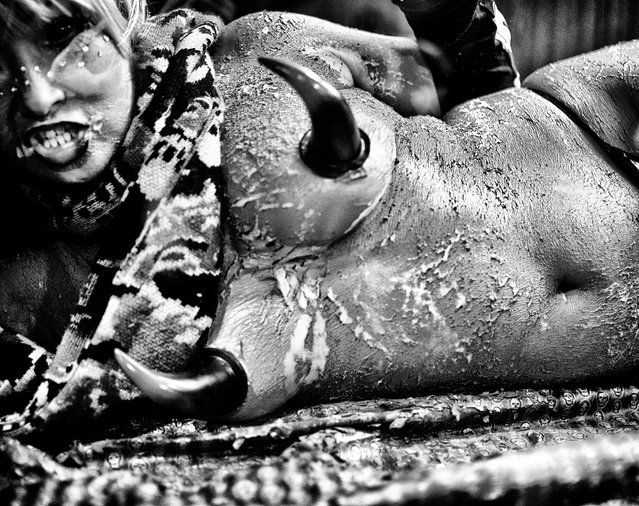
The underbelly of fetish parties has been exposed in photographs captured by Belgian photographer MagLau. The photographer dedicated three years to capturing the obsession with leather and chains, visiting fetish parties through Europe and Japan. The photographer told: “I just took pictures, always finding some beauty in the dark side”. He said that most people were happy to be photographed for the project, with the images included in a new book Fetish Ballad. Aiming to capture the candid moments, he said he never judged but instead wanted to simply observe and understand. Here: Picture from Fetish Ballad book. (Photo by MagLau/Laurent Muschel)

The underbelly of fetish parties has been exposed in photographs captured by Belgian photographer MagLau. The photographer dedicated three years to capturing the obsession with leather and chains, visiting fetish parties through Europe and Japan. The photographer told: “I just took pictures, always finding some beauty in the dark side”. He said that most people were happy to be photographed for the project, with the images included in a new book Fetish Ballad. Aiming to capture the candid moments, he said he never judged but instead wanted to simply observe and understand. Here: Picture from Fetish Ballad book. (Photo by MagLau/Laurent Muschel)
Details
16 Oct 2016 10:49:00
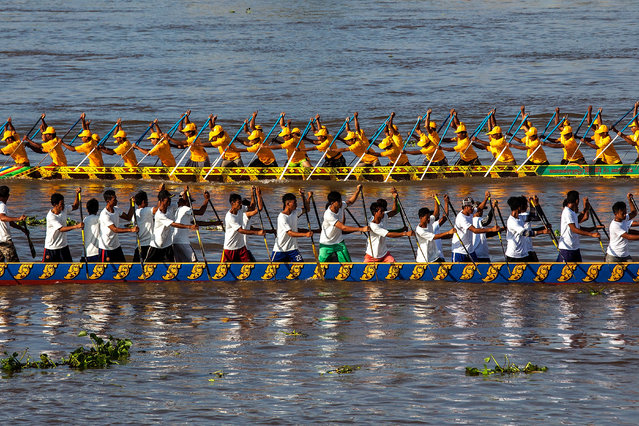
Boat crew members train on the waters of the Tonle Sap River on the morning of the first day of the Water Festival on November 13, 2016 in Phnom Penh, Cambodia. The yearly three-day Water Festival is one of the most important holidays in Cambodia and celebrates the end of the rainy season and the start of the rice harvesting. The Festival also coincides with the Tonle Sap river reversing course, which it does twice a year. Approximately 2 million people are expected to attend this year's festival, during which 259 boats and nearly 20,000 oarsmen will participate in the races. After a fatal stampede resulting in the death of some 353 people during the Water Festival in 2010, it has been cancelled four times over the past five years, with weather used as an official excuse. (Photo by Omar Havana/Getty Images)

Boat crew members train on the waters of the Tonle Sap River on the morning of the first day of the Water Festival on November 13, 2016 in Phnom Penh, Cambodia. The yearly three-day Water Festival is one of the most important holidays in Cambodia and celebrates the end of the rainy season and the start of the rice harvesting. The Festival also coincides with the Tonle Sap river reversing course, which it does twice a year. Approximately 2 million people are expected to attend this year's festival, during which 259 boats and nearly 20,000 oarsmen will participate in the races. After a fatal stampede resulting in the death of some 353 people during the Water Festival in 2010, it has been cancelled four times over the past five years, with weather used as an official excuse. (Photo by Omar Havana/Getty Images)
Details
15 Nov 2016 11:26:00
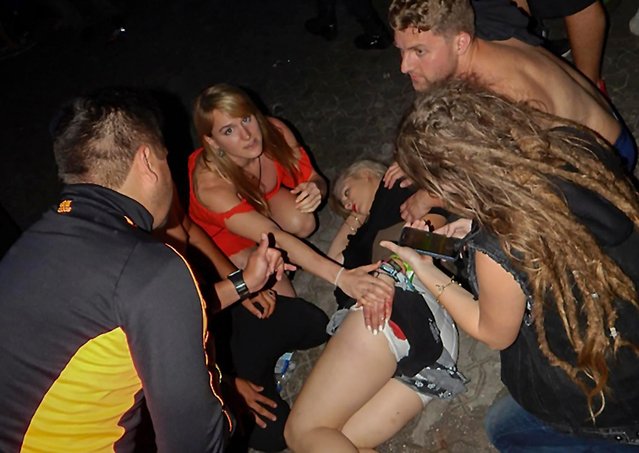
An injured woman is pictured near the Blue Parrot nightclub in Playa del Carmen, Quintana Ro state, Mexico where 5 people were killed, three of them foreigners, during a music festival on January 16, 2017. A shooting erupted at an electronic music festival in the Mexican resort of Playa del Carmen early Monday, leaving at least five people dead and sparking a stampede, the mayor said. Fifteen people were injured, some in the stampede, after at least one shooter opened fire before dawn at the Blue Parrot nightclub during the BPM festival. (Photo by Victor Vargas/AFP Photo)

An injured woman is pictured near the Blue Parrot nightclub in Playa del Carmen, Quintana Ro state, Mexico where 5 people were killed, three of them foreigners, during a music festival on January 16, 2017. A shooting erupted at an electronic music festival in the Mexican resort of Playa del Carmen early Monday, leaving at least five people dead and sparking a stampede, the mayor said. Fifteen people were injured, some in the stampede, after at least one shooter opened fire before dawn at the Blue Parrot nightclub during the BPM festival. (Photo by Victor Vargas/AFP Photo)
Details
17 Jan 2017 12:35:00
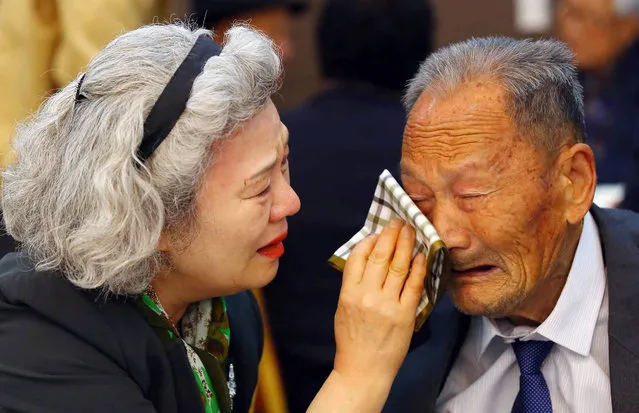
South Korean Lee Jung-sook (L), 68, wipes the tears from her North Korean father Lee Heung-jong, 88, as they bid each other a sad farewell at a resort on Mount Kumgang, North Korea, 22 October 2015. About 390 South Koreans arrived at the resort two days ago for the first face-to-face reunion of families separated by the 1950-53 Korean War in nearly 20 months. A second group of some 260 South Koreans will do the same for three days starting on 24 October. (Photo by Yonhap/EPA)

South Korean Lee Jung-sook (L), 68, wipes the tears from her North Korean father Lee Heung-jong, 88, as they bid each other a sad farewell at a resort on Mount Kumgang, North Korea, 22 October 2015. About 390 South Koreans arrived at the resort two days ago for the first face-to-face reunion of families separated by the 1950-53 Korean War in nearly 20 months. A second group of some 260 South Koreans will do the same for three days starting on 24 October. (Photo by Yonhap/EPA)
Details
24 Oct 2015 08:06:00