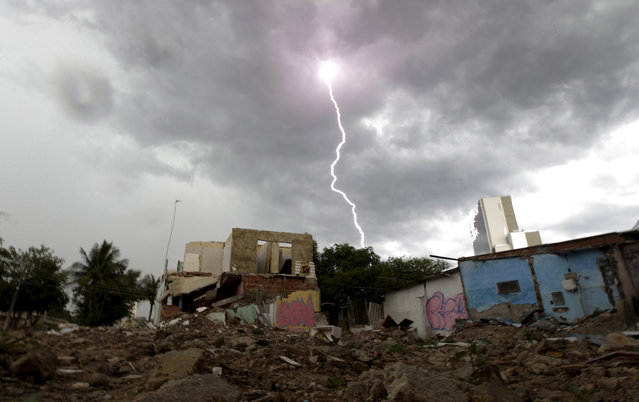
Partially demolished houses stand in the Vila Autodromo slum with the Rio 2016 Olympic Park in the background in Rio de Janeiro, Brazil, February 25, 2016. (Photo by Ricardo Moraes/Reuters)
A participant rides a bicycle carrying an orangutan mascot costume as he attends an awareness action calling for the protection of orangutans, organised by local environmental NGO Satya Bumi to mark World Orangutan Day, observed on August 19, during Car Free Day in Jakarta on August 24, 2025. (Photo by Yasuyoshi Chiba/AFP Photo)
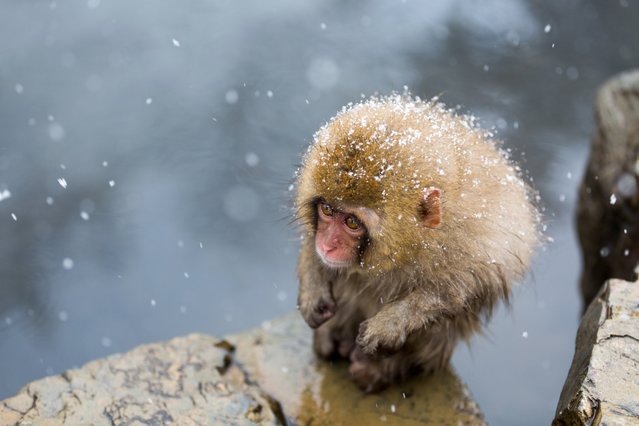
“A Little Monkey on the Cliff”. “A cold front hit the Nagano prefecture. I saw a little monkey enduring the cold in Jigokudani Monkey Park. This little monkey is really cute”. (Photo by Hidetoshi Ogata/Smithsonian Photo Contest)
Everton fan and legendary fashion photographer Matt Lever has captured the dizzying drama behind the scenes at catwalk shows since 1999. Here: Balmain, Spring/Summer 2011. (Photo by Matt Lever)
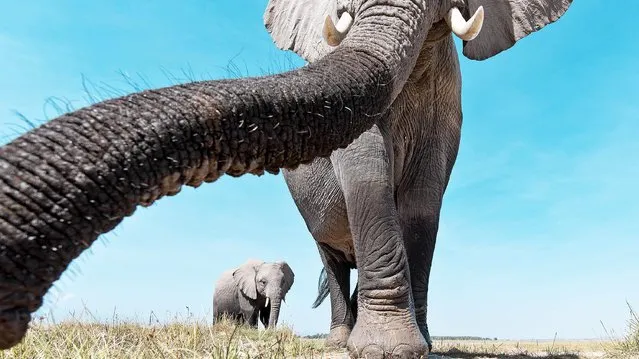
An elephant in Amboseli National Park in Kenya, June 2021. Gurcharan Roopra, 42, a Nairobi-born engineer-turned-wildlife photographer, has dedicated the past four years of his career to photographing these animals. He spends hours in his workshop camouflaging and encasing his equipment with protective gear before laying his camera in the path of lions, elephants, rhino, zebra and buffalo. (Photo by Gurcharan Roopra/Mercury Press)
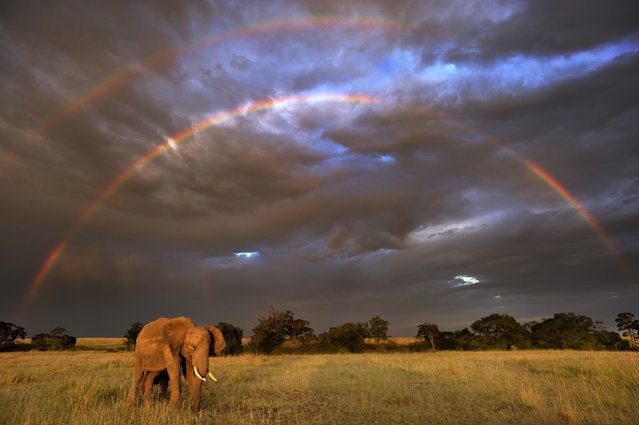
This photo provided by Netflix/naturepl.com and WWF-International shows an African Elephant (Loxodonta africana) in front of double rainbow, in Masai Mara, Kenya, included in the Netflix natural history series, “Our Planet”, in collaboration with Silverback Films and WWF. The eight-part series debuts in 2019. (Photo by Andy Rouse/Naturepl/WWF-International/Netflix via AP Photo)
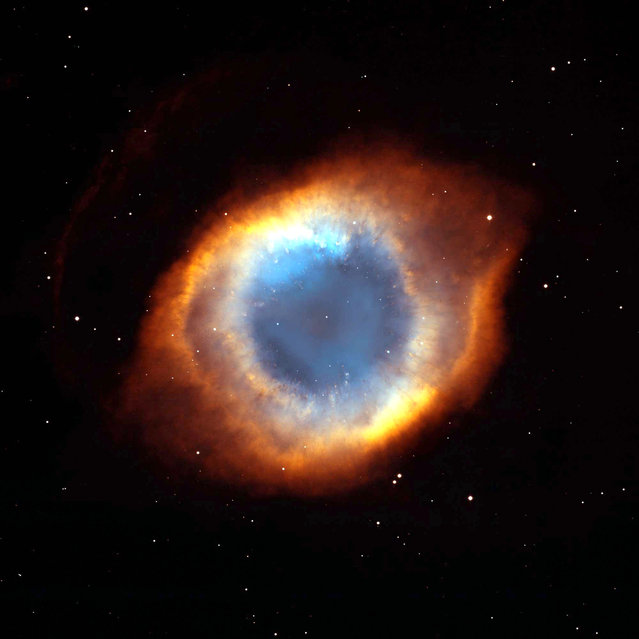
A coil-shaped Helix Nebula showing a fine web of filamentary “bicycle-spoke” features embedded in the colorful red and blue ring of gas. At 650 light-years away, the Helix is one of the nearest planetary nebulae to Earth. A planetary nebula is the glowing gas around a dying, Sun-like star. (Photo by Reuters/NASA)
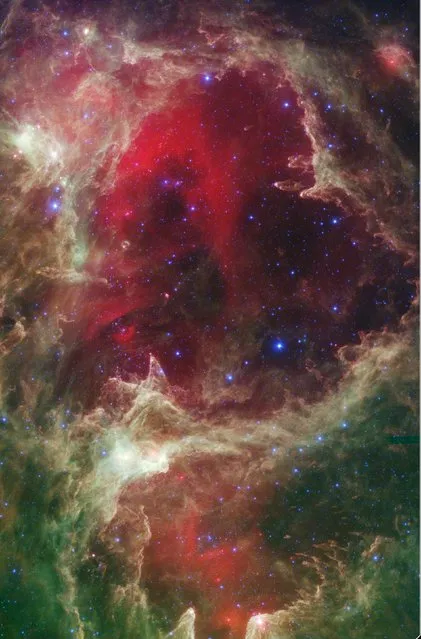
An infrared portrait from NASA's Spitzer Space Telescope which shows generations of stars is seen in this undated NASA handout image released February 14, 2013. In this wispy star-forming region, called W5, the oldest stars can be seen as blue dots in the centers of the two hollow cavities (other blue dots are background and foreground stars not associated with the region). Red shows heated dust that pervades the region's cavities, while green highlights dense clouds. (Photo by NASA/Reuters/JPL-Caltech/Harvard-Smithsonian/Handout)