Loading...
Done
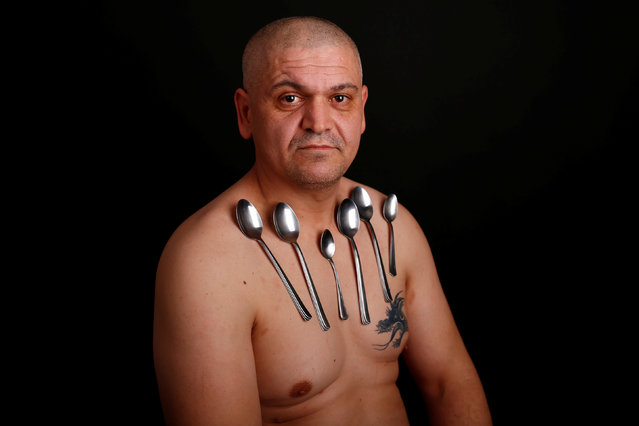
Nermin Halilagic, 38, poses with kitchen utensils in Bihac, Bosnia and Herzegovina, January 23, 2017. (Photo by Dado Ruvic/Reuters)

Nermin Halilagic, 38, poses with kitchen utensils in Bihac, Bosnia and Herzegovina, January 23, 2017. Halilagic discovered earlier this year that he had the unusual ability to attach items to his body using what he says is a special energy radiated from his body. (Photo by Dado Ruvic/Reuters)
Details
26 Jan 2017 12:52:00
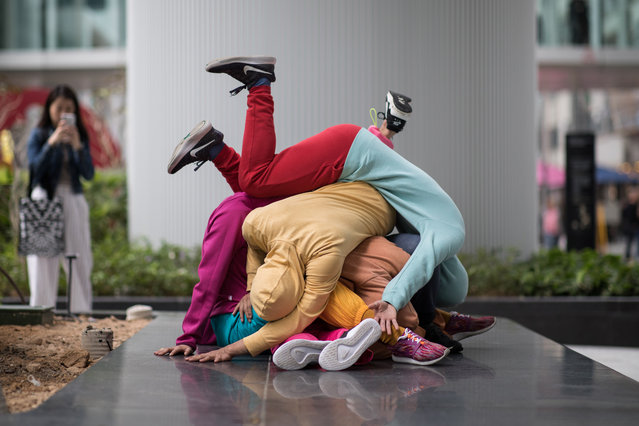
Dancers perform as human sculptures during an exhibition in Hong Kong, China, 26 March 2019. (Photo by Jerome Favre/EPA/EFE)

Dancers perform as human sculptures during an exhibition in Hong Kong, China, 26 March 2019. The exhibition entitled “Multisensory Exhibition Urban Playgrounds” shows how Austrian artist Willi Dorner uses urban spaces to interpret the relationship between bodies and objects. (Photo by Jerome Favre/EPA/EFE)
Details
30 Mar 2019 00:01:00
Madson of Santos reacts during the match between Santos and Palmeiras as part of Brasileirao Series A 2022 at Vila Belmiro Stadium on May 29, 2022 in Santos, Brazil. (Photo by Carla Carniel/Reuters)

Madson of Santos reacts during the match between Santos and Palmeiras as part of Brasileirao Series A 2022 at Vila Belmiro Stadium on May 29, 2022 in Santos, Brazil. (Photo by Carla Carniel/Reuters)
Details
08 Jun 2022 05:23:00
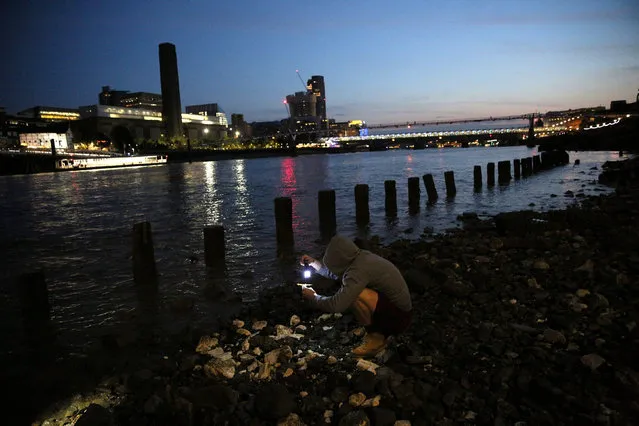
A mudlark uses a torch to look for items on the bank of the River Thames in London, Britain June 06, 2016. Mudlarking is believed to trace its origins to the 18th and 19th century, when scavengers searched the Thames' shores for items to sell. These days, history and archaeology fans are the ones hoping to find old relics such as coins, ceramics, artifacts or everyday items from across centuries. They wait for the low tide and then scour specific areas of exposed shores. "If you're in a field you could be out all day long, with the river you're restricted to about two or three hours," mudlark Nick Stevens said. While many just use the naked eye for their searches, others rely on metal detectors for which a permit from the Port of London Authority is needed. Digging also requires consent. (Photo by Neil Hall/Reuters)

A mudlark uses a torch to look for items on the bank of the River Thames in London, Britain June 06, 2016. Mudlarking is believed to trace its origins to the 18th and 19th century, when scavengers searched the Thames' shores for items to sell. These days, history and archaeology fans are the ones hoping to find old relics such as coins, ceramics, artifacts or everyday items from across centuries. their finds with the Portable Antiquities Scheme. Any item over 300 years old must be recorded. (Photo by Neil Hall/Reuters)
Details
27 Aug 2016 10:43:00
Boxer Tommy Fury is pictured during a weight measurement, a day ahead of a match against Jake Paul (not pictured) in Riyadh, on February 25, 2023. (Photo by Fayez Nureldine/AFP Photo)

Boxer Tommy Fury is pictured during a weight measurement, a day ahead of a match against Jake Paul (not pictured) in Riyadh, on February 25, 2023. (Photo by Fayez Nureldine/AFP Photo)
Details
06 Mar 2023 04:27:00
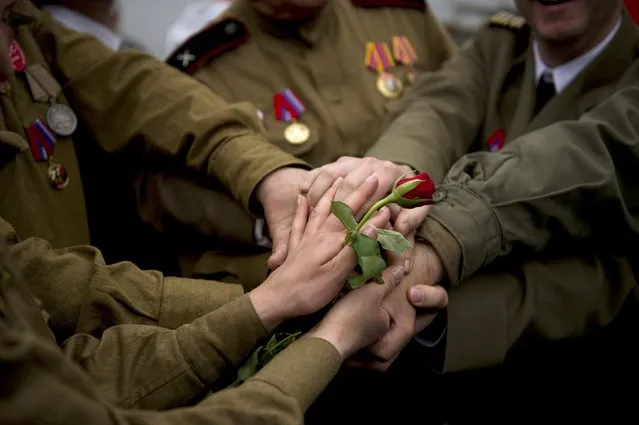
Members of a historical re-enactment group dressed as U.S. and Soviet Army soldiers take part in Elbe Day celebrations, in eastern German city of Torgau at the river Elbe, April 25, 2015. (Photo by Stefanie Loos/Reuters)

Members of a historical re-enactment group dressed as U.S. and Soviet Army soldiers take part in Elbe Day celebrations, in eastern German city of Torgau at the river Elbe, April 25, 2015. Elbe Day commemorates the encounter of the Allies 70 years ago, on the 25th of April 1945 when American and Soviet army units joined together on the destroyed bridge over the river Elbe. The photograph of the meaningful handshake made its way around the world and became a symbol of the near end of World War II in Europe. (Photo by Stefanie Loos/Reuters)
Details
26 Apr 2015 08:58:00
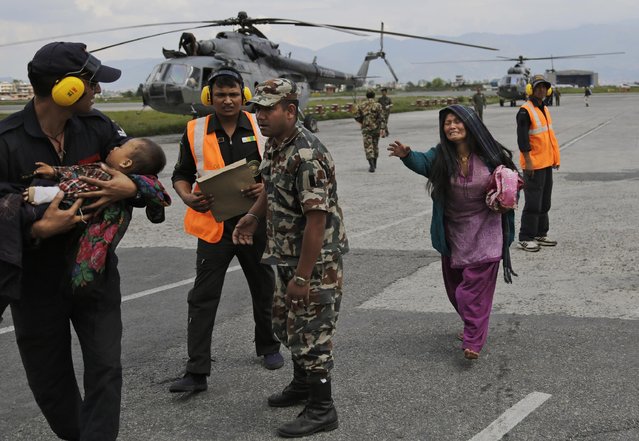
An Indian Air Force person walks carrying a Nepalese child, wounded in Saturday's earthquake, to a waiting ambulance as the mother rushes to join after they were evacuated from a remote area at the airport in Kathmandu, Nepal, Monday, April 27, 2015. (Photo by Altaf Qadri/AP Photo)

An Indian Air Force person walks carrying a Nepalese child, wounded in Saturday's earthquake, to a waiting ambulance as the mother rushes to join after they were evacuated from a remote area at the airport in Kathmandu, Nepal, Monday, April 27, 2015. The death toll from Nepal's earthquake is expected to rise depended largely on the condition of vulnerable mountain villages that rescue workers were still struggling to reach two days after the disaster. (Photo by Altaf Qadri/AP Photo)
Details
28 Apr 2015 13:52:00
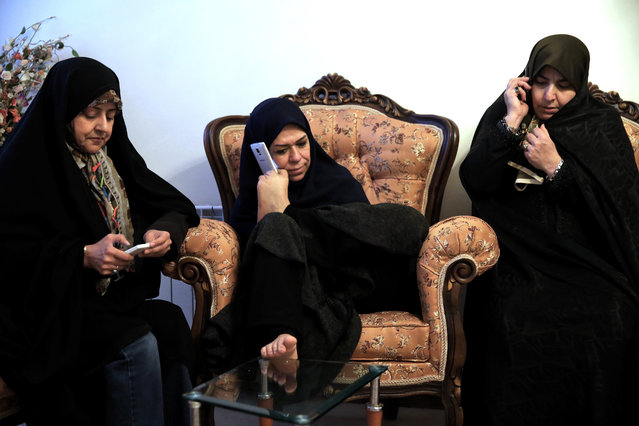
In this picture taken on Saturday, January 31, 2015, Zohreh Etezadossaltaneh, center, talks on her mobile phone, held with her foot, during a meeting at her friend's home in Tehran, Iran. Now 52 years old, the retired Iranian teacher who was born without arms has dedicated herself to helping others with similar disabilities live full and satisfying lives. (Photo by Ebrahim Noroozi/AP Photo)

In this picture taken on Saturday, January 31, 2015, Zohreh Etezadossaltaneh, center, talks on her mobile phone, held with her foot, during a meeting at her friend's home in Tehran, Iran. Now 52 years old, the retired Iranian teacher who was born without arms has dedicated herself to helping others with similar disabilities live full and satisfying lives. (Photo by Ebrahim Noroozi/AP Photo)
Details
03 May 2015 11:52:00