Loading...
Done
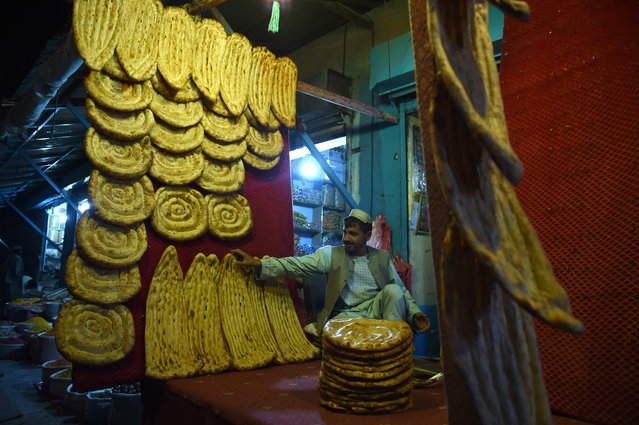
In this photograph taken on October 4, 2016, an Afghan baker prepares bread at his shop as he waits for customers in Lashkar Gah, the capital city of Helmand province For years Helmand was the centerpiece of the Western military intervention in Afghanistan only for it to slip deeper into a quagmire of instability, with almost the entire southern province teetering on the verge of collapse. Intensified fighting has killed hundreds and forced thousands to flee to besieged capital Lashkar Gah, sparking a humanitarian crisis as the city – one of the last government- held enclaves – risks falling to the Taliban' s repeated ferocious assaults. (Photo by Wakil Kohsar/AFP Photo)

In this photograph taken on October 4, 2016, an Afghan baker prepares bread at his shop as he waits for customers in Lashkar Gah, the capital city of Helmand province. For years Helmand was the centerpiece of the Western military intervention in Afghanistan only for it to slip deeper into a quagmire of instability, with almost the entire southern province teetering on the verge of collapse. Intensified fighting has killed hundreds and forced thousands to flee to besieged capital Lashkar Gah, sparking a humanitarian crisis as the city – one of the last government- held enclaves – risks falling to the Taliban' s repeated ferocious assaults. (Photo by Wakil Kohsar/AFP Photo)
Details
08 Dec 2016 12:41:00
For her series “Japanese Whispers”, Belgian photographer Zaza Bertrand headed inside the intimate world of rabuhos – Japanese love hotels. Love hotels became popular in Japan from the 1960s onwards, due to a lack of privacy in many family homes. There are now around 37,000 of these hotels in Japan, allowing short daytime “rests” or overnight stays. (Photo by Zaza Bertrand/The Guardian)

For her series “Japanese Whispers”, Belgian photographer Zaza Bertrand headed inside the intimate world of rabuhos – Japanese love hotels. Love hotels became popular in Japan from the 1960s onwards, due to a lack of privacy in many family homes. There are now around 37,000 of these hotels in Japan, allowing short daytime “rests” or overnight stays. (Photo by Zaza Bertrand/The Guardian)
Details
02 Dec 2016 11:30:00
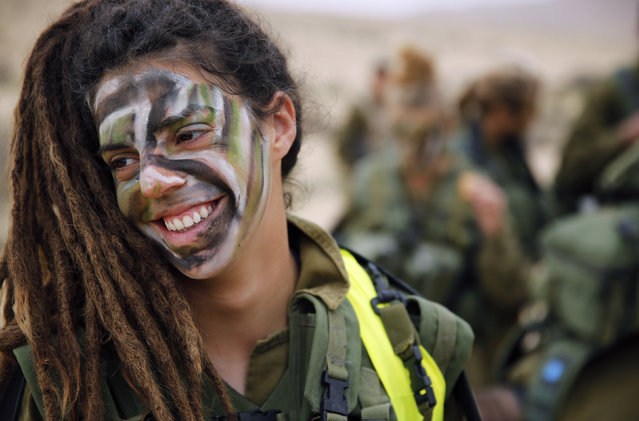
An Israeli soldier of the Caracal battalion smiles during a 23-kilometer march marking the end of their training in Israel's Negev desert, near Kibbutz Sde Boker February 14, 2013. The “Caracal” battalion, two-thirds of whose members are women, was established in 2004 with the purpose of incorporating female soldiers in combat units. The main mission of Caracal is routine patrols on Israel's border with Egypt to intercept infiltrators and smuggling from the Sinai desert. (Photo by Darren Whiteside/Reuters)

An Israeli soldier of the Caracal battalion smiles during a 23-kilometer march marking the end of their training in Israel's Negev desert, near Kibbutz Sde Boker February 14, 2013. The “Caracal” battalion, two-thirds of whose members are women, was established in 2004 with the purpose of incorporating female soldiers in combat units. The main mission of Caracal is routine patrols on Israel's border with Egypt to intercept infiltrators and smuggling from the Sinai desert. (Photo by Darren Whiteside/Reuters)
Details
23 Sep 2014 13:22:00
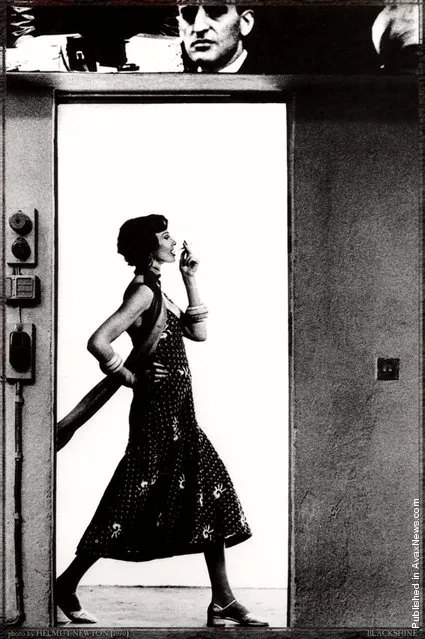
Photographers: Helmut Newton

“Newton was born in Berlin, the son of Klara “Claire” (Marquis) and Max Neustädter, a button factory owner. His family was Jewish. Newton attended the Heinrich-von-Treitschke-Realgymnasium and the American School in Berlin. Interested in photography from the age of 12 when he purchased his first camera, he worked for the German photographer Yva (Elsie Neulander Simon) from 1936. The increasingly oppressive restrictions placed on Jews by the Nuremberg laws meant that his father lost control of the factory in which he manufactured buttons and buckles; he was briefly interned in a concentration camp on “Kristallnacht”, November 9, 1938, which finally compelled the family to leave Germany. Newton's parents fled to South America. He was issued with a passport just after turning 18, and left Germany on December 5, 1938. At Trieste he boarded the “Conte Rosso” (along with about 200 others escaping the Nazis) intending to journey to China. After arriving in Singapore he found he was able to remain there, first and briefly as a photographer for the Straits Times and then as a portrait photographer”. – Wikipedia

Photo: Sigourney Weaver by Helmut Newton, 1995.
Details
08 Apr 2012 13:49:00
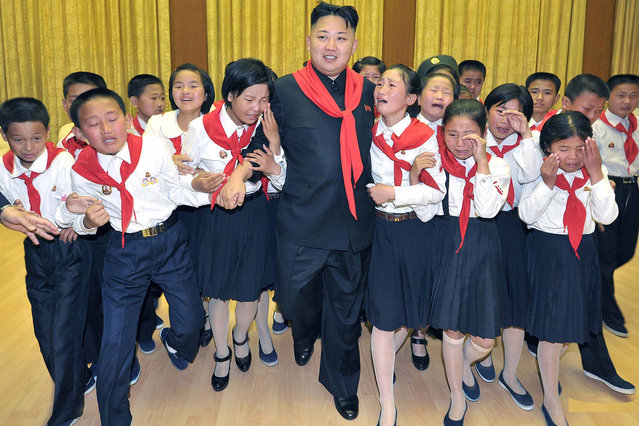
This photo released by North Korea's official Korean Central News Agency (KCNA) on June 7, 2012 shows North Korean leader Kim Jong-Un (C) surrounded by members of the Korean Children's Union (KCU) organizations during a joint national meeting to celebrate the 66th anniversary of the KCU organizations at Kim Il-Sung Stadium in Pyongyang on June 6, 2012. (Photo by AFP Photo/KCNA via KNS)

This photo released by North Korea's official Korean Central News Agency (KCNA) on June 7, 2012 shows North Korean leader Kim Jong-Un (C) surrounded by members of the Korean Children's Union (KCU) organizations during a joint national meeting to celebrate the 66th anniversary of the KCU organizations at Kim Il-Sung Stadium in Pyongyang on June 6, 2012. (Photo by AFP Photo/KCNA via KNS)
Details
25 Apr 2014 07:54:00
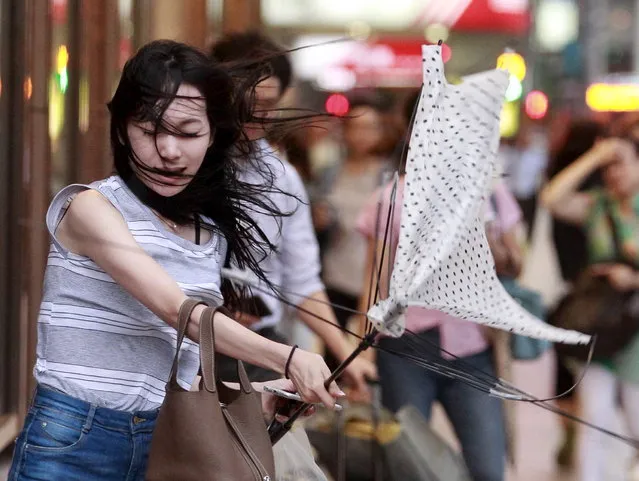
A woman holds her umbrella while walking against strong winds as Typhoon Soudelor approaches Taiwan in Taipei, August 7, 2015. (Photo by Pichi Chuang/Reuters)

A woman holds her umbrella while walking against strong winds as Typhoon Soudelor approaches Taiwan in Taipei, August 7, 2015. (Photo by Pichi Chuang/Reuters)
Details
09 Nov 2015 08:06:00
Model Olivia Culpo (L) and host Nick Jonas, after getting slimed, backstage during Nickelodeon's 28th Annual Kids' Choice Awards held at The Forum on March 28, 2015 in Inglewood, California. (Photo by Lester Cohen/KCA2015/WireImage)

Model Olivia Culpo (L) and host Nick Jonas, after getting slimed, backstage during Nickelodeon's 28th Annual Kids' Choice Awards held at The Forum on March 28, 2015 in Inglewood, California. (Photo by Lester Cohen/KCA2015/WireImage)
Details
24 Dec 2022 04:01:00
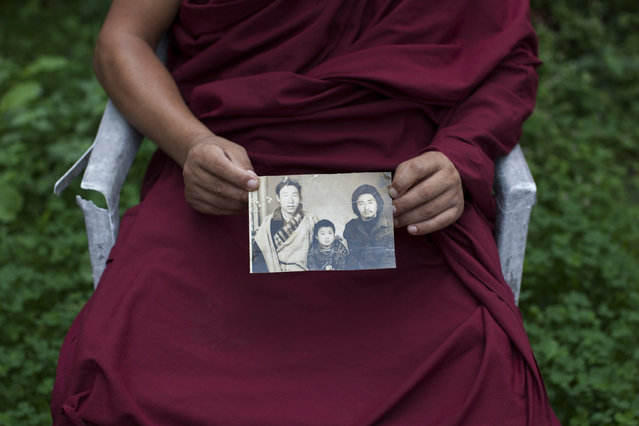
In this Saturday, September 27, 2014 photo, Tibetan monk Dorjee, 38, displays a photograph of his father, left, and himself, center, taken in Tibet, in Dharamsala, India. Dorjee said he held back his tears when he spoke with his parents on the phone after a separation period of 27 years. He exchanged a few words with his father but said his mother fainted on hearing his voice. (Photo by Tsering Topgyal/AP Photo)

“When I was 8 years old, my parents paid a smuggler to take me across the Himalayas, a weekslong walk over the mountains from Tibet to India. It was a trek that tens of thousands of other Tibetans have taken since the Dalai Lama fled a failed 1959 uprising against Chinese rule. My parents must have had their reasons to send me here; they must have had the best of intentions. But 18 years later, I still don't know why they did it. They are not political people. They are small farmers who raise barley and a few yak in a rural area not far from Lhasa, the Tibetan capital. I have not seen them since I left...”. – Tsering Topgyal via The Associated Press. (Photo by Tsering Topgyal/AP Photo)
Details
05 Nov 2014 12:27:00