Loading...
Done
Three pals pose for a picture on a night out in Liverpool city centre, United Kingdom on December 24, 2020. Festive boozers braved the cold in Liverpool and York – as millions down South rang in Christmas Day indoors due to Covid restrictions. (Photo by David Nelson/South West News Service)

Three pals pose for a picture on a night out in Liverpool city centre, United Kingdom on December 24, 2020. Festive boozers braved the cold in Liverpool and York – as millions down South rang in Christmas Day indoors due to Covid restrictions. (Photo by David Nelson/South West News Service)
Details
26 Dec 2020 00:07:00
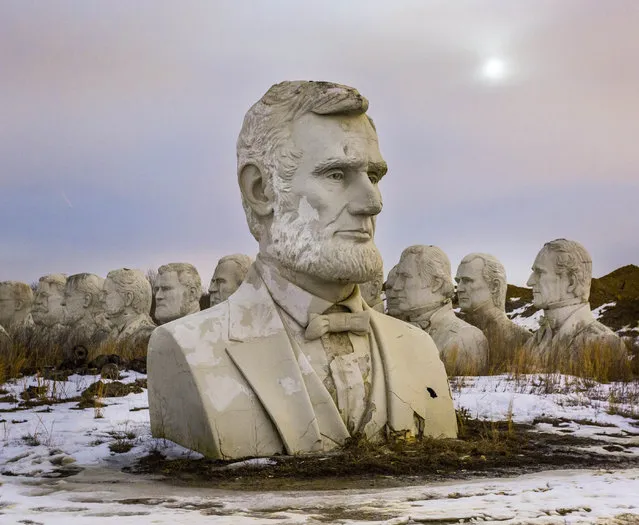
Abraham Lincoln in front of presidential busts. (Photo by David Ogden/Caters News)

In a remote location in rural America, a photographer has discovered a rather unique gathering: row after row of presidential busts. Like a zombie graveyard, the field contains 43 gigantic sculptures, ranging from Dick Nixon and FDR to JFK and Honest Abe. The likenesses weigh between 11,000 and 20,000 pounds, with some standing as tall as 20 feet. Almost all the busts are cracked, crumbling and worn by the elements, adding to their eerie appearance but not preventing the presidents from being recognizable at first glance. Here: Abraham Lincoln in front of presidential busts. (Photo by David Ogden/Caters News)
Details
21 Feb 2016 11:37:00
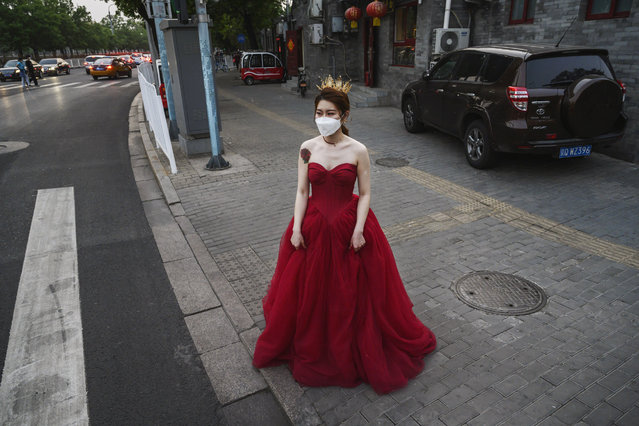
A Chinese woman wears her dress and a protective mask as she waits to change after taking pictures in advance of her wedding near the Forbidden City, on April 30, 2020 in Beijing, China. Beijing lowered its risk level after more than three months Thursday in advance of the May holiday, allowing most domestic travellers arriving in the city to do so without having to do 14 days of quarantine. The Forbidden City will open to a limited number of visitors as of Thursday morning. After decades of growth, officials said China's economy had shrunk in the latest quarter due to the impact of the coronavirus epidemic. The slump in the world's second largest economy is regarded as a sign of difficult times ahead for the global economy. While industrial sectors in China are showing signs of reviving production, a majority of private companies are operating at only 50% capacity, according to analysts. With the pandemic hitting hard across the world, officially the number of coronavirus cases in China is dwindling, ever since the government imposed sweeping measures to keep the disease from spreading. Officials believe the worst appears to be over in China, though there are concerns of another wave of infections as the government attempts to reboot the world's second largest economy. Since January, China has recorded more than 81,000 cases of COVID-19 and at least 3,200 deaths, mostly in and around the city of Wuhan, in central Hubei province, where the outbreak first started. (Photo by Kevin Frayer/Getty Images)

A Chinese woman wears her dress and a protective mask as she waits to change after taking pictures in advance of her wedding near the Forbidden City, on April 30, 2020 in Beijing, China. Beijing lowered its risk level after more than three months Thursday in advance of the May holiday, allowing most domestic travellers arriving in the city to do so without having to do 14 days of quarantine. (Photo by Kevin Frayer/Getty Images)
Details
03 May 2020 00:07:00
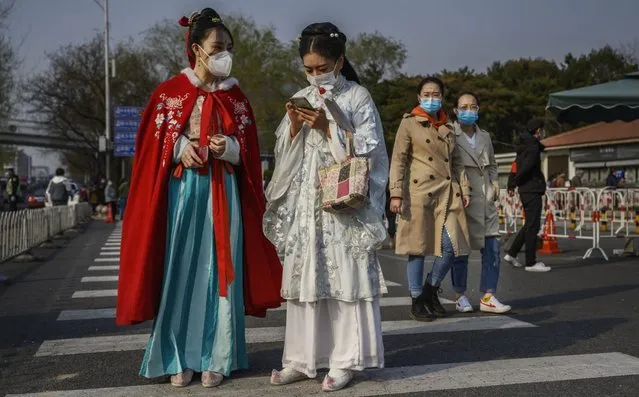
Chinese women wear protective masks as they are dressed in traditional clothing from the Qing Dynasty era outside a park on March 29, 2020 in Beijing, China. A limited section of the iconic tourist site was re-opened to the public this week allowing a smaller number of visitors to reserve tickets online in advance and to enter after passing health screening. With the pandemic hitting hard across the world, China recorded its first day with no new domestic cases of the coronavirus last week, since the government imposed sweeping measures to keep the disease from spreading. For two months, millions of people across China have been restricted in how they move from their homes, while other cities have been locked down in ways that appeared severe at the time but are now being replicated in other countries trying to contain the virus. Officials believe the worst appears to be over in China, though there are concerns of another wave of infections as the government attempts to reboot the worlds second largest economy. In Beijing, it is mandatory to wear masks outdoors, retail stores operate on reduced hours, restaurants employ social distancing among patrons, and tourist attractions at risk of drawing large crowds remain closed. Monitoring and enforcement of virus-related measures and the quarantine of anyone arriving to Beijing is carried out by neighborhood committees and a network of Communist Party volunteers who wear red arm bands. A primary concern for Chinese authorities remains the arrival of flights from Europe and elsewhere, given the exposure of passengers in regions now regarded as hotbeds for transmission. Since January, China has recorded more than 81,000 cases of COVID-19 and at least 3200 deaths, mostly in and around the city of Wuhan, in central Hubei province, where the outbreak first started. (Photo by Kevin Frayer/Getty Images)

Chinese women wear protective masks as they are dressed in traditional clothing from the Qing Dynasty era outside a park on March 29, 2020 in Beijing, China. A limited section of the iconic tourist site was re-opened to the public this week allowing a smaller number of visitors to reserve tickets online in advance and to enter after passing health screening. (Photo by Kevin Frayer/Getty Images)
Details
01 Apr 2020 00:05:00
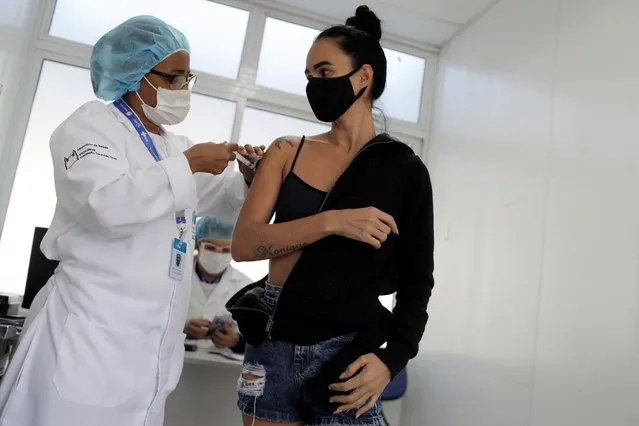
A health worker applies a dose of the AstraZeneca vaccine during the first day of a three-day COVID-19 vaccination campaign for people over age 35 in the Complexo da Maré favela of Rio de Janeiro, Brazil, Brazil, Thursday, July 29, 2021. Some recipients will be monitored to study the rate of protection the vaccines provide and the extent to which virus variants are circulating. (Photo by Bruna Prado/AP Photo)

A health worker applies a dose of the AstraZeneca vaccine during the first day of a three-day COVID-19 vaccination campaign for people over age 35 in the Complexo da Maré favela of Rio de Janeiro, Brazil, Brazil, Thursday, July 29, 2021. Some recipients will be monitored to study the rate of protection the vaccines provide and the extent to which virus variants are circulating. (Photo by Bruna Prado/AP Photo)
Details
30 Jul 2021 09:31:00
Traditional wooden boats, or dhows, compete at sunrise during the Al Gaffal race, a long-distance dhow sailing race, near Sir Bu Nuayr, near Sharjah May 18, 2014. (Photo by Martin Dokoupil/Reuters)

The Al-Gaffal is an annual long-distance race between crews sailing 60-ft. traditional wooden boats called dhows and takes place in the Persian Gulf, between the island of Sir Bu Nair, near the Iranian coast and the Gulf emirate of Dubai. Photo: Traditional wooden boats, or dhows, compete at sunrise during the Al Gaffal race, a long-distance dhow sailing race, near Sir Bu Nuayr, near Sharjah May 18, 2014. (Photo by Martin Dokoupil/Reuters)
Details
19 May 2014 10:59:00
Humanoid robot bartender “Carl” interacts with guests at the Robots Bar and Lounge in the eastern German town of Ilmenau, July 26, 2013. “Carl”, developed and built by mechatronics engineer Ben Schaefer who runs a company for humanoid robots, prepares spirits for the mixing of cocktails and is able to interact with customers in small conversations. (Photo by Fabrizio Bensch/Reuters)

Humanoid robot bartender “Carl” interacts with guests at the Robots Bar and Lounge in the eastern German town of Ilmenau, July 26, 2013. “Carl”, developed and built by mechatronics engineer Ben Schaefer who runs a company for humanoid robots, prepares spirits for the mixing of cocktails and is able to interact with customers in small conversations. (Photo by Fabrizio Bensch/Reuters)
Details
22 Oct 2013 09:04:00
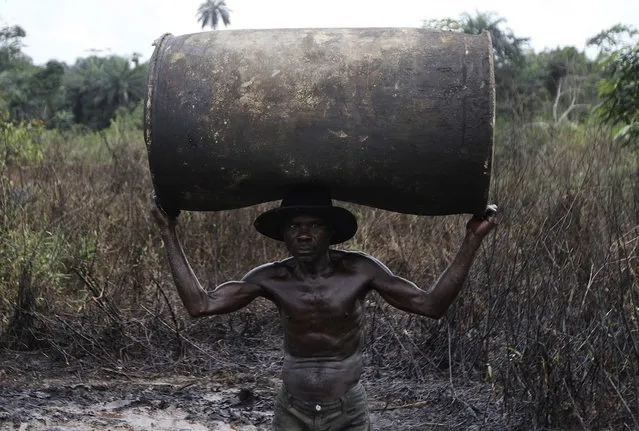
Ebiowei, 48, carries an empty oil container on his head to a place where it would be filled with refined fuel at an illegal refinery site near river Nun in Nigeria's oil state of Bayelsa November 27, 2012. (Photo by Akintunde Akinleye/Reuters)

Ebiowei, 48, carries an empty oil container on his head to a place where it would be filled with refined fuel at an illegal refinery site near river Nun in Nigeria's oil state of Bayelsa November 27, 2012. Locals in the industry say workers can earn $50 to $60 a day. Thousands of people in Nigeria engage in a practice known locally as “oil bunkering” – hacking into pipelines to steal crude then refining it or selling it abroad. The practice, which leaves oil spewing from pipelines for miles around, managed to lift around a fifth of Nigeria's two million barrel a day production last year according to the finance ministry. (Photo by Akintunde Akinleye/Reuters)
Details
18 Jan 2013 14:29:00