An Icelandic mare and her foal stand on a meadow at a stud farm in Wehrheim near Frankfurt, Germany, Tuesday, June 17, 2025. (Photo by Michael Probst/AP Photo)
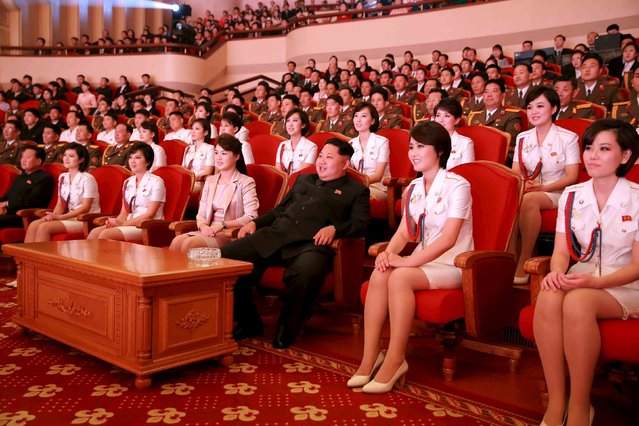
North Korean leader Kim Jong Un (3rd R) and wife Ri Sol Ju (4th L) enjoy an art performance given by the Chongbong Band to mark the 70th anniversary of the founding of the Workers' Party of Korea (WPK) in this undated photo released by North Korea's Korean Central News Agency (KCNA) in Pyongyang on October 19, 2015. (Photo by Reuters/KCNA)
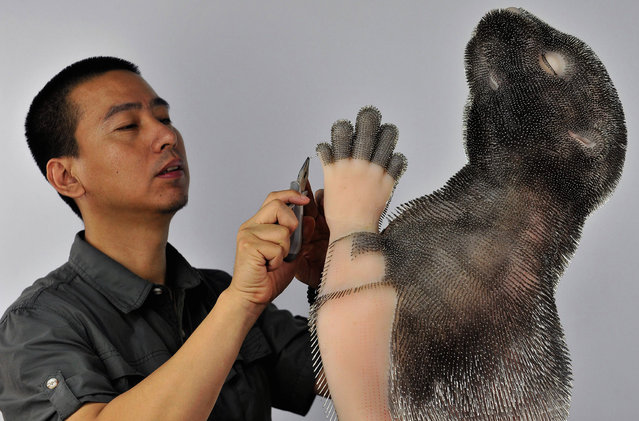
Professor Xie Yong works on an art installation of a beaver, which is made out of plastic and around 300,000 needles, in Shenyang, Liaoning province, July 23, 2013. The needles, according to Xie, represent the pain felt by animals when their fur is taken off to produce clothing. (Photo by Reuters/Stringer)
Miniature spring-wound 35-mm film camera in a modified cigarette pack. The Tessina’s small size and quiet operation provided more options for concealment than most commercially available models. (Photo by Central Intelligence Agency)
Members of the “Avalon” team wearing 14th century knight costumes fight against each other on the bank of the Yenisei River during the regional amateurs tournament of clubs of historical reconstruction, “The Battle of the Nations 2015. Siberia”, in Krasnoyarsk January 24, 2015. (Photo by Ilya Naymushin/Reuters)
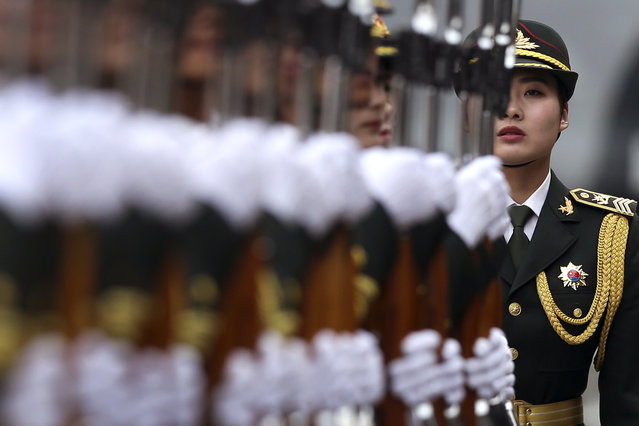
A female Chinese People's Liberation Army soldier looks at members of an honor guard preparing for a welcome ceremony for visiting German President Joachim Gauck, outside the Great Hall of the People in Beijing, Monday, March 21, 2016. (Photo by Andy Wong/AP Photo)
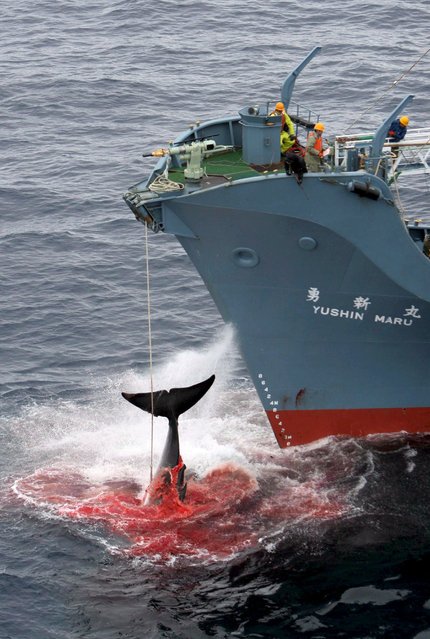
A file photograph dated 07 January 2006 and released by Greenpeace, showing the Yushin Maru, a factory ship in a Japanese whaling fleet, injuring a whale with it's first harpoon attempt. A UN court in The Hague on 31 March 2014 halted Japan's much-criticized whaling programme, ruling that it contravenes a 1986 moratorium on whale hunting. Japan must end its 'research whaling' programme, the International Court of Justice (ICJ) said. Japan said the programme was for scientific research and permitted under international conventions. Australia had brought the case to the ICJ in 2010, charging that Japan was breaching international law by killing hundreds of whales every year for commercial purposes. Japan was “deeply disappointed” by the ruling, an unnamed government official was quoted by the Kyodo News agency as saying. But the official said Japan would stand by the ruling. (Photo by Kate Davison/EPA)