Loading...
Done
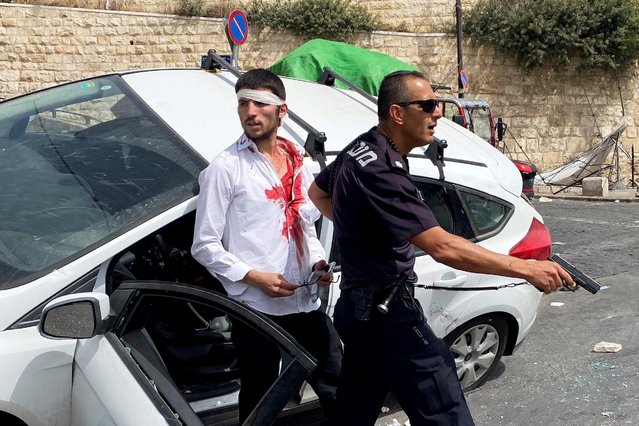
An Israeli police officer holds his weapon as he stands in front of an injured Israeli driver moments after witnesses said his car crashed into a Palestinian on a pavement during stone-throwing clashes near Lion's Gate just outside Jerusalem's Old City on May 10, 2021. (Photo by Ilan Rosenberg/Reuters)

An Israeli police officer holds his weapon as he stands in front of an injured Israeli driver moments after witnesses said his car crashed into a Palestinian on a pavement during stone-throwing clashes near Lion's Gate just outside Jerusalem's Old City on May 10, 2021. (Photo by Ilan Rosenberg/Reuters)
Details
11 May 2021 08:54:00
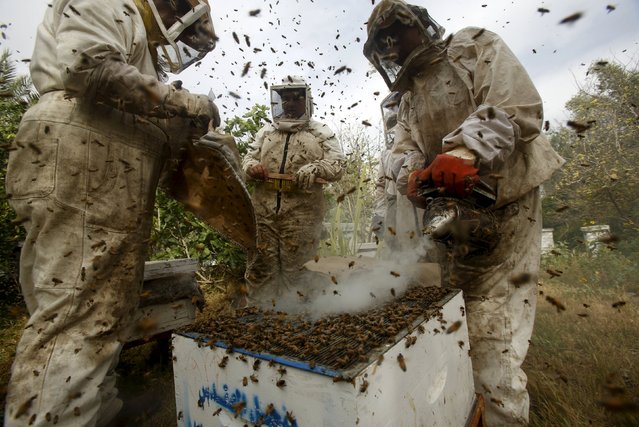
A Palestinian beekeeper uses smoke to calm bees in the process of collecting honey at a farm in Rafah, in the southern Gaza Strip April 11, 2016. (Photo by Suhaib Salem/Reuters)

A Palestinian beekeeper uses smoke to calm bees in the process of collecting honey at a farm in Rafah, in the southern Gaza Strip April 11, 2016. Rateb Samour sees 250 patients a day, whose complaints range from hair loss to cerebral palsy and cancer. He is not a doctor and has never worked in a hospital. Samour inherited the skill of bee-sting therapy from his father. From 2003 the agricultural engineer dedicated all his time to study and develop the alternative-medicine treatment of apitherapy, which uses bee-related products from honey, propolis – or bee glue used to build hives – to venom. (Photo by Suhaib Salem/Reuters)
Details
13 Apr 2016 09:14:00
Members of the NYPD detain protesters from the pro-Palestinian protest encampment and Hamilton Hall where demonstrators barricaded themselves inside on April 30, 2024 in New York City. Police arrested nearly 100 people as they cleared the university of demonstrators who were issued a notice to disband their encampment after negotiations failed to come to a resolution. University President Minouche Shafik has requested the NYPD maintain a presence on campus through at least May 17.(Photo by Stephanie Keith/Getty Images)

Members of the NYPD detain protesters from the pro-Palestinian protest encampment and Hamilton Hall where demonstrators barricaded themselves inside on April 30, 2024 in New York City. Police arrested nearly 100 people as they cleared the university of demonstrators who were issued a notice to disband their encampment after negotiations failed to come to a resolution. University President Minouche Shafik has requested the NYPD maintain a presence on campus through at least May 17.(Photo by Stephanie Keith/Getty Images)
Details
09 May 2024 04:59:00
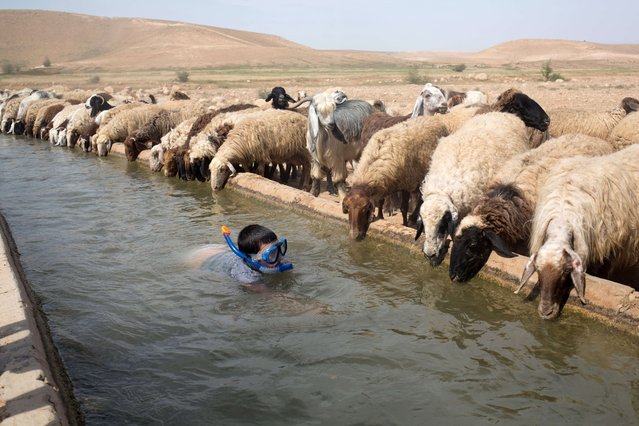
An Israeli boy swims next to sheep belonging to a Palestinian farmer in the West Bank village of Al-Auja in the Jordan Valley on April 8, 2015 during the Jewish Passover holiday. Thousands of Israelis spent the day outdoors, picnicking and touring the country during the eight-day Passover holiday, which commemorates the Israelites' exodus from Egypt some 3,500 years ago. (Photo by Menahem Kahana/AFP Photo)

An Israeli boy swims next to sheep belonging to a Palestinian farmer in the West Bank village of Al-Auja in the Jordan Valley on April 8, 2015 during the Jewish Passover holiday. Thousands of Israelis spent the day outdoors, picnicking and touring the country during the eight-day Passover holiday, which commemorates the Israelites' exodus from Egypt some 3,500 years ago. (Photo by Menahem Kahana/AFP Photo)
Details
11 Apr 2015 10:59:00
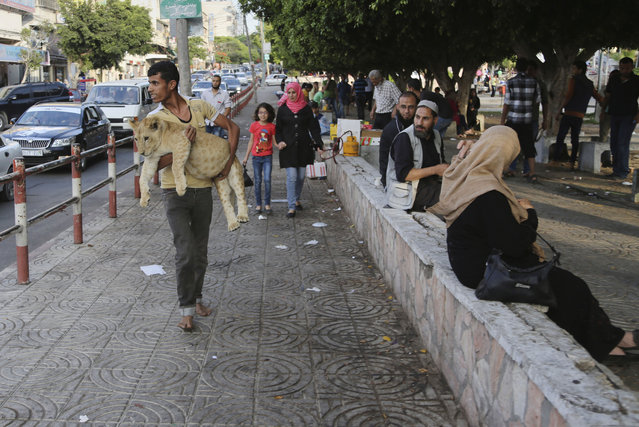
In this Monday, June 15, 2015 photo, Ahmad Abu Jereda, 16, carries Max, the male lion cub, as he passes by Palestinians at the main garden in Gaza City, in the northern Gaza Strip. (Photo by Adel Hana/AP Photo)

In this Monday, June 15, 2015 photo, Ahmad Abu Jereda, 16, carries Max, the male lion cub, as he passes by Palestinians at the main garden in Gaza City, in the northern Gaza Strip. A pair of lion cubs are stuck at a Gaza-Israel border crossing en route to a Jordan animal sanctuary, after being kept for a year by a family in crowded Gaza. Saduldin al-Jamal had bought the cubs from the Gaza zoo, hit during last summer's Israel-Hamas war. His family would take them to parks or the beach and children – those brave enough – would come up to pet them. (Photo by Adel Hana/AP Photo)
Details
04 Jul 2015 11:07:00
Palestinian barber Ramadan Odwan styles and straightens the hair of a customer with fire at his salon in Rafah, in the southern Gaza Strip February 2, 2017. In Ramadan Odwan's barbershop in Gaza, hair isn't just blow-dried, it's blowtorch-dried. “People have gone crazy about it, many people are curious to go through the experience and they are not afraid”, he told Reuters. “People here love adventures”. Odwan, 37, is not the first stylist in the world to use flame to straighten hair, but his craft is unique in the Gaza Strip. In his salon in the southern Gaza town of Rafah, Odwan applied what he described as a protective liquid coating to a customer's hair – he declined to disclose its contents – before aiming for the head and pressing the button on a small blowtorch. “I control how long I apply fire, I keep it on and off for 10 seconds or 15 seconds. It is completely safe and I have not encountered any accident since I started it two months ago”, Odwan added. Odwan charges 20 shekels ($5.20) for a haircut and fire-straightening. A barber for the past 18 years, he said part of the reason he uses the technique is to show that Palestinian barbers are as “professional as those out there around the world”. (Photo by Ibraheem Abu Mustafa/Reuters)

Palestinian barber Ramadan Odwan styles and straightens the hair of a customer with fire at his salon in Rafah, in the southern Gaza Strip February 2, 2017. In Ramadan Odwan's barbershop in Gaza, hair isn't just blow-dried, it's blowtorch-dried. “People have gone crazy about it, many people are curious to go through the experience and they are not afraid”, he told Reuters. “People here love adventures”. (Photo by Ibraheem Abu Mustafa/Reuters)
Details
11 Feb 2017 00:05:00
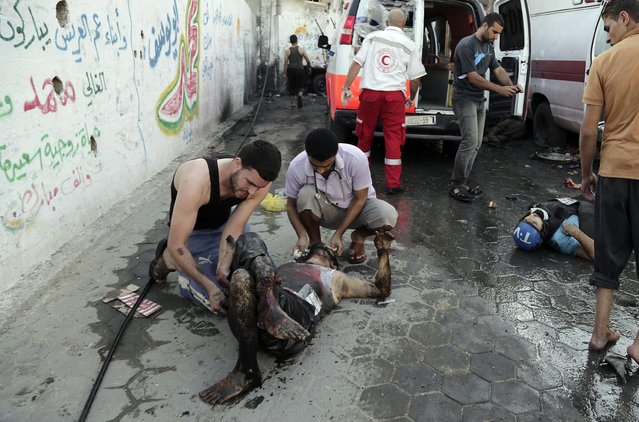
In this July 30, 2014 photo, neighbors help gravely injured Mohammed al-Selek, 39, wounded by an Israeli mortar strike as he lays next to the body of Palestinian journalist Rami Reyan who was killed, in the Shijaiyah neighborhood of the northern Gaza Strip. Al-Selek's life changed forever last July 30, when the shells slammed into his home killing all his three children, his father and six other relatives. (Photo by Adel Hana/AP Photo)

In this July 30, 2014 photo, neighbors help gravely injured Mohammed al-Selek, 39, wounded by an Israeli mortar strike as he lays next to the body of Palestinian journalist Rami Reyan who was killed, in the Shijaiyah neighborhood of the northern Gaza Strip. Al-Selek's life changed forever last July 30, when the shells slammed into his home killing all his three children, his father and six other relatives. A year later, al-Selek, who lost his leg during the airstrike, still struggles to recover and come to terms with his family's loss in the 50-day Israel-Hamas war. (Photo by Adel Hana/AP Photo)
Details
07 Jul 2015 11:28:00
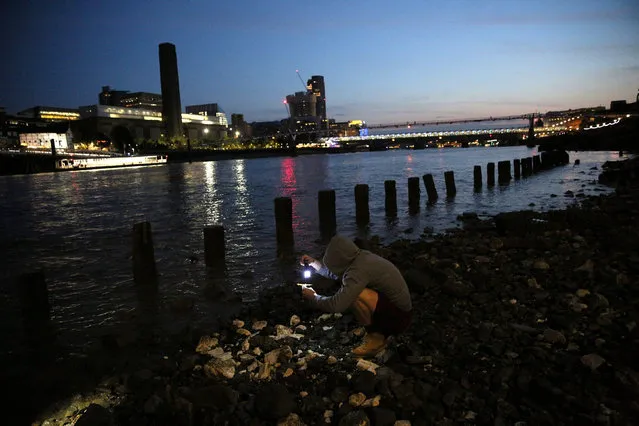
A mudlark uses a torch to look for items on the bank of the River Thames in London, Britain June 06, 2016. Mudlarking is believed to trace its origins to the 18th and 19th century, when scavengers searched the Thames' shores for items to sell. These days, history and archaeology fans are the ones hoping to find old relics such as coins, ceramics, artifacts or everyday items from across centuries. They wait for the low tide and then scour specific areas of exposed shores. "If you're in a field you could be out all day long, with the river you're restricted to about two or three hours," mudlark Nick Stevens said. While many just use the naked eye for their searches, others rely on metal detectors for which a permit from the Port of London Authority is needed. Digging also requires consent. (Photo by Neil Hall/Reuters)

A mudlark uses a torch to look for items on the bank of the River Thames in London, Britain June 06, 2016. Mudlarking is believed to trace its origins to the 18th and 19th century, when scavengers searched the Thames' shores for items to sell. These days, history and archaeology fans are the ones hoping to find old relics such as coins, ceramics, artifacts or everyday items from across centuries. their finds with the Portable Antiquities Scheme. Any item over 300 years old must be recorded. (Photo by Neil Hall/Reuters)
Details
27 Aug 2016 10:43:00