Loading...
Done
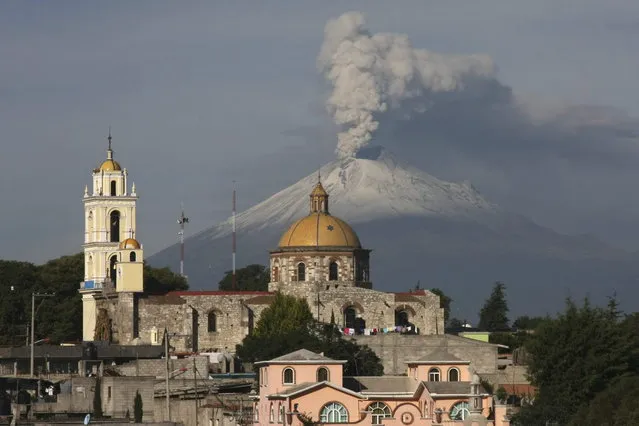
The main church in the town of San Damian Texoloc, Mexico stands in front of the Popocatepetl volcano as is spews ash and vapor early Tuesday, July 9, 2013. Last Saturday, Mexico's National Center for Disaster Prevention raised the volcano alert from Stage 2 Yellow to Stage 3 Yellow, the final step before a Red alert, when possible evacuations could be ordered after the Popocatepetl volcano spit out a cloud of ash and vapor 2 miles (3 kilometers) high over several days of eruptions. (Photo by J. Guadalupe Perez/AP Photo)

The main church in the town of San Damian Texoloc, Mexico stands in front of the Popocatepetl volcano as is spews ash and vapor early Tuesday, July 9, 2013. Last Saturday, Mexico's National Center for Disaster Prevention raised the volcano alert from Stage 2 Yellow to Stage 3 Yellow, the final step before a Red alert, when possible evacuations could be ordered after the Popocatepetl volcano spit out a cloud of ash and vapor 2 miles (3 kilometers) high over several days of eruptions. (Photo by J. Guadalupe Perez/AP Photo)
Details
10 Jul 2013 08:45:00
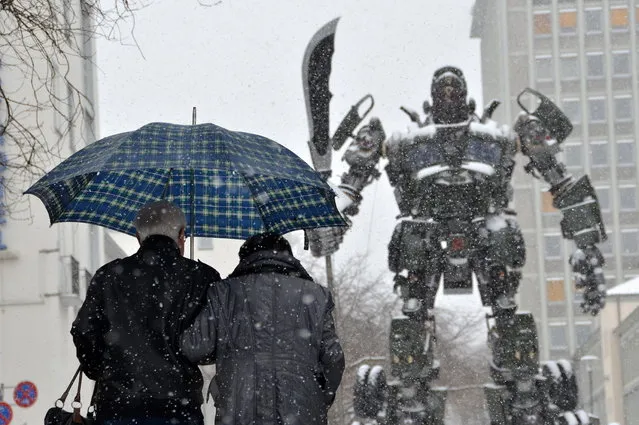
A couple passes the sculpture “Transformer” by Chinese artist Bi Heng during snowfall  in Kassel, central Germany, Tuesday March 12, 2013.  Frankfurt airport closed, a quarter of flights out of Paris were canceled, Belgium suffered record traffic jams and high-speed trains were stuck in stations – all because of a sudden dump of oddly late snowfall on Western Europe.   Less prepared for the kind of heavy snow that regularly hits northern and eastern neighbors, France, Britain and Belgium struggled Tuesday to keep moving amid the frosty, blustery conditions. (Photo by Uwe Zucchi/AP Photo/Dpa)

A couple passes the sculpture “Transformer” by Chinese artist Bi Heng during snowfall in Kassel, central Germany, Tuesday March 12, 2013. Frankfurt airport closed, a quarter of flights out of Paris were canceled, Belgium suffered record traffic jams and high-speed trains were stuck in stations – all because of a sudden dump of oddly late snowfall on Western Europe. Less prepared for the kind of heavy snow that regularly hits northern and eastern neighbors, France, Britain and Belgium struggled Tuesday to keep moving amid the frosty, blustery conditions. (Photo by Uwe Zucchi/AP Photo/Dpa)
Details
14 Mar 2013 13:46:00
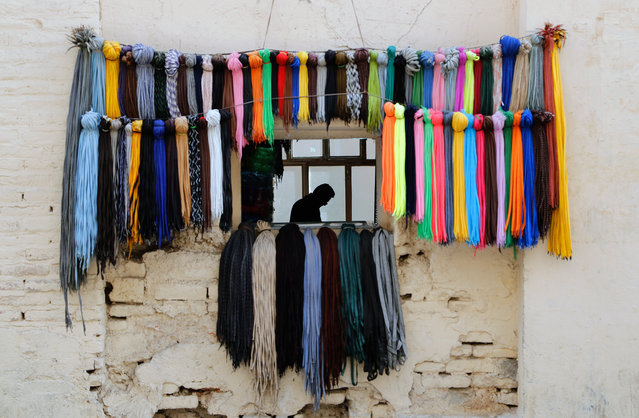
An Iranian man sells colorful ropes at  the Tehrans old Bazaar, the place where the main economy trades take place, in Tehran, Iran, 25 January 2016. Reports state that Iranian officials expected the Iranian economy to grow on an average of eight percent over the coming five years following the lifting of sanctions against Iran. (Photo by Abedin Taherkenareh/EPA)

An Iranian man sells colorful ropes at the Tehrans old Bazaar, the place where the main economy trades take place, in Tehran, Iran, 25 January 2016. Reports state that Iranian officials expected the Iranian economy to grow on an average of eight percent over the coming five years following the lifting of sanctions against Iran. (Photo by Abedin Taherkenareh/EPA)
Details
02 Feb 2016 12:53:00
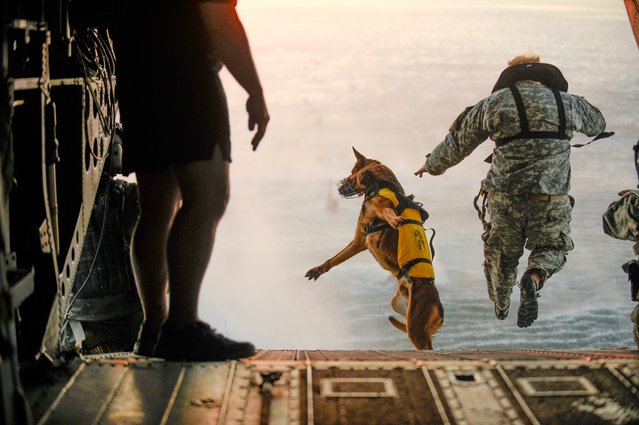
A U.S. Army soldier with the 10th Special Forces Group and his military working dog jump off the ramp of a CH-47 Chinook helicopter from the 160th Special Operations Aviation Regiment during water training over the Gulf of Mexico as part of exercise Emerald Warrior 2011 on March 1, 2011. (Photo by Tech. Sgt. Manuel J. Martinez/U.S. Air Force)

A U.S. Army soldier with the 10th Special Forces Group and his military working dog jump off the ramp of a CH-47 Chinook helicopter from the 160th Special Operations Aviation Regiment during water training over the Gulf of Mexico as part of exercise Emerald Warrior 2011 on March 1, 2011. (Photo by Tech. Sgt. Manuel J. Martinez/U.S. Air Force)
Details
05 Mar 2016 11:52:00
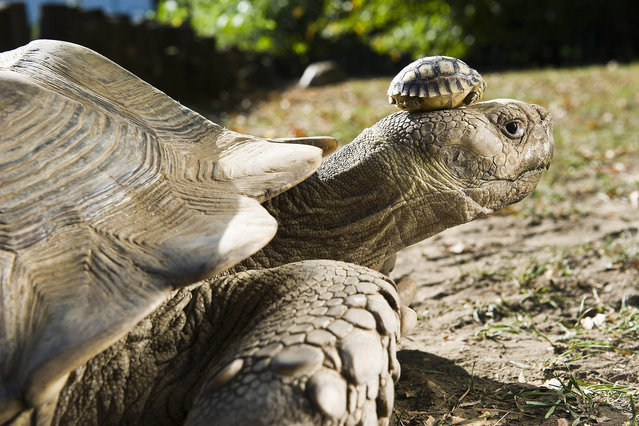
A four-day old African spurred tortoise, Geochelone sulcata, one of eight babies, was place on the head of its mother in their enclosure in Nyiregyhaza Animal Park in Nyiregyhaza, 226 km east of Budapest, Hungary, 27 September 2011. This was the first time that offspring of an African spurred tortoise were born in this zoo. The eight babies hatched after 115 days, they are 5.5 cms long and weigh 25 grams. Spurred tortoise is the largest species of land tortoises in Africa, the weight of an adult animal may reach 80 kgs. (Photo by Attila Balazs/EPA)

A four-day old African spurred tortoise, Geochelone sulcata, one of eight babies, was place on the head of its mother in their enclosure in Nyiregyhaza Animal Park in Nyiregyhaza, 226 km east of Budapest, Hungary, 27 September 2011. This was the first time that offspring of an African spurred tortoise were born in this zoo. The eight babies hatched after 115 days, they are 5.5 cms long and weigh 25 grams. Spurred tortoise is the largest species of land tortoises in Africa, the weight of an adult animal may reach 80 kgs. (Photo by Attila Balazs/EPA)
Details
07 May 2016 12:58:00
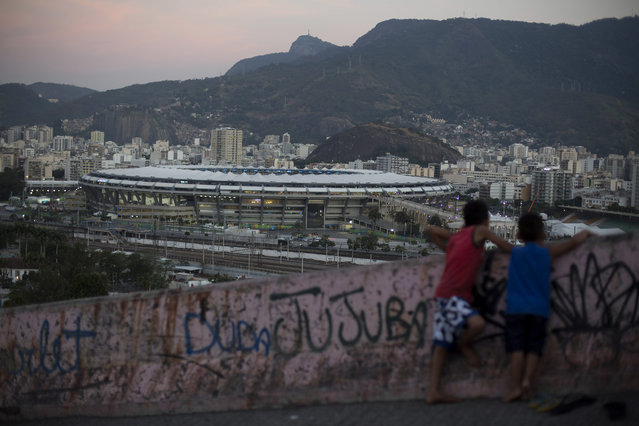
Two boys look out from the Mangueira slum towards the Maracana Stadium that is hosting the Rio's 2016 Summer Olympics opening ceremonies, in Rio de Janeiro, Brazil, Friday, August 5, 2016. (Photo by Leo Correa/AP Photo)

Two boys look out from the Mangueira slum towards the Maracana Stadium that is hosting the Rio's 2016 Summer Olympics opening ceremonies, in Rio de Janeiro, Brazil, Friday, August 5, 2016. (Photo by Leo Correa/AP Photo)
Details
07 Aug 2016 09:13:00
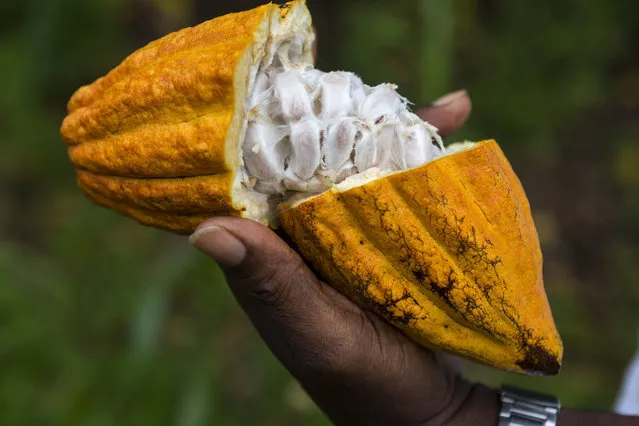
Farmer holding a freshly cut cocoa bean pod, revealing the pulp and seed inside on a rainforest farm. (Photo by Doug McKinlay/Getty Images)

Chocolate is the greatest gift the Earth has given us. The dessert table would be a sad sight without it. It’s so beloved, so appreciated, that the Swedish scientist who named the cocoa plant that gives us chocolate called it Theobroma cacao, which means “food of the gods”. Here: Farmer holding a freshly cut cocoa bean pod, revealing the pulp and seed inside on a rainforest farm. (Photo by Doug McKinlay/Getty Images)
Details
10 Aug 2016 10:20:00
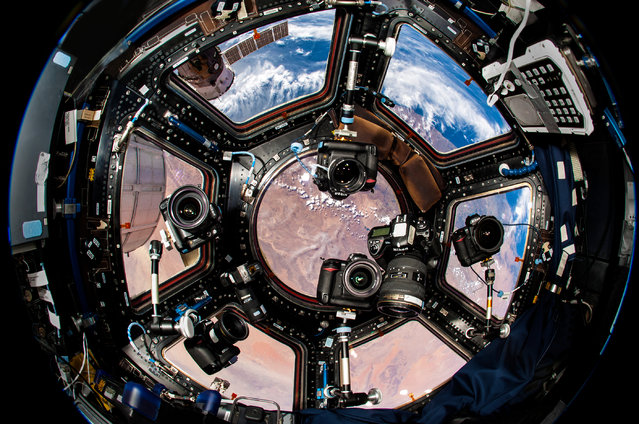
Astronaut Donald R. Pettit would often rig an array of as many as six cameras in the cupola windows and set them all to fire continuously for events such as sunsets, which only last around seven seconds on the ISS. (Photo by Donald R. Pettit)

Astronaut Donald R. Pettit would often rig an array of as many as six cameras in the cupola windows and set them all to fire continuously for events such as sunsets, which only last around seven seconds on the ISS. (Photo by Donald R. Pettit)
Details
05 Sep 2016 11:34:00