Loading...
Done
The following “Utopian Tours” drawings are conceptual images of what tourism in North Korea might one day look like, created by North Korean architects. The images, curated by Nick Bonner, are on view as part of the exhibition at the Venice Architecture Biennale in the Korean Pavilion. Bonner runs the Beijing-based Koryo Tours – a company that organizes tours of outsiders into North Korea. (Photo by Nick Bonner/Kyle Vanhemert/Venice Architecture Biennale)

At this year’s Venice Bienniale in Italy, the Korean pavilion has a curious exhibit called “Commissions for Utopia”. It includes renderings from North Korea’s top architects and artists (all anonymous), many of whom studied at the Paekho Institute of Architecture, North Korea’s state-run architectural college, and none of whom have ever left the country. They were asked to create a vision of North Korea’s future sustainable architecture for its expanding tourism industry. Their final products are a glimpse into what it would be like to envision the future after being entirely cut off from the present for almost 70 years. (Photo by Nick Bonner/Kyle Vanhemert/Venice Architecture Biennale)
Details
08 Aug 2014 11:03:00
Filipino beauty candidates hide from the sun before a group photo during the media presentation of the Miss Philippines Earth 2017 held at a hotel in Manila, Philippines, 05 July 2017. A total of 40 environmentally aware and concerned Filipino young ladies will compete to represent the Philippines at the Miss Earth beauty pageant. Miss Earth is a pioneering beauty pageant that serves as a vehicle for environmental advocacy. (Photo by Mark R. Cristino/EPA)

Filipino beauty candidates hide from the sun before a group photo during the media presentation of the Miss Philippines Earth 2017 held at a hotel in Manila, Philippines, 05 July 2017. A total of 40 environmentally aware and concerned Filipino young ladies will compete to represent the Philippines at the Miss Earth beauty pageant. Miss Earth is a pioneering beauty pageant that serves as a vehicle for environmental advocacy. (Photo by Mark R. Cristino/EPA)
Details
06 Jul 2017 09:31:00
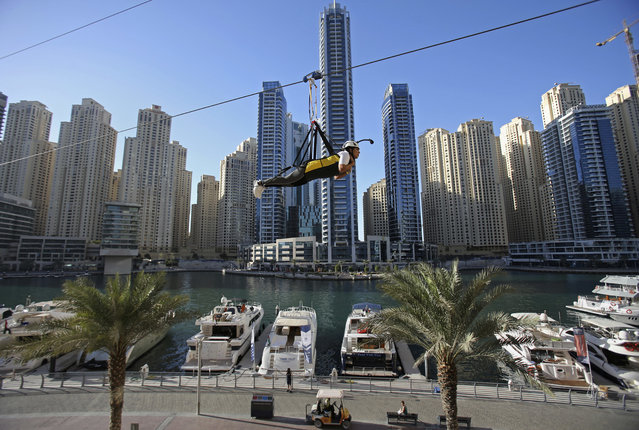
A woman rides the world's longest urban zip line, with a speed of up to 80 kilometers per hour on a one kilometer run from 170 meter to ground level, in the Marina district of Dubai, United Arab Emirates, Tuesday, December 5, 2017. (Photo by Kamran Jebreili/AP Photo)

A woman rides the world's longest urban zip line, with a speed of up to 80 kilometers per hour on a one kilometer run from 170 meter to ground level, in the Marina district of Dubai, United Arab Emirates, Tuesday, December 5, 2017. (Photo by Kamran Jebreili/AP Photo)
Details
06 Dec 2017 07:36:00
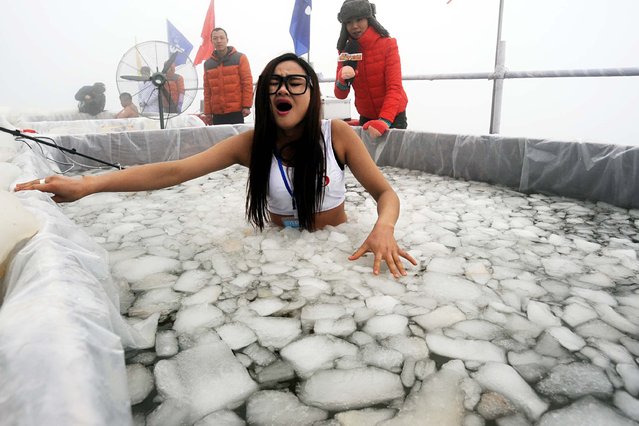
This picture taken on January 25, 2015 shows a participant taking part in an ice water challenge in Zhangjiajie, central China's Hunan province. Participants were required to stay in an ice pond, holding an ice block while eating ice-cream with an electric fan blowing at them. (Photo by AFP Photo/Stringer)

This picture taken on January 25, 2015 shows a participant taking part in an ice water challenge in Zhangjiajie, central China's Hunan province. Participants were required to stay in an ice pond, holding an ice block while eating ice-cream with an electric fan blowing at them. (Photo by AFP Photo/Stringer)
Details
31 Jan 2015 12:58:00
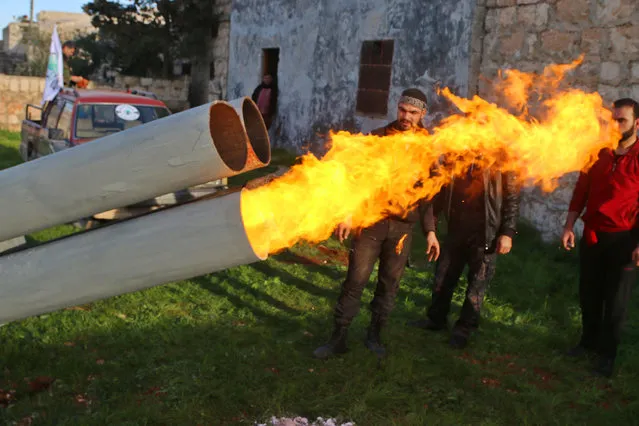
Al-Shamiyah Front fighters inspect a new locally-made cannon named “Borkan” (Volcano) as it was being launched towards forces loyal to Syria's president Bashar Al-Assad located in Aleppo artillery school, March 7, 2015. The “Borkan” is made out of four tubes attached to a loader, which can fire four shells at a time, and have a range of three kilometers (1.86 miles). (Photo by Abdalrhman Ismail/Reuters)

Al-Shamiyah Front fighters inspect a new locally-made cannon named “Borkan” (Volcano) as it was being launched towards forces loyal to Syria's president Bashar Al-Assad located in Aleppo artillery school, March 7, 2015. The “Borkan” is made out of four tubes attached to a loader, which can fire four shells at a time, and have a range of three kilometers (1.86 miles). (Photo by Abdalrhman Ismail/Reuters)
Details
24 Mar 2015 10:11:00
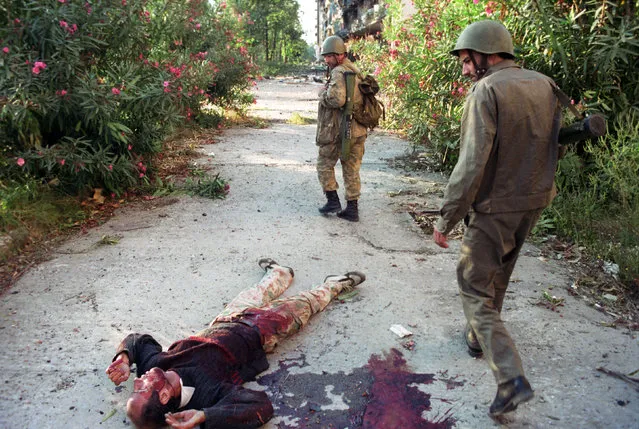
Abkhazia. Sukhumi, 1993. A house-to-house combat. (Photo by Andrei Solovyov/ITAR-TASS)

The War in Abkhazia from 1992 to 1993 was fought between Georgian government forces for the most part, and Abkhaz separatist forces, Russian armed forces and North Caucasian militants. Ethnic Georgians who lived in Abkhazia fought largely on the side of Georgian government forces. Ethnic Armenians and Russians within Abkhazia's population largely supported the Abkhazians, and many fought on their side. The separatists received support from thousands of North Caucasus and Cossack militants and from the Russian Federation forces stationed in and near Abkhazia. Here: Abkhazia. Sukhumi, 1993. A house-to-house combat. (Photo by Andrei Solovyov/ITAR-TASS)
Details
29 Sep 2017 07:31:00
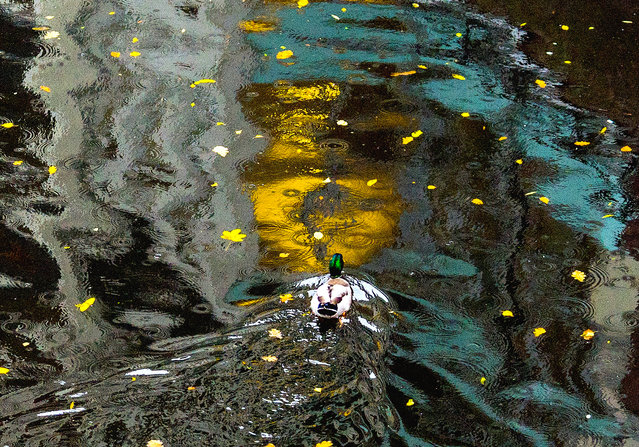
A duck swims in a Osterbekkanal during a the rainy autumn afternoon, central Hamburg, Germany 20 November 2017. (Photo by Srdjan Suki/EPA/EFE)

A duck swims in a Osterbekkanal during a the rainy autumn afternoon, central Hamburg, Germany 20 November 2017. (Photo by Srdjan Suki/EPA/EFE)
Details
15 Mar 2018 00:03:00
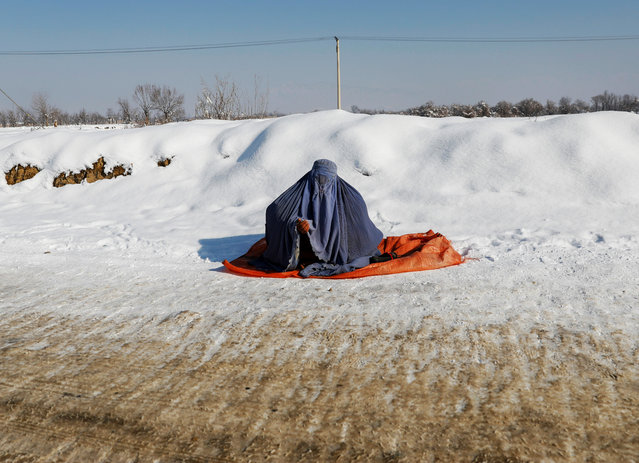
An Afghan woman clad in burqa begs in a snow-covered street in Kabul, Afghanistan on January 7, 2020. (Photo by Mohammad Ismail/Reuters)

An Afghan woman clad in burqa begs in a snow-covered street in Kabul, Afghanistan on January 7, 2020. (Photo by Mohammad Ismail/Reuters)
Details
16 Jan 2020 00:01:00