Women atop a boat take a group photo as the U.S. Navy’s Flight Demonstration Squadron’s Blue Angels perform in the skies over Annapolis, Maryland, on May 22, 2024. (Photo by Kevin Lamarque/Reuters)
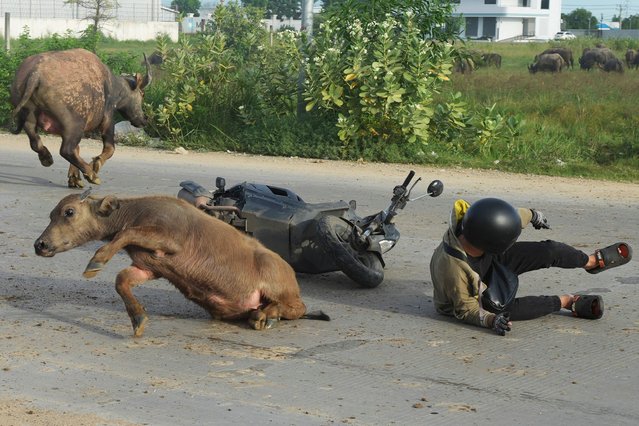
A man falls from his motorcycle after hitting a water buffalo on his way to work outside Phnom Penh, Cambodia, Friday, September 6, 2024. Cambodian animal owners have been warned to keep their animals, which often cause traffic accidents, leashed and could face prison time if relatives of those who die or are injured in such accidents initiate legal proceedings. (Photo by Heng Sinith/AP Photo)
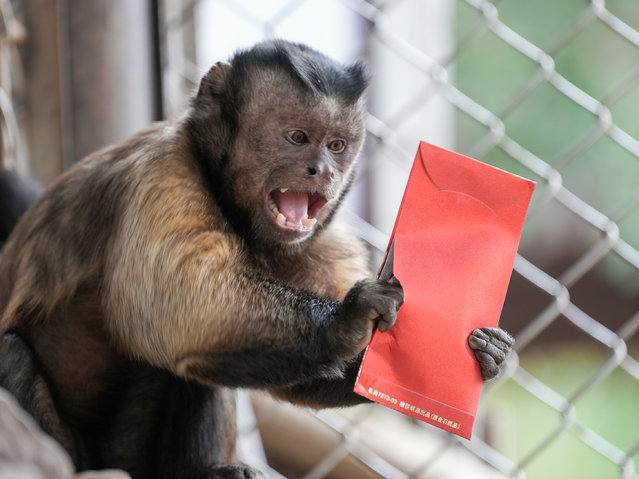
Tufted capuchin (Sapajus apella) receives a special red envelope containing delicious food to celebrate Chinese New Year at the Chongqing Zoo on January 28, 2025 in Chongqing, China. (Photo by Wang Chengjie/VCG via Getty Images)
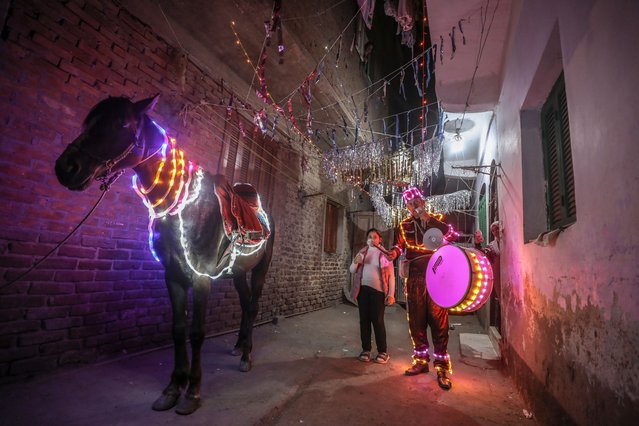
Mohammed Al-Dahshan, who decorates himself and his horse with led lights, performs the Ramadan drumming on the north of the Egyptian capital Cairo on March 20, 2025. Al-Dahshan and his horse hit the road at sahur (Ramadan meal eaten at night) time, wandering the streets of Dekernes region every night during Ramadan and waking people up for sahur. (Photo by Mohamed Elshahed/Anadolu via Getty Images)
Women dressed in traditional attire participate in a procession to mark Gudi Padwa or the Marathi New Year in Mumbai, India, Sunday, March 30, 2025. (Photo by Rajanish Kakade/AP Photo)
Horse riding along the beach at Frinton-on-Sea in Essex, UK on Sunday, November 30, 2025 as the sun was setting, Becky James riding Ayla. Photo by Kevin Jay/Picture Exclusive)
A model presents a creation during a catwalk presentation for the Paul Costelloe Spring/Summer 2024 collection, at London Fashion Week in London, on September 13, 2024. (Photo by Henry Nicholls/AFP Photo)
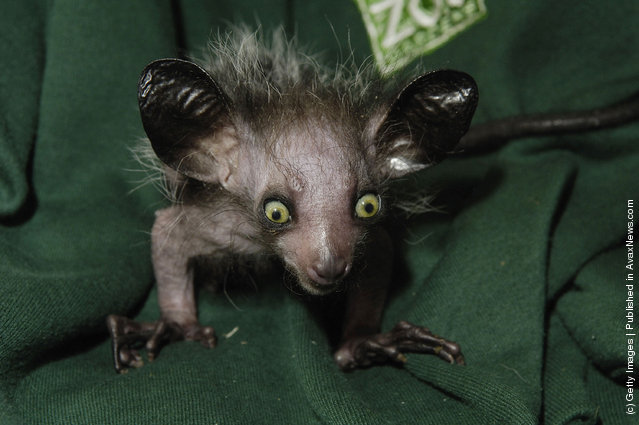
“The aye-aye (Daubentonia madagascariensis) is a lemur, a strepsirrhine primate native to Madagascar that combines rodent-like teeth and a special thin middle finger to fill the same ecological niche as a woodpecker. It is the world's largest nocturnal primate, and is characterized by its unusual method of finding food; it taps on trees to find grubs, then gnaws holes in the wood and inserts its narrow middle finger to pull the grubs out. The only other animal species known to find food in this way is the striped possum. From an ecological point of view the aye-aye fills the niche of a woodpecker as it is capable of penetrating wood to extract the invertebrates within”. – Wikipedia
Photo: In this handout image from Bristol Zoo is seen the first captive bred aye-aye in the UK named “Kintana” (meaning star in Malagasy) April 15, 2005 at Bristol Zoo Gardens, England. The zoo announced today only the second baby aye-aye to be hand-reared in the world (the first was in Jersey Zoo) and has now made his first public appearance since his birth on 11 February 2005. (Photo by Rob Cousins/Bristol Zoo via Getty Images)