A model wears a creation for Schiaparelli's Haute Couture Spring-Summer 2024 collection presented in Paris, Monday, January 22, 2024. (Photo by Christophe Ena/AP Photo)
Naruemol Thonglek, right, with her daughter, waits for news of her partner, who is missing after the collapse of an under-construction high-rise building after an earthquake in Bangkok, Thailand, Monday, March, 31, 2025. (Photo by Manish Swarup/AP Photo)
A woman holds her dog to be blessed by a priest at the Cathedral San Bernardino de Siena during the ceremony commemorating the Feast of San Antonio Abad, the patron saint of domestic animals, in Xochimilco on the outskirts of Mexico City, Mexico on January 17, 2024. (Photo by Raquel Cunha/Reuters)
Big wave surfers on their jet skis in front of a surf of a huge wave on the rock of Sao Miguel Arcanjo fort and Nazare lighthouse during a surfing session at Praia do Norte on January 27, 2025 in Nazare, Portugal. (Photo by Stefan Matzke - sampics/Corbis via Getty Images)
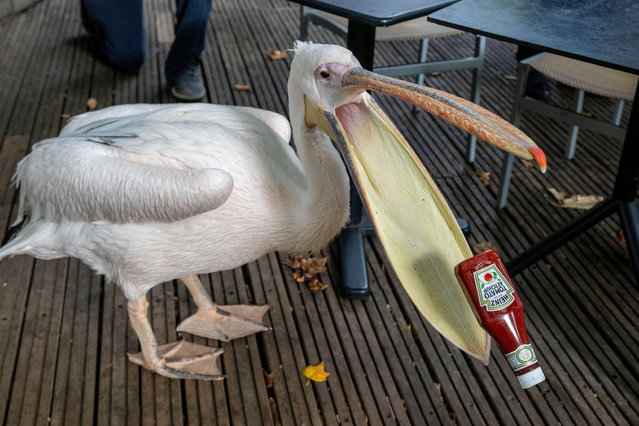
A pelican investigates a fallen ketchup bottle outside a cafe in St James’s Park in London, England on October 9, 2025. The species has lived there for hundreds of years and remain a popular sight for visitors. Introduced in 1664 as a gift from the Russian ambassador, about 40 pelicans have since made the park their home. The bottle was safely retrieved from the pelican. (Photo by Stephen Chung/Alamy Live News)
Spencer Slate, costumed as a scuba-diving Easter bunny, is shown in this handout photo provided by the Florida Keys News Bureau as he hides eggs amid eel grass, in the Florida Keys National Marine Sanctuary off Key Largo, Florida March 31, 2013. About 80 adults and children participated in an Underwater Easter Egg Hunt, seeking real hard-boiled eggs painted with non-toxic food coloring to avoid adverse effects on the marine ecosystem. (Photo by Bob Care/Reuters/Florida Keys News Bureau)
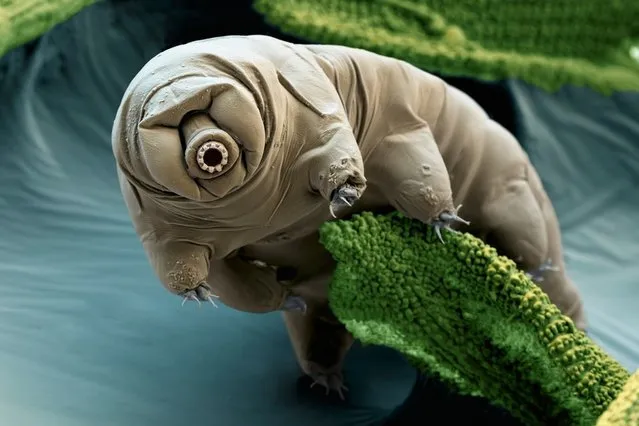
“Tardigrades (commonly known as waterbears or moss piglets) are small, water-dwelling, segmented animals with eight legs. Tardigrades were first discovered in 1773 by Johann August Ephraim Goeze, who called them kleiner Wasserbär, meaning “little water bear” in German. The name Tardigrada means “slow walker” and was given by Lazzaro Spallanzani in 1777. The name water bear comes from the way they walk, reminiscent of a bear's gait. The biggest adults may reach a body length of 1.5 millimetres (0.059 in), the smallest below 0.1 mm. Freshly hatched tardigrades may be smaller than 0.05 mm”. – Wikipedia. Photo: Tardigrades. (Photo by SPL/East News)