Loading...
Done
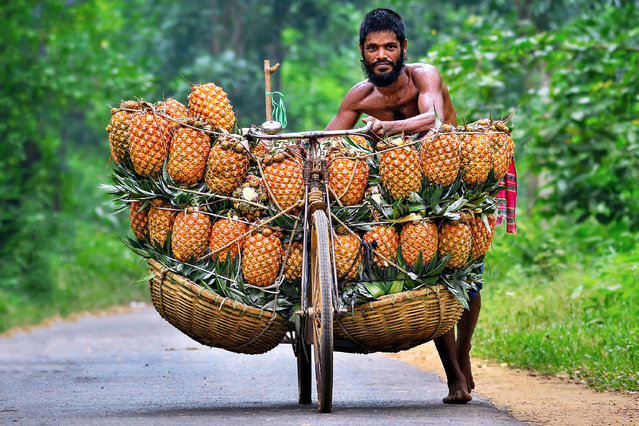
Cyclists desperately try to keep their heavily-laden bicycles upright as they arrive at a market with baskets full of pineapples on August 23, 2018. The men travel up to 12 and a half miles with two baskets tied to the sides of their bikes, carrying between 50 and 100 pineapples to sell. Each of the bicycles is so heavily laden with fruit it is impossible for the men to actually ride their bikes, instead having to walk alongside them. When they arrive at the market place in Madhupur, Bangladesh, buyers will pay up to 30 Taka for a pineapple – the equivalent of around 28 pence. (Photo by Abdul Momin/Solent News & Photo Agency UK)

Cyclists desperately try to keep their heavily-laden bicycles upright as they arrive at a market with baskets full of pineapples on August 23, 2018. The men travel up to 12 and a half miles with two baskets tied to the sides of their bikes, carrying between 50 and 100 pineapples to sell. Each of the bicycles is so heavily laden with fruit it is impossible for the men to actually ride their bikes, instead having to walk alongside them. When they arrive at the market place in Madhupur, Bangladesh, buyers will pay up to 30 Taka for a pineapple – the equivalent of around 28 pence. (Photo by Abdul Momin/Solent News & Photo Agency UK)
Details
21 Sep 2018 00:03:00
Camels kick up clouds of sand as they race down a steep dune. The camels can reach speeds of up to 40 kilometres per hour as they descend the ten-metre tall dunes on April 20, 2022. The photos were taken by photographer Qian Guo in Naiman Banner, near the city of Tongliao in the Inner Mongolia region of northeastern China. The 58 year old said: “These are local Mongolian farmers, and two of them are a father and a son. They have more than ten camels which they farm and train”. (Photo by Qian Guo/Solent News & Photo Agency)

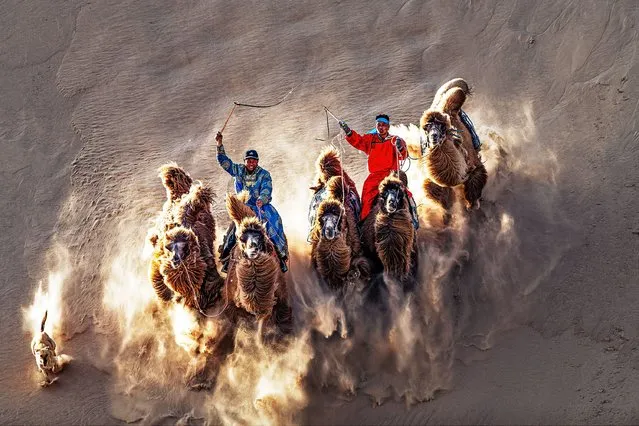
Camels kick up clouds of sand as they race down a steep dune. The camels can reach speeds of up to 40 kilometres per hour as they descend the ten-metre tall dunes on April 20, 2022. The photos were taken by photographer Qian Guo in Naiman Banner, near the city of Tongliao in the Inner Mongolia region of northeastern China. The 58 year old said: “These are local Mongolian farmers, and two of them are a father and a son. They have more than ten camels which they farm and train”. (Photo by Qian Guo/Solent News & Photo Agency)
Details
25 Apr 2022 04:34:00
The sea otter mother with her three day old newborn pup ontop of her to keep it dry and warm while it sleeps. This devoted mother otter kept her newborn pup dry as she let the baby ride on her belly. Nature photographer Suzi Eszterhas, 40, spotted the adorable pair of southern sea otters swimming in Monterey Bay, California. The mother lifted the pup out of the water and on to her belly to keep it warm and dry and also blew air into the pup's fur to groom it. Ms Eszterhas was shocked to see the otters come closer to where she was standing and the mother left her child to float alone in the water. (Photo by Suzi Eszterhas/Minden Pictures/Solent News & Photo Agency)

The sea otter mother with her three day old newborn pup ontop of her to keep it dry and warm while it sleeps. This devoted mother otter kept her newborn pup dry as she let the baby ride on her belly. Nature photographer Suzi Eszterhas, 40, spotted the adorable pair of southern sea otters swimming in Monterey Bay, California. The mother lifted the pup out of the water and on to her belly to keep it warm and dry and also blew air into the pup's fur to groom it. Ms Eszterhas was shocked to see the otters come closer to where she was standing and the mother left her child to float alone in the water. (Photo by Suzi Eszterhas/Minden Pictures/Solent News & Photo Agency)
Details
30 Oct 2016 10:44:00
Barrier tape is tied around 15-month-old Shivani's ankle to prevent her from running away, while her mother Sarta Kalara works at a construction site nearby, in Ahmedabad, India, April 19, 2016. Kalara says she has no option but to tether her daughter Shivani to a stone despite her crying, while she and her husband work for 250 rupees ($3.8) each a shift digging holes for electricity cables in the city of Ahmedabad. There are about 40 million construction workers in India, at least one in five of them women, and the majority poor migrants who shift from site to site, building infrastructure for India's booming cities. Across the country it is not uncommon to see young children rolling in the sand and mud as their parents carry bricks or dig for new roads or luxury houses. (Photo by Amit Dave/Reuters)

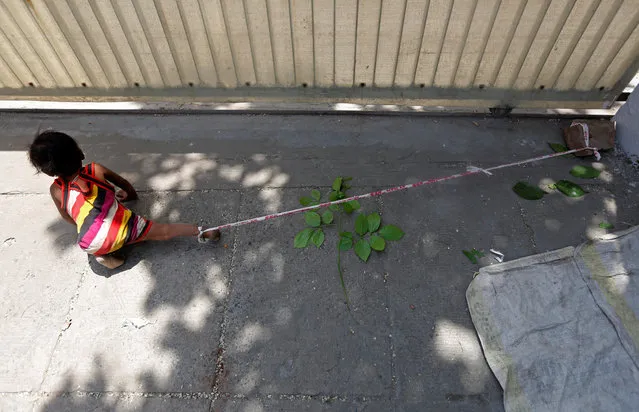
Barrier tape is tied around 15-month-old Shivani's ankle to prevent her from running away, while her mother Sarta Kalara works at a construction site nearby, in Ahmedabad, India, April 19, 2016. Kalara says she has no option but to tether her daughter Shivani to a stone despite her crying, while she and her husband work for 250 rupees ($3.8) each a shift digging holes for electricity cables in the city of Ahmedabad. There are about 40 million construction workers in India, at least one in five of them women, and the majority poor migrants who shift from site to site, building infrastructure for India's booming cities. Across the country it is not uncommon to see young children rolling in the sand and mud as their parents carry bricks or dig for new roads or luxury houses. (Photo by Amit Dave/Reuters)
Details
14 Dec 2016 07:39:00
From Britain to China to Mali, new maps showing travel times to the nearest urban centre reveal huge differences between countries. Using Open Street Map and Google, a University of Oxford team have created a visual breakdown that suggests major inequalities when it comes to commuting. Here: China. The dataset used for China was unique as it relied solely on Open Street Map, due to restrictions on accessing Google data. The population is densely concentrated in the east and accessibility is increased, whereas rural provinces in the west remain remote. (Photo by Daniel Weiss/Jennifer Rozier/Malaria Atlas Project/University of Oxford )

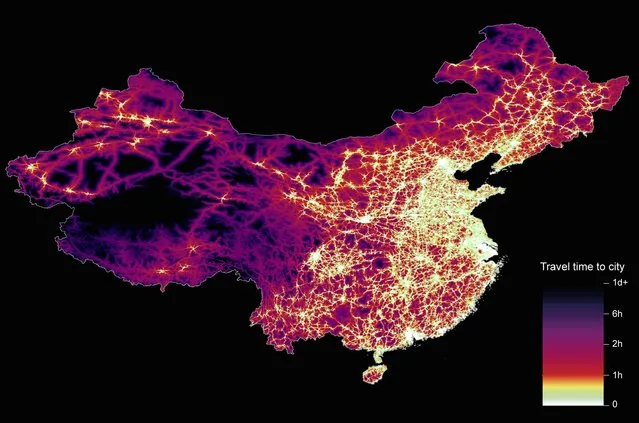
From Britain to China to Mali, new maps showing travel times to the nearest urban centre reveal huge differences between countries. Using Open Street Map and Google, a University of Oxford team have created a visual breakdown that suggests major inequalities when it comes to commuting. Here: China. The dataset used for China was unique as it relied solely on Open Street Map, due to restrictions on accessing Google data. The population is densely concentrated in the east and accessibility is increased, whereas rural provinces in the west remain remote. (Photo by Daniel Weiss/Jennifer Rozier/Malaria Atlas Project/University of Oxford)
Details
12 Jan 2018 06:43:00
Mayon Volcano spews ash and lava in the town of Daraga, Albay province, Philippines, 25 January 2018. Mayon volcano located in eastern Philippines and active over the last 10 days spewed fresh lava and ash while the number of evacuees exceeded 60 thousand in the face of the threat of an even more potent explosion. The Philippines, which currently has 23 active volcanoes, is situated on the so-called 'Pacific Ring of Fire', an area known for its intense seismic activity which extends from the west coast of the American continent to New Zealand, Japan, the Philippines and Indonesia. (Photo by Francis R. Malasig/EPA/EFE)

Mayon Volcano spews ash and lava in the town of Daraga, Albay province, Philippines, 25 January 2018. Mayon volcano located in eastern Philippines and active over the last 10 days spewed fresh lava and ash while the number of evacuees exceeded 60 thousand in the face of the threat of an even more potent explosion. The Philippines, which currently has 23 active volcanoes, is situated on the so-called 'Pacific Ring of Fire', an area known for its intense seismic activity which extends from the west coast of the American continent to New Zealand, Japan, the Philippines and Indonesia. (Photo by Francis R. Malasig/EPA/EFE)
Details
27 Jan 2018 06:36:00
This undated handout picture taken by Tim Samuel and provided through his instagram account www.instagram.com/timsamuelphotography shows a small fish swimming inside the belly of a jellyfish off the coast of Byron Bay in New South Wales, eastern Australia. A fish has been pictured swimming inside a jellyfish off Australia's east coast in a remarkable and rare image that has gone viral, with more than two million online views. Underwater photographer Tim Samuel was in the water with a friend near popular tourist resort Byron Bay in December when they came across the little creature trapped inside the only slightly larger jellyfish. (Photo by Tim Samuel Photography/AFP Photo/Instagram)

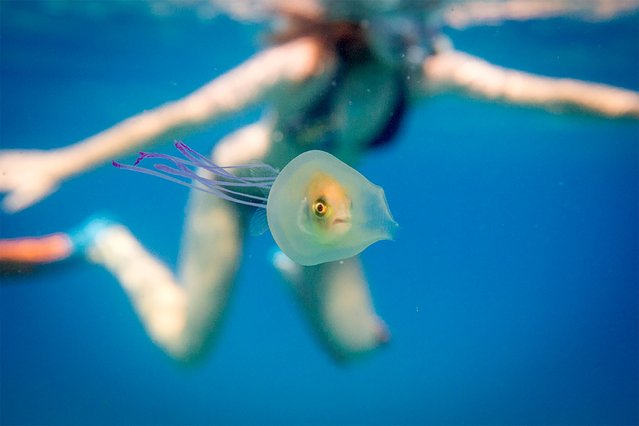
This undated handout picture taken by Tim Samuel and provided through his Instagram account shows a small fish swimming inside the belly of a jellyfish off the coast of Byron Bay in New South Wales, eastern Australia. A fish has been pictured swimming inside a jellyfish off Australia's east coast in a remarkable and rare image that has gone viral, with more than two million online views. Underwater photographer Tim Samuel was in the water with a friend near popular tourist resort Byron Bay in December when they came across the little creature trapped inside the only slightly larger jellyfish. (Photo by Tim Samuel Photography/AFP Photo/Instagram)
Details
10 Jun 2016 13:41:00
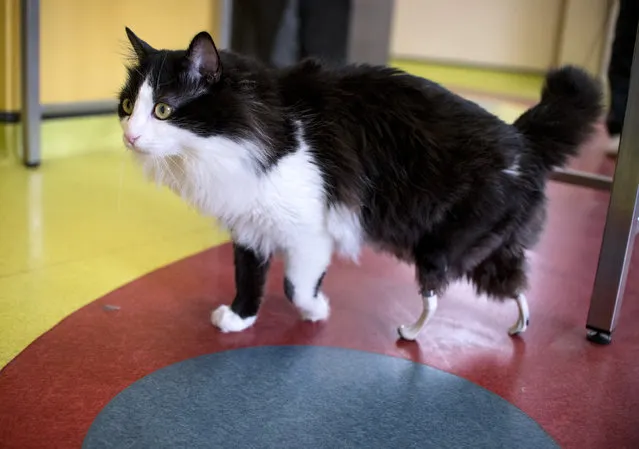
Pooh, a one-year-old cat, who lost his hind legs in an accident and has been given bionic paws, walks in a vet clinic in Sofia on January 31, 2017. Pooh, who is thought to have lost his legs in a car or train accident last April, is back on the prowl thanks to Bulgarian veterinary surgeon Vladislav Zlatinov. He is the first vet in Europe to successfully apply the pioneering method of Irish neuro-orthopaedic surgeon Noel Fitzpatrick, who shot to fame in 2009 when making Oscar the first bionic cat by fitting him with new hind legs in Britain. (Photo by Nikolay Doychinov/AFP Photo)

Pooh, a one-year-old cat, who lost his hind legs in an accident and has been given bionic paws, walks in a vet clinic in Sofia on January 31, 2017. Pooh, who is thought to have lost his legs in a car or train accident last April, is back on the prowl thanks to Bulgarian veterinary surgeon Vladislav Zlatinov. He is the first vet in Europe to successfully apply the pioneering method of Irish neuro-orthopaedic surgeon Noel Fitzpatrick, who shot to fame in 2009 when making Oscar the first bionic cat by fitting him with new hind legs in Britain. (Photo by Nikolay Doychinov/AFP Photo)
Details
03 Feb 2017 07:35:00