Loading...
Done
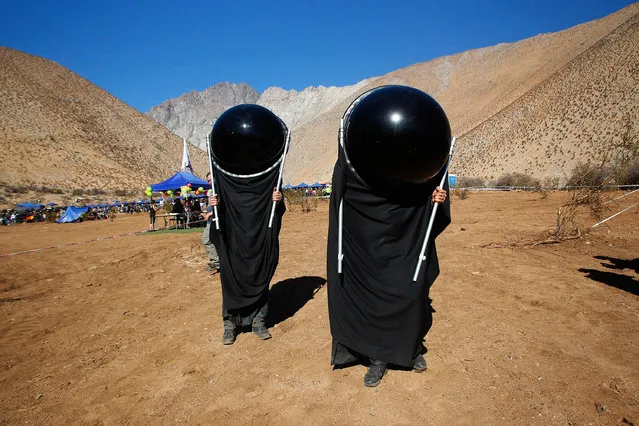
Chileans watch the sky with special suits prior to a total solar eclipse on July 2, 2019 in Paiguano, Chile. Around 25,0000 tourists arrived to Paiguano, a small town of around 1,000 inhabitants in the Elqui Valley, 650 km away Santiago. This is the only Earth's total solar eclipse of 2019 and the first one since 2017. From this point, the sun will fully disappear for around two minutes. It is best visible from a stripe in the South Pacific, Chile and Argentina. (Photo by Marcelo Hernandez/Getty Images)

Chileans watch the sky with special suits prior to a total solar eclipse on July 2, 2019 in Paiguano, Chile. Around 25,0000 tourists arrived to Paiguano, a small town of around 1,000 inhabitants in the Elqui Valley, 650 km away Santiago. This is the only Earth's total solar eclipse of 2019 and the first one since 2017. From this point, the sun will fully disappear for around two minutes. It is best visible from a stripe in the South Pacific, Chile and Argentina. (Photo by Marcelo Hernandez/Getty Images)
Details
04 Jul 2019 00:05:00
At 10,582 square kilometres, the Bolivian salt flats – otherwise known as Salar de Uyuni – are the largest on the planet and contain between 50 and 70% of the world’s lithium reserves. After exploring Chile and Argentina, photographer Joel Santos decided to travel to Bolivia in January 2017 to check the salt flats off his bucket list. With an electrical storm rolling in, Joel and his two travelling companions were the only souls left on the vast flats and captured the eerie flats without a person in sight. (Photo by Joel Santos/Barcroft Images)

At 10,582 square kilometres, the Bolivian salt flats – otherwise known as Salar de Uyuni – are the largest on the planet and contain between 50 and 70% of the world’s lithium reserves. After exploring Chile and Argentina, photographer Joel Santos decided to travel to Bolivia in January 2017 to check the salt flats off his bucket list. With an electrical storm rolling in, Joel and his two travelling companions were the only souls left on the vast flats and captured the eerie flats without a person in sight. (Photo by Joel Santos/Barcroft Images)
Details
12 Aug 2019 00:03:00
The Vattenfall Solar Team car “Nuna” from the Netherlands competes in the Challenger class on Day 2 of the 2019 Bridgestone World Solar Challenge at Elliott on October 14, 2019 in Elliott Australia. Teams from across the globe are competing in the 2019 World Solar Challenge – a 3000 km solar-powered vehicle race between Darwin and Adelaide. The race starts on the 13th of October in Darwin in the Northern Territory and travels the Stuart Highway to Port Augusta and then via Highway 1 to finish in the City of Adelaide in South Australia. (Photo by Mark Evans/Getty Images for SATC)

The Vattenfall Solar Team car “Nuna” from the Netherlands competes in the Challenger class on Day 2 of the 2019 Bridgestone World Solar Challenge at Elliott on October 14, 2019 in Elliott Australia. Teams from across the globe are competing in the 2019 World Solar Challenge – a 3000 km solar-powered vehicle race between Darwin and Adelaide. The race starts on the 13th of October in Darwin in the Northern Territory and travels the Stuart Highway to Port Augusta and then via Highway 1 to finish in the City of Adelaide in South Australia. (Photo by Mark Evans/Getty Images for SATC)
Details
17 Oct 2019 00:07:00
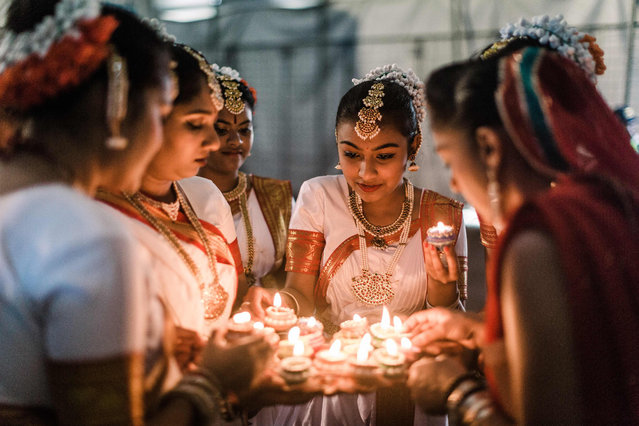
A group of colourful dancers from the Kumari Shiksha Dance Institution light colourful clay lamps in preparation to celebrate Diwali during the two day Diwali (Festival of Lights) Hindu festival celebrations at the old Drive-Inn in Durban, on October 19, 2019. The two-day festival attracts over 100,000 visitors. The festival celebrations include, parading of floats, chariots, singing of devotional songs, dances, games, face painting, food stalls of vegetarian food, clothing, display of toys and jewellery. Young people also get the opportunity to showcase their cultural and spiritual talents. A billion Hindus worlwide will officially celebrate Diwali on 27 October 2019. (Photo by Rajesh Jantilal/AFP Photo)

A group of colourful dancers from the Kumari Shiksha Dance Institution light colourful clay lamps in preparation to celebrate Diwali during the two day Diwali (Festival of Lights) Hindu festival celebrations at the old Drive-Inn in Durban, on October 19, 2019. The two-day festival attracts over 100,000 visitors. The festival celebrations include, parading of floats, chariots, singing of devotional songs, dances, games, face painting, food stalls of vegetarian food, clothing, display of toys and jewellery. Young people also get the opportunity to showcase their cultural and spiritual talents. A billion Hindus worlwide will officially celebrate Diwali on 27 October 2019. (Photo by Rajesh Jantilal/AFP Photo)
Details
22 Oct 2019 00:07:00
A zoo keeper carries a pelican to move it to its winter enclosure at Dvur Kralove Zoo in Dvur Kralove nad Labem, Czech Republic November 5, 2019. (Photo by David W. Cerny/Reuters)

A zoo keeper carries a pelican to move it to its winter enclosure at Dvur Kralove Zoo in Dvur Kralove nad Labem, Czech Republic on November 5, 2019. (Photo by David W. Cerny/Reuters)
Details
10 Nov 2019 00:03:00
British band Florence and the Machine performs at the Bilbao BBK Live festival in Bilbao, Spain, early 13 July 2018. Bilbao BBK Live festival runs from 12 July to 14 July 2018. (Photo by Miguel Tona/EPA/EFE)

British band Florence and the Machine performs at the Bilbao BBK Live festival in Bilbao, Spain, early 13 July 2018. Bilbao BBK Live festival runs from 12 July to 14 July 2018. (Photo by Miguel Tona/EPA/EFE)
Details
15 Jul 2018 08:29:00
Tightrope walker Tatian-Mosio Bongonga hangs from a tightrope as she pauses while scaling the Monmartre hill towards the Sacre Coeur Basilica (not pictured) in Paris, France, July 20, 2018. (Photo by Philippe Wojazer/Reuters)

Tightrope walker Tatian-Mosio Bongonga hangs from a tightrope as she pauses while scaling the Monmartre hill towards the Sacre Coeur Basilica (not pictured) in Paris, France, July 20, 2018. (Photo by Philippe Wojazer/Reuters)
Details
22 Jul 2018 08:34:00
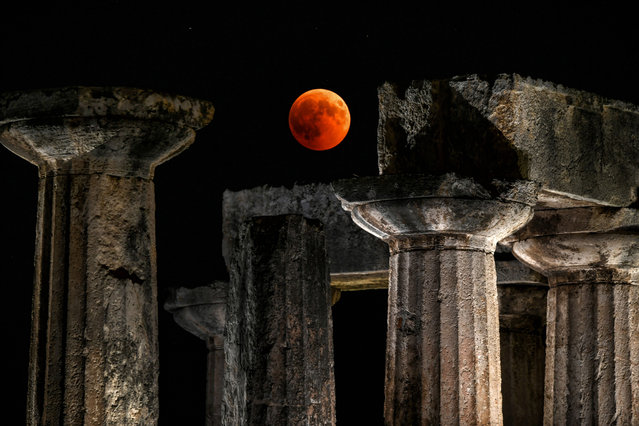
A picture shows the full moon during a “blood moon” eclipse over the temple of Apollo in Corinth on July 27, 2018. The longest “blood moon” eclipse this century began on July 27, coinciding with Mars' closest approach in 15 years to treat skygazers across the globe to a thrilling celestial spectacle. (Photo by Valerie Gache/AFP Photo)

A picture shows the full moon during a “blood moon” eclipse over the temple of Apollo in Corinth on July 27, 2018. The longest “blood moon” eclipse this century began on July 27, coinciding with Mars' closest approach in 15 years to treat skygazers across the globe to a thrilling celestial spectacle. (Photo by Valerie Gache/AFP Photo)
Details
29 Jul 2018 09:47:00