Loading...
Done
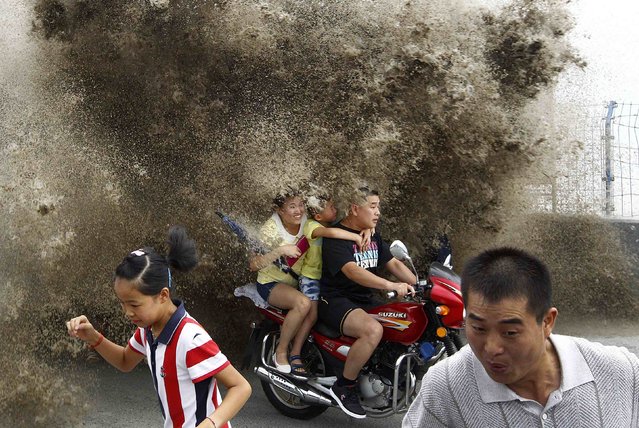
Visitors run away as waves caused by a tidal bore surge past a barrier on the banks of Qiantang River, in Hangzhou, Zhejiang province August 13, 2014. (Photo by Reuters/Stringer)

Visitors run away as waves caused by a tidal bore surge past a barrier on the banks of Qiantang River, in Hangzhou, Zhejiang province August 13, 2014. (Photo by Reuters/Stringer)
Details
16 Aug 2014 10:46:00
These little grizzly bear cubs had fun making a real splash when their mum took them for a dip to learn how to fish. Kamchatka, Russia. (Photo by Marco Mattiussi/Solent News & Photo Agency)

These little grizzly bear cubs had fun making a real splash when their mum took them for a dip to learn how to fish. Kamchatka, Russia. (Photo by Marco Mattiussi/Solent News & Photo Agency)
Details
11 Jan 2014 13:24:00
White lioness Azira lies in the cage with her three white cubs, on February 4, 2014. Zoo owner Andrzej Pabich says white lions often have defects that prevent giving birth, or the mother rejects her cubs, but Azira has been patiently feeding and caring for her little ones. (Photo by Czarek Sokolowski/Associated Press)

White lioness Azira lies in the cage with her three white cubs, on February 4, 2014. Zoo owner Andrzej Pabich says white lions often have defects that prevent giving birth, or the mother rejects her cubs, but Azira has been patiently feeding and caring for her little ones. (Photo by Czarek Sokolowski/Associated Press)
Details
08 Feb 2014 15:52:00
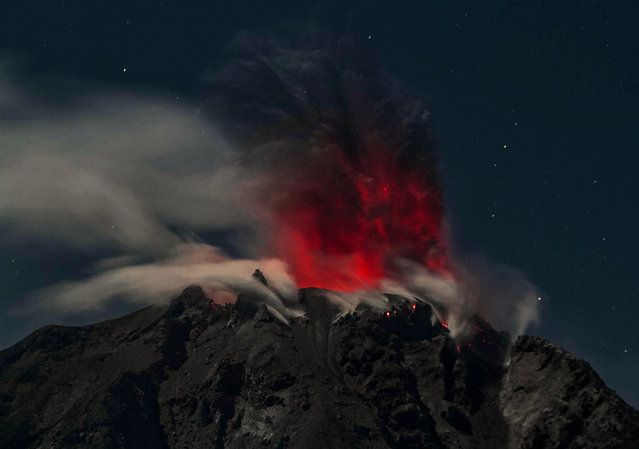
In this timed-exposure night photo taken early on February 12, 2017, Mount Sinabung volcano spews reddish smoke and ash, as seen from the Karo district in North Sumatra province. Activity levels have increased in the past week, with Sinabung shooting hot ash clouds into the sky dozens of times, according to the local volcano monitoring agency. (Photo by AFP Photo/Stringer)

In this timed-exposure night photo taken early on February 12, 2017, Mount Sinabung volcano spews reddish smoke and ash, as seen from the Karo district in North Sumatra province. Activity levels have increased in the past week, with Sinabung shooting hot ash clouds into the sky dozens of times, according to the local volcano monitoring agency. (Photo by AFP Photo/Stringer)
Details
13 Feb 2017 10:02:00
A burning tank is in Daraa, on March 9, 2013. (Photo by Ali Abu-Salah/Reuters/Shaam News Network /The Atlantic)

A burning tank is in Daraa, on March 9, 2013. (Photo by Ali Abu-Salah/Reuters/Shaam News Network via The Atlantic)
Details
07 Apr 2013 09:24:00
Armed Yemeni children sit in the back of a pick up truck with fighters loyal to Yemen's Saudi-backed President Abedrabbo Mansour Hadi in the Dar saad neighbourhood of the southern Yemeni city of Aden on May 10, 2015, as they continue to battle Shiite Huthi rebels. (Photo by Saleh Al-Obeidi/AFP Photo)

Armed Yemeni children sit in the back of a pick up truck with fighters loyal to Yemen's Saudi-backed President Abedrabbo Mansour Hadi in the Dar saad neighbourhood of the southern Yemeni city of Aden on May 10, 2015, as they continue to battle Shiite Huthi rebels. (Photo by Saleh Al-Obeidi/AFP Photo)
Details
27 May 2015 00:02:00
Bob Steele, of Jefferson, Texas, positions his bears during The Great Bear Show at the Dubuque (Iowa) County Fair on July 25, 2012. (Photo by Jessica Reilly/Telegraph Herald)

Bob Steele, of Jefferson, Texas, positions his bears during The Great Bear Show at the Dubuque (Iowa) County Fair on July 25, 2012. (Photo by Jessica Reilly/Telegraph Herald)
Details
28 Jul 2012 08:43:00
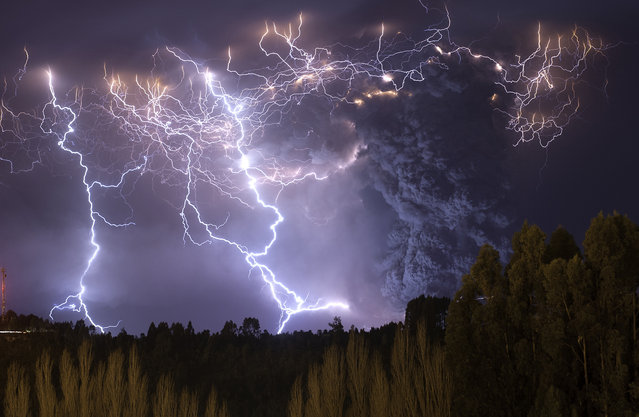
The eruption of Cordon Caulle began on June 4, 2011, located in the Region of Los Rios in Chile. For about 12 months, people and animals became accustomed to living with the daily fall of ash, which also caused problems in the air traffic in South America. The explosions and lightning during first days of the eruption could be seen from hundreds of miles around. This photograph was taken on the second night of eruption from the town of Lago Ranco. (Photo and caption by Francisco Negroni/National Geographic Traveler Photo Contest)

The eruption of Cordon Caulle began on June 4, 2011, located in the Region of Los Rios in Chile. For about 12 months, people and animals became accustomed to living with the daily fall of ash, which also caused problems in the air traffic in South America. The explosions and lightning during first days of the eruption could be seen from hundreds of miles around. This photograph was taken on the second night of eruption from the town of Lago Ranco. (Photo and caption by Francisco Negroni/National Geographic Traveler Photo Contest)

ATTENTION! All pictures are presented in high resolution. To see Hi-Res images – just TWICE click on any picture. In other words, click small picture – opens the BIG picture. Click BIG picture – opens VERY BIG picture.
Details
23 Jun 2013 11:24:00