Loading...
Done
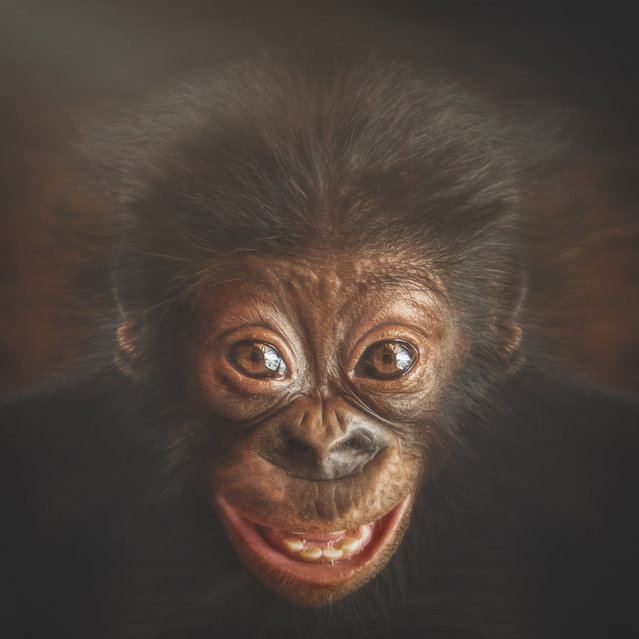
These portraits reveal the incredibly humanlike expressions of a variety of apes.Through piercing eyes and finite facial details, the intimate photographs show the animals looking angry, sad, delighted and pensive. They are the works of Manuela Kulpa – an IT consultant and keen photographer from near Cologne, Germany – who shot the apes predominantly at zoos across Austria, Belgium, the Czech Republic, Germany and the Netherlands. Here: Bonobo, Azibo. (Photo by Manuela Kulpa/Caters News)

These portraits reveal the incredibly humanlike expressions of a variety of apes.Through piercing eyes and finite facial details, the intimate photographs show the animals looking angry, sad, delighted and pensive. They are the works of Manuela Kulpa – an IT consultant and keen photographer from near Cologne, Germany – who shot the apes predominantly at zoos across Austria, Belgium, the Czech Republic, Germany and the Netherlands. Here: Bonobo, Azibo. (Photo by Manuela Kulpa/Caters News)
Details
26 Feb 2016 10:04:00
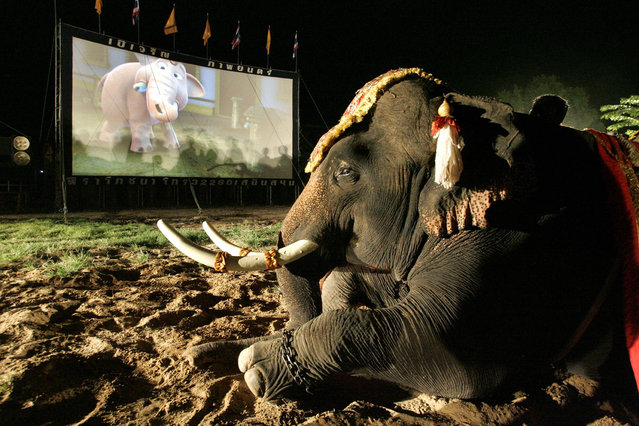
A mahout watches the Thai animation movie Kan Kluay with his elephant in Ayuthaya province, about 80km (49 miles) north of Bangkok June 5, 2006. The movie tells the story of a young Thai wild elephant who, while looking for his father, becomes the war elephant of the Thai King fighting against Burma and restored Thailand's ancient Ayuthaya empire that existed about 400 years ago. (Photo by Sukree Sukplang/Reuters)

A mahout watches the Thai animation movie Kan Kluay with his elephant in Ayuthaya province, about 80km (49 miles) north of Bangkok June 5, 2006. The movie tells the story of a young Thai wild elephant who, while looking for his father, becomes the war elephant of the Thai King fighting against Burma and restored Thailand's ancient Ayuthaya empire that existed about 400 years ago. (Photo by Sukree Sukplang/Reuters)
Details
12 Aug 2015 13:33:00
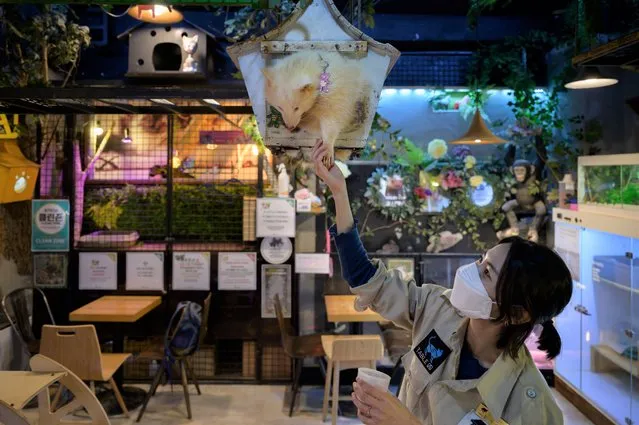
In a photo taken on April 2, 2020 a staff member feeds a raccoon at the Table A Raccoon Cafe in Seoul. Business has been devastated by the coronavirus outbreak, with South Koreans staying at home under social distancing guidelines, and tourism disappearing. But unlike other firms, animal cafes have to stay open so that staff can look after their stock. (Photo by Ed Jones/AFP Photo)

In a photo taken on April 2, 2020 a staff member feeds a raccoon at the Table A Raccoon Cafe in Seoul. Business has been devastated by the coronavirus outbreak, with South Koreans staying at home under social distancing guidelines, and tourism disappearing. But unlike other firms, animal cafes have to stay open so that staff can look after their stock. (Photo by Ed Jones/AFP Photo)
Details
13 Apr 2020 00:05:00
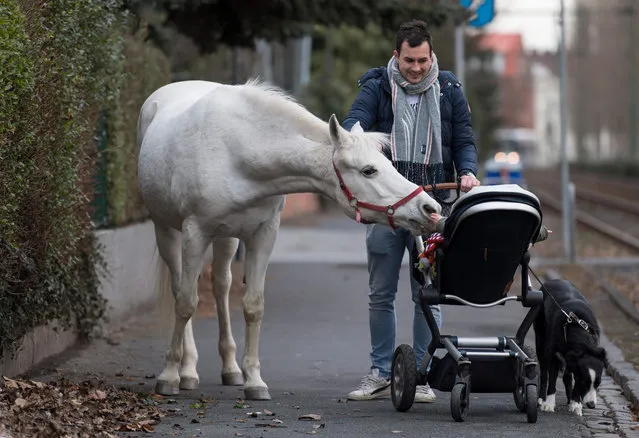
The Arabian mare “Jenny” curiously sniffs at the child of Raphael Wöllstein, who is on his way to the train, on her daily walk through the Fechenheim district of Frankfurt, Germany on March 8, 2019. Her owner opens the stable door for the 22-year-old horse every morning. Then the animal can decide for itself where it wants to spend the day. So that nobody thinks she's escaped, a sign with the inscription “My name is Jenny, didn't run away, just go for a walk” is on the halter. (Photo by Boris Roessler/dpa)

The Arabian mare “Jenny” curiously sniffs at the child of Raphael Wöllstein, who is on his way to the train, on her daily walk through the Fechenheim district of Frankfurt, Germany on March 8, 2019. Her owner opens the stable door for the 22-year-old horse every morning. Then the animal can decide for itself where it wants to spend the day. So that nobody thinks she's escaped, a sign with the inscription “My name is Jenny, didn't run away, just go for a walk” is on the halter. (Photo by Boris Roessler/dpa)
Details
10 Mar 2019 00:07:00
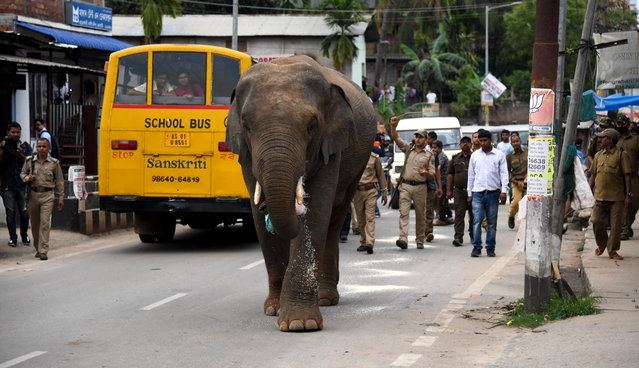
Indian forest officials and police personnel try to chase away a wild male elephant at Hengrabari area in Guwahati on April 30, 2019. The elephant came down from Amchang Wildlife Sanctuary in search of food and later forest official tranquillized it, local media reported. As the pressure of population pushes human habitation closer to forests incidents of wild animals straying into cities is increasingly reported. (Photo by Biju Boro/AFP Photo)

Indian forest officials and police personnel try to chase away a wild male elephant at Hengrabari area in Guwahati on April 30, 2019. The elephant came down from Amchang Wildlife Sanctuary in search of food and later forest official tranquillized it, local media reported. As the pressure of population pushes human habitation closer to forests incidents of wild animals straying into cities is increasingly reported. (Photo by Biju Boro/AFP Photo)
Details
02 May 2019 00:07:00
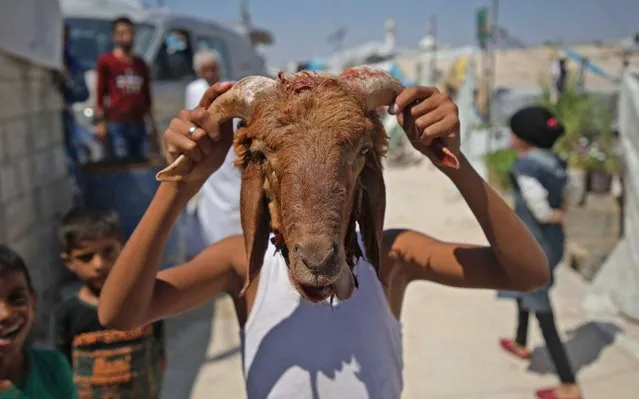
A Syrian boy plays with the head of a sacrificed sheep at a DIP camp for Interally Displaced Persons near the town of Aqrabat in Syria's northern Idlib province on August 12, 2019. Known as the “big” festival, Eid Al-Adha is celebrated each year by Muslims sacrificing various animals according to religious traditions, including cows, camels, goats and sheep. The festival marks the end of the Hajj pilgrimage to Mecca and commemorates Prophet Abraham's readiness to sacrifice his son to show obedience to God. (Photo by Aaref Watad/AFP Photo)

A Syrian boy plays with the head of a sacrificed sheep at a DIP camp for Interally Displaced Persons near the town of Aqrabat in Syria's northern Idlib province on August 12, 2019. Known as the “big” festival, Eid Al-Adha is celebrated each year by Muslims sacrificing various animals according to religious traditions, including cows, camels, goats and sheep. The festival marks the end of the Hajj pilgrimage to Mecca and commemorates Prophet Abraham's readiness to sacrifice his son to show obedience to God. (Photo by Aaref Watad/AFP Photo)
Details
15 Aug 2019 00:05:00
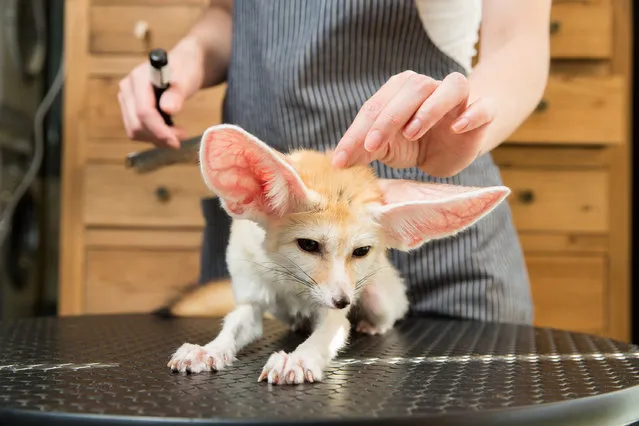
A fennec fox (Vulpes zerda) is groomed in a pet store in central Beijing. Native to the Sahara in North Africa, the species became a popular pet after being depicted as a character in Disney’s 2016 animated movie Zootopia. Individuals can cost between $2,000–$3,000. (Photo by Sean Gallagher/The Guardian)

A dramatic rise in owning exotic pets in China is fuelling global demand for threatened species. The growing trade in alligators, snakes, monkeys, crocodiles and spiders is directly linked to species loss in some of the world’s most threatened ecosystems. Here: A fennec fox (Vulpes zerda) is groomed in a pet store in central Beijing. Native to the Sahara in North Africa, the species became a popular pet after being depicted as a character in Disney’s 2016 animated movie Zootopia. Individuals can cost between $2,000–$3,000. (Photo by Sean Gallagher/The Guardian)
Details
23 Sep 2017 08:04:00
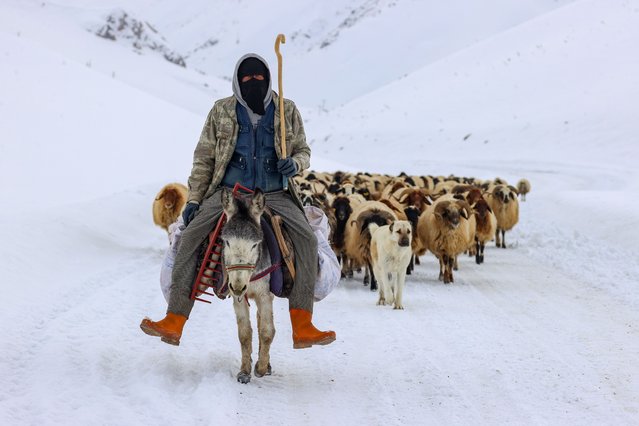
A shepherd rides a donkey as he leads sheep during winter in Van, Turkiye on February 19, 2022. Despite the terrible winter weather and the hard geology of the region, breeders in Van's Gurpnar district, where livestock is the most important source of revenue, do not disregard the care of their animals. Livestock farmers in the Cepkenli and Topcudegirmeni neighborhoods have the similar difficulties as those in rural areas, where the snow depth reaches one meter. (Photo by Ozkan Bilgin/Anadolu Agency via Getty Images)

A shepherd rides a donkey as he leads sheep during winter in Van, Turkiye on February 19, 2022. Despite the terrible winter weather and the hard geology of the region, breeders in Van's Gurpnar district, where livestock is the most important source of revenue, do not disregard the care of their animals. Livestock farmers in the Cepkenli and Topcudegirmeni neighborhoods have the similar difficulties as those in rural areas, where the snow depth reaches one meter. (Photo by Ozkan Bilgin/Anadolu Agency via Getty Images)
Details
04 Mar 2022 06:01:00