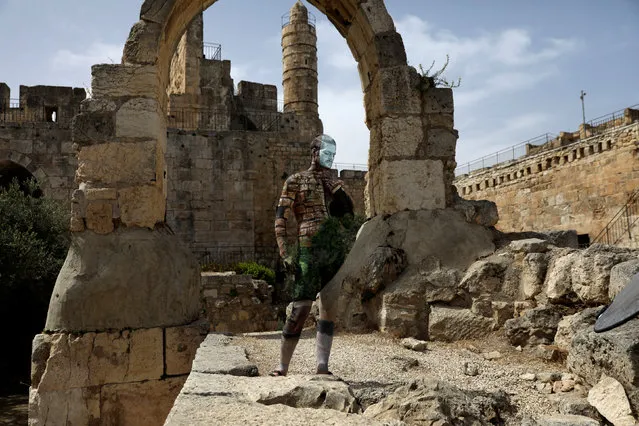
A model, painted by the artist Avi Ram from Airbrush Hero, poses for a photo as part of a calendar project, at the Tower of David in Jerusalem's Old City, April 27, 2017. (Photo by Ronen Zvulun/Reuters)
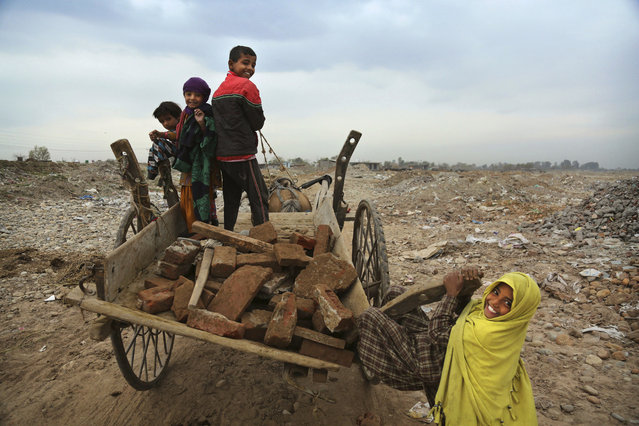
An Indian nomadic Gujjar girl hangs on to a horse cart after collecting bricks from debris on the outskirts of Jammu, India, Tuesday, March 7, 2017. The Gujjar tribal communities are considered by some to be economically and socially backward and the lack of care by the state government has led to resentment amongst the community. The tribe moves to the plains from the hills to escape the cold winters. (Photo by Channi Anand/AP Photo)
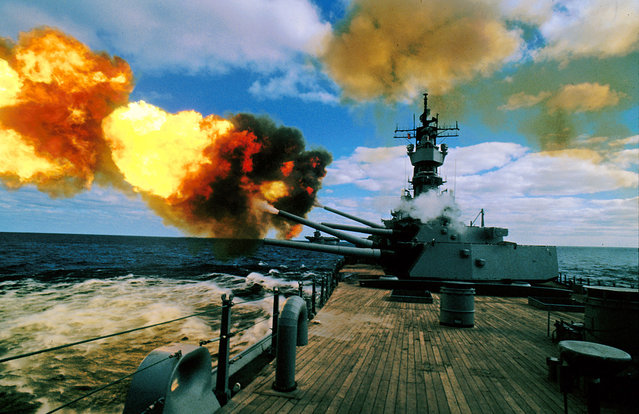
The battleship USS Iowa fires its 16-inch guns during duty in the Persian Gulf on December 16, 1987. In 1943, the Iowa ferried President Franklin Roosevelt home from the Teheran Conference, where post-WW II leaders divided up the world. The ship fought battles from the South Pacific to Korea and escorted convoys through the Persian Gulf. Forty-seven sailors died atop its deck when an explosion ripped through a gun turret. Now, the new port for the retired USS Iowa just might be the home of California's annual asparagus festival, the gritty agriculture port town of Stockton on the San Joaquin River, about 80 miles inland from San Francisco. (Photo by Eric Risberg/AP Photo)
A woman walks past servicemen of the self-proclaimed Donetsk People's Republic (DNR), who take part in a rehearsal for the Victory Day parade in Donetsk, Ukraine on May 3, 2018. (Photo by Alexander Ermochenko/Reuters)
In this Thursday, June 14, 2018, file photo, students wear virtual reality goggles during a science class at Pyongyang Teachers' University, a teacher training college, in Pyongyang, North Korea. (Photo by Dita Alangkara/AP Photo)
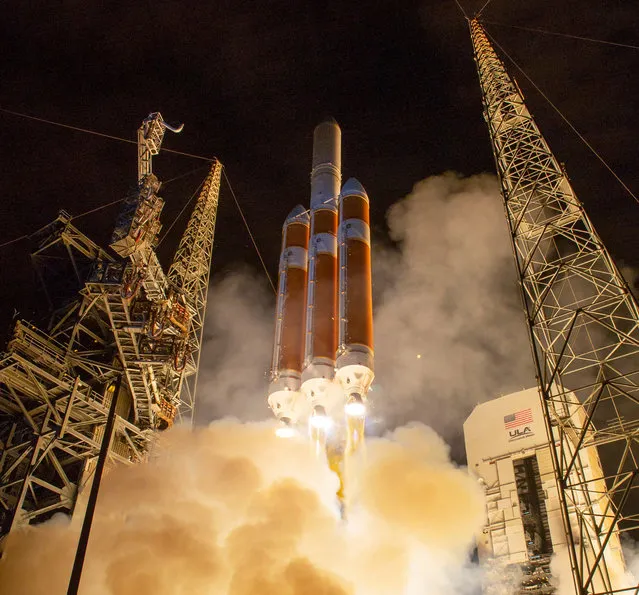
A handout photo made available by the NASA shows the United Launch Alliance Delta IV Heavy rocket launches NASA's Parker Solar Probe to touch the Sun, from Launch Complex 37 at Cape Canaveral Air Force Station, Florida, USA, 12 August 2018. Parker Solar Probe is humanity’s first-ever mission into a part of the Sun’s atmosphere called the corona. Here it will directly explore solar processes that are key to understanding and forecasting space weather events that can impact life on Earth. (Photo by Bill Ingalls/EPA-EFE/NASA)