Loading...
Done
Employees conduct a final check to fix any cavities in the seams of balls inside the soccer ball factory that produces official match balls for the 2014 World Cup in Brazil, in Sialkot, Punjab province May 16, 2014. (Photo by Sara Farid/Reuters)

Employees conduct a final check to fix any cavities in the seams of balls inside the soccer ball factory that produces official match balls for the 2014 World Cup in Brazil, in Sialkot, Punjab province May 16, 2014. It was when he felt the roar of the crowd at the 2006 World Cup in Germany that Pakistani factory owner Khawaja Akhtar first dreamt up a goal of his own: to manufacture the ball for the biggest soccer tournament on the planet. Last year he finally got his chance – but only 33 days to make it happen. (Photo by Sara Farid/Reuters)
Details
26 May 2014 13:59:00
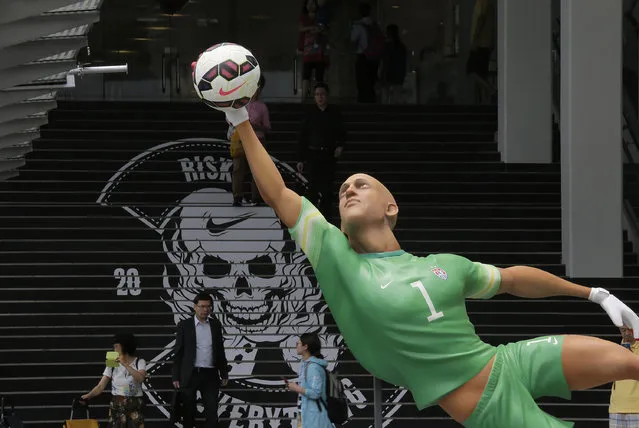
A giant size figure of the United States' goalkeeper Tim Howard is displayed outside a shopping mall in Hong Kong, Thursday, June 12, 2014, to promote the upcoming 2014 World Cup in Brazil. A total of seven 3.5 meters to 4 meters (11 feet 6 inch to 13 feet one inch) tall figures of famous players attract many soccer fans. (Photo by Vincent Yu/AP Photo)

A giant size figure of the United States' goalkeeper Tim Howard is displayed outside a shopping mall in Hong Kong, Thursday, June 12, 2014, to promote the upcoming 2014 World Cup in Brazil. A total of seven 3.5 meters to 4 meters (11 feet 6 inch to 13 feet one inch) tall figures of famous players attract many soccer fans. (Photo by Vincent Yu/AP Photo)
Details
13 Jun 2014 11:31:00
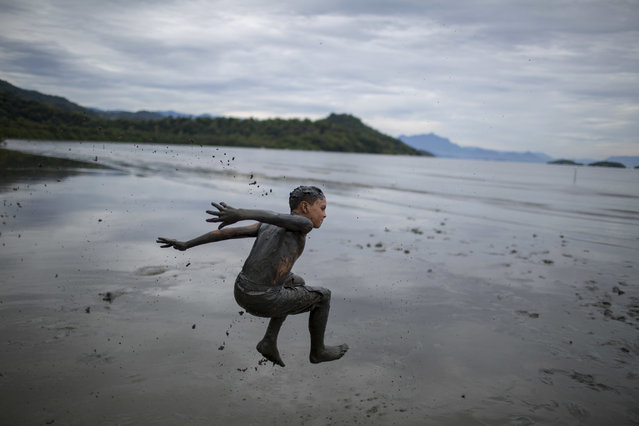
A boy jumps into a pool of mud during the traditional “Bloco da Lama” or “Mud Street” carnival party, in Paraty, Brazil, Saturday, February 25, 2017. Legend has it the “bloco” was born in 1986 after local teens hiking in a nearby mangrove forest smeared themselves with mud to discourage mosquitoes and then wandered through Paraty. The party grew year after year, but revelers eventually were banned from parading in the colonial downtown after shopkeepers complained pristine white walls were stained with the hard-to-remove mud. (Photo by Mauro Pimentel/AP Photo)

A boy jumps into a pool of mud during the traditional “Bloco da Lama” or “Mud Street” carnival party, in Paraty, Brazil, Saturday, February 25, 2017. Legend has it the “bloco” was born in 1986 after local teens hiking in a nearby mangrove forest smeared themselves with mud to discourage mosquitoes and then wandered through Paraty. The party grew year after year, but revelers eventually were banned from parading in the colonial downtown after shopkeepers complained pristine white walls were stained with the hard-to-remove mud. (Photo by Mauro Pimentel/AP Photo)
Details
28 Mar 2017 09:07:00
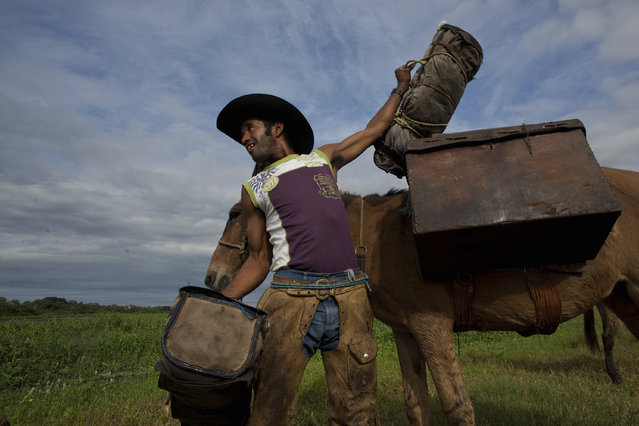
In this May 17, 2017 photo, cowboy cook Odair Batista carries a case with food in Corumba, the Pantanal wetlands of Mato Grosso do Sul state, Brazil. Dressed with leather chaps on top of their jeans, stetson hats and a machete attached to their waists, before setting off, the men finish their breakfast with Terere, an herbal “mate” beverage served ice cold in an ox drinking horn. (Photo by Eraldo Peres/AP Photo)

In this May 17, 2017 photo, cowboy cook Odair Batista carries a case with food in Corumba, the Pantanal wetlands of Mato Grosso do Sul state, Brazil. Dressed with leather chaps on top of their jeans, stetson hats and a machete attached to their waists, before setting off, the men finish their breakfast with Terere, an herbal “mate” beverage served ice cold in an ox drinking horn. (Photo by Eraldo Peres/AP Photo)
Details
12 Jun 2017 09:00:00
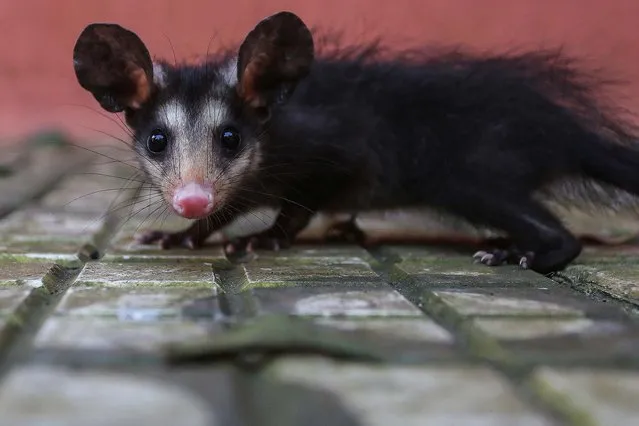
Photo taken on September 19, 2015 shows a baby Brazilian opossum at the “Parque Estoril” zoo in Sao Bernardo do Campo of Sao Paulo, Brazil. According to local press, the “Parque Estoril” zoo houses currently 23 orphan cubs of wild animals rescued in the south region of Sao Paulo, victims of illegal wildlife trade or problems caused by urban growth. (Photo by Rahel Patrasso/Xinhua via ZUMA Wire)

Photo taken on September 19, 2015 shows a baby Brazilian opossum at the “Parque Estoril” zoo in Sao Bernardo do Campo of Sao Paulo, Brazil. According to local press, the “Parque Estoril” zoo houses currently 23 orphan cubs of wild animals rescued in the south region of Sao Paulo, victims of illegal wildlife trade or problems caused by urban growth. According to the zoo, all the animals arrived in the last three months, and many of them, not being able to be reintroduced to their natural habitat, will be used as examples in environmental education classes. (Photo by Rahel Patrasso/Xinhua via ZUMA Wire)
Details
26 Sep 2015 08:00:00
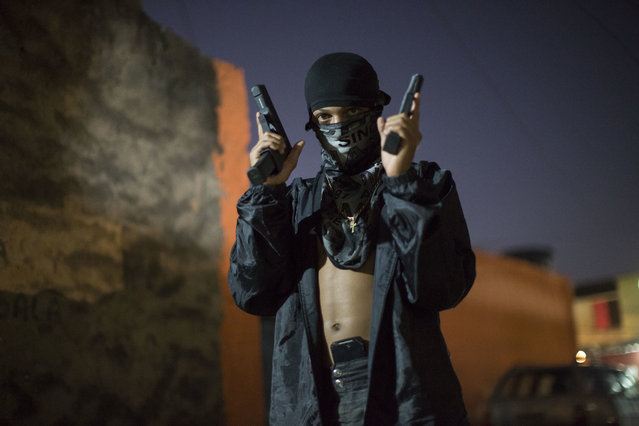
In this July 11, 2016 photo, a young, masked drug trafficker poses for photos holding his guns at a slum in Rio de Janeiro, Brazil. Teenagers openly tote guns while they work as guards, lookouts and distributors for drug lords operating just a few miles from where hundreds of thousands and tourists and athletes will be for the Aug. 5-21 Olympic Games. (Photo by Felipe Dana/AP Photo)

In this July 11, 2016 photo, a young, masked drug trafficker poses for photos holding his guns at a slum in Rio de Janeiro, Brazil. Teenagers openly tote guns while they work as guards, lookouts and distributors for drug lords operating just a few miles from where hundreds of thousands and tourists and athletes will be for the Aug. 5-21 Olympic Games. (Photo by Felipe Dana/AP Photo)
Details
24 Jul 2016 10:47:00
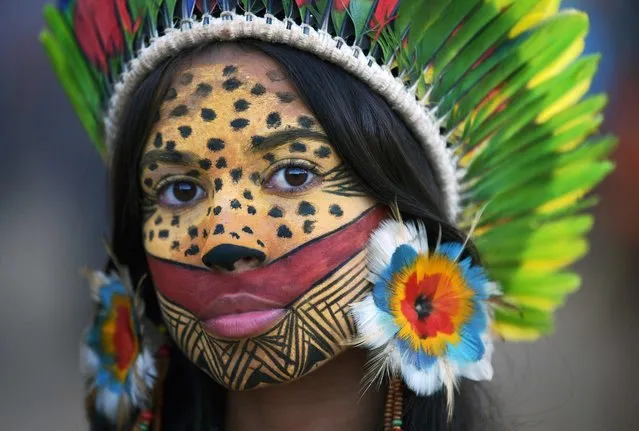
A woman from the Pataxo tribe poses for a photo at an indigenous protest camp on the fourth day of the Terra Livre Indigenous Camp in Brasilia on April 7, 2022. The 10-day annual protest is held by indigenous people from tribes that arrive from all over Brazil, and calls for greater protection of their land and rights. (Photo by Carl de Souza/AFP Photo)

A woman from the Pataxo tribe poses for a photo at an indigenous protest camp on the fourth day of the Terra Livre Indigenous Camp in Brasilia on April 7, 2022. The 10-day annual protest is held by indigenous people from tribes that arrive from all over Brazil, and calls for greater protection of their land and rights. (Photo by Carl de Souza/AFP Photo)
Details
24 Jun 2023 03:41:00
A clown nose is placed on a child's face during a protest opposing violence against women after the murder of Venezuelan actress and clown Julieta Inés Hernández Martínez in Rio de Janeiro, Brazil, Monday, January 8, 2024. The body of Hern·ndez, who had been missing since Dec. 23 while traveling by bicycle, was found in Presidente Figueiredo city, near Manaus in Amazonas state. (Photo by Bruna Prado/AP Photo)

A clown nose is placed on a child's face during a protest opposing violence against women after the murder of Venezuelan actress and clown Julieta Inés Hernández Martínez in Rio de Janeiro, Brazil, Monday, January 8, 2024. The body of Hern·ndez, who had been missing since Dec. 23 while traveling by bicycle, was found in Presidente Figueiredo city, near Manaus in Amazonas state. (Photo by Bruna Prado/AP Photo)
Details
24 Jan 2024 08:21:00