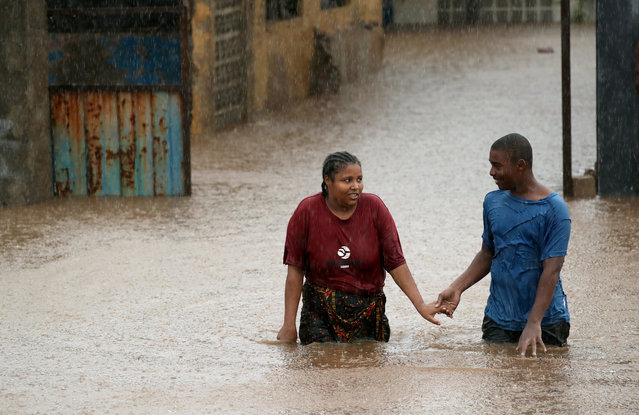
A man helps a woman through a flooded neighbourhood in the aftermath of Cyclone Kenneth, in Pemba, Mozambique, April 28, 2019. (Photo by Mike Hutchings/Reuters)
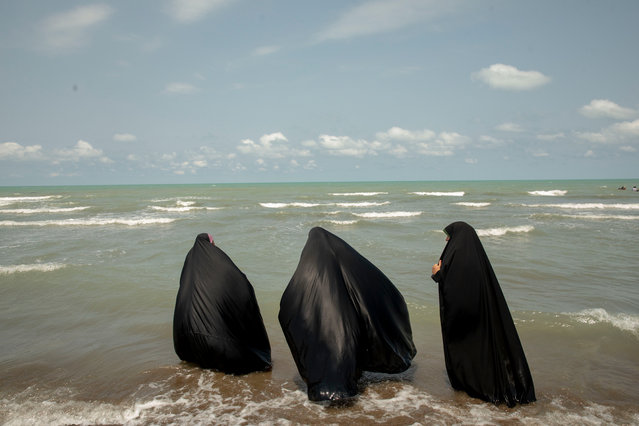
Three Iranian women bathe in the sea on a shore of the Caspian sea in the city of Babolsar north of Tehran, on July 14, 2023 in Babolsar, Iran. The 7th National Festival of Sand Sculptures is being held in this town on the edge of the Caspian Sea. (Photo by Majid Saeedi/Getty Images)
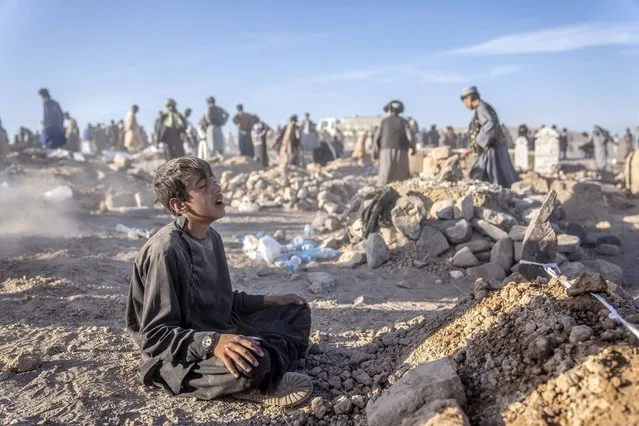
An Afghan boy mourns next to the grave of his little brother who died due to an earthquake, in Zenda Jan district in Herat province, western of Afghanistan, Monday, October 9, 2023. Saturday's deadly earthquake killed and injured thousands when it leveled an untold number of homes in Herat province. (Photo by Ebrahim Noroozi/AP Photo)
Debbie Barton from Blufton, South Carolina, asks supporters of Republican presidential candidate and former U.S. President Donald Trump to sign a petition calling for one day of voting and the eradication of voting machines, ahead of a “Team Trump” event in Beaufort, South Carolina, U.S. February 21, 2024. (Photo by Evelyn Hockstein/Reuters)
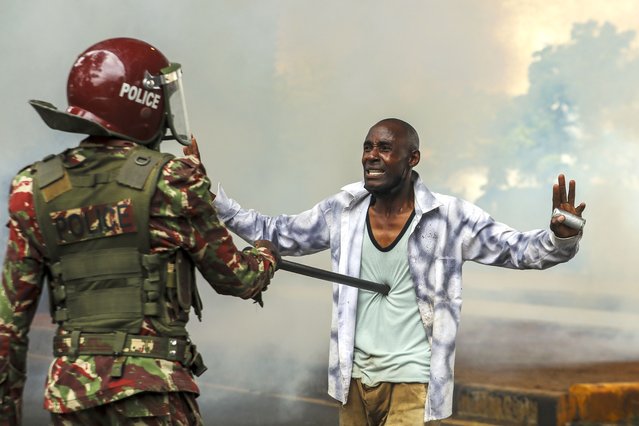
A protester reacts at an anti-riot police officer after being teargased as he takes part in a demonstration against a controversial tax bill in the central business district in Nairobi, Kenya, 20 June 2024. Police have fired tear gas to disperse protesters who gathered near the parliament to demonstrate against planned tax hikes that many fear will worsen the cost-of-living crisis. (Photo by Daniel Irungu/EPA)
Students of Rabindrabharati University apply colour dust or Gulal on each other during a celebration the festival of colour Holi in Kolkata, Eastern India, 23 March 2024. Holi, also known as the Festival of Colors, is an ancient Hindu festival symbolizing the victory of good over evil and marking the arrival of spring. It is observed with joyful gatherings during which revelers cover each other in colored powders. (Photo by Piyal Adhikary/EPA/EFE)
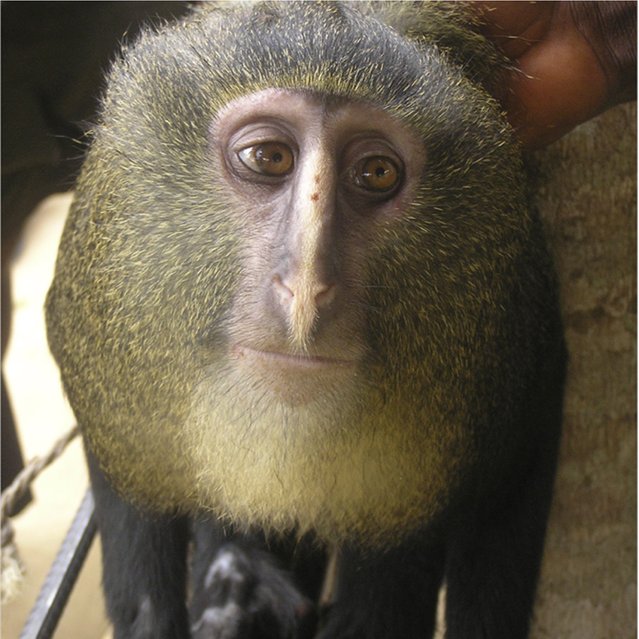
A new species of monkey found in the Democratic Republic of the Congo and identified as Lesula (Cercopithecus lomamiensis) is seen in this undated photograph from an article published September 12, 2012 in the science journal PLOS One. The monkey was first seen in 2007 by researchers John and Terese Hart of the Peabody Museum of Natural History at Yale Research Project. The finding of C. lomamiensis represents only the second new species of African monkey to be discovered in the past 28 years, according to the research article. (Photo by Hart J. A., Detwiler K. M., Gilbert C. C./Reuters)