Loading...
Done
Cemetery workers repaint tombs inside the municipal cemetery in Navotas city, north of Manila October 29, 2015. (Photo by Ezra Acayan/Reuters)

Cemetery workers repaint tombs inside the municipal cemetery in Navotas city, north of Manila October 29, 2015. Filipinos are preparing to celebrate All Saints Day on November 1 by visiting the graves of their departed loved ones. (Photo by Ezra Acayan/Reuters)
Details
02 Nov 2015 08:04:00
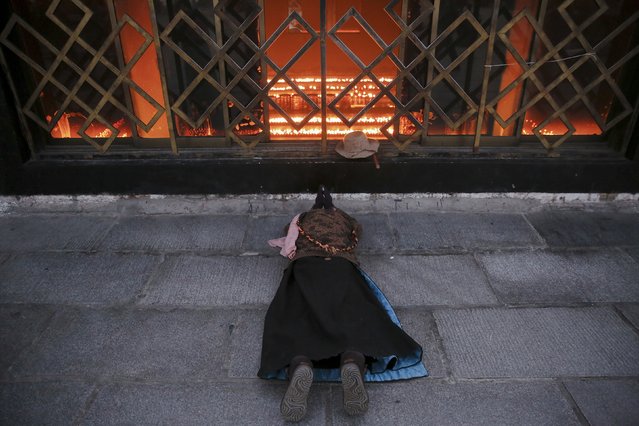
A Tibetan pilgrim prostrates herself at the Jokhang Temple in central Lhasa, Tibet Autonomous Region, China early November 20, 2015. (Photo by Damir Sagolj/Reuters)

A Tibetan pilgrim prostrates herself at the Jokhang Temple in central Lhasa, Tibet Autonomous Region, China early November 20, 2015. Every day thousands of Tibetans visit and pray at Jokhang Temple, considered one of the most sacred places of worship. (Photo by Damir Sagolj/Reuters)
Details
22 Nov 2015 08:03:00
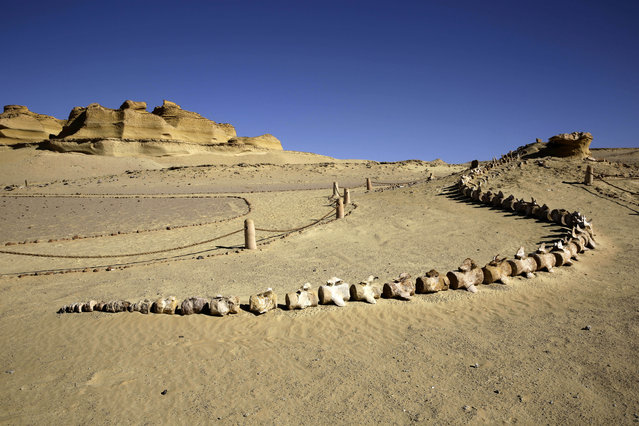
Fossilized whale bones are on display  outside the Wati El Hitan Fossils and Climate Change Museum, a UNESCO natural World Heritage site, on the opening day, in the Fayoum oasis, Egypt, Thursday, January 14, 2016. Egypt has cut the ribbon on the Middle East's first fossil museum housing the world's largest intact skeleton of a "walking whale" in an attempt to attract much-needed tourists driven off by recent militant attacks. The construction of the much-hyped Fossils and Climate Change Museum was covered a 2 billion euros (2. 17 billion dollars) grant from Italy, according to Italian Ambassador Maurizio Massari. (Photo by Thomas Hartwell/AP Photo)

Fossilized whale bones are on display outside the Wati El Hitan Fossils and Climate Change Museum, a UNESCO natural World Heritage site, on the opening day, in the Fayoum oasis, Egypt, Thursday, January 14, 2016. Egypt has cut the ribbon on the Middle East's first fossil museum housing the world's largest intact skeleton of a "walking whale" in an attempt to attract much-needed tourists driven off by recent militant attacks. The construction of the much-hyped Fossils and Climate Change Museum was covered a 2 billion euros (2. 17 billion dollars) grant from Italy, according to Italian Ambassador Maurizio Massari. Its centerpiece is an intact, 37-million-year-old and 20-meter-long skeleton of a legged form of whale that testifies to how modern-day whales evolved from land mammals. The sand-colored, dome-shaped museum is barely discernible in the breathtaking desert landscape that stretches all around. (Photo by Thomas Hartwell/AP Photo)
Details
16 Jan 2016 08:06:00
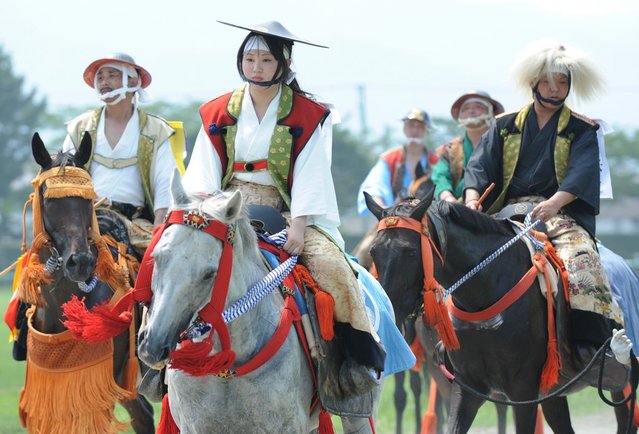
A young woman (C) clad in samurai costume leads other local poeple as she rides her horse during a parade at the annual Soma Nomaoi festival in Minamisoma, Fukushima Prefecture, on July 28, 2012.  The traditional full-scale festival kicked off for the first time after the accident of the Fukushima Dai-ichi Nuclear Power Plant following the massive earthquake and the tsunami on March 11, 2011. (Photo by Toru Yamanaka/AFP Photo)

Soma-Nomaoi is a festival that recreates a battle scene from more than 1,000 years ago. It is annually held for 4 days from July 22 to 25 in Haramachi City, Fukushima Prefecture, in the eastern part of Japan. In this historical event, 600 mounted samurai in traditional Japanese armor, with long swords at their side and ancestral flagstaffs streaming from their backs, ride across open fields. Soma-Nomaoi has been designated an Important Intangible Folk Cultural Property.

Photo: A young woman (C) clad in samurai costume leads other local poeple as she rides her horse during a parade at the annual Soma Nomaoi festival in Minamisoma, Fukushima Prefecture, on July 28, 2012. The traditional full-scale festival kicked off for the first time after the accident of the Fukushima Dai-ichi Nuclear Power Plant following the massive earthquake and the tsunami on March 11, 2011. (Photo by Toru Yamanaka/AFP Photo)
Details
02 Aug 2012 12:59:00
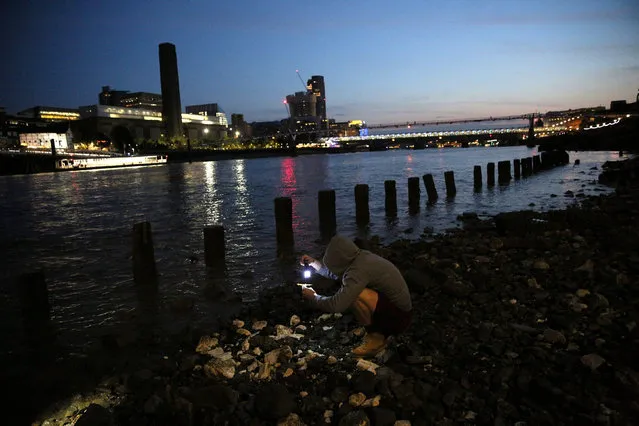
A mudlark uses a torch to look for items on the bank of the River Thames in London, Britain June 06, 2016. Mudlarking is believed to trace its origins to the 18th and 19th century, when scavengers searched the Thames' shores for items to sell. These days, history and archaeology fans are the ones hoping to find old relics such as coins, ceramics, artifacts or everyday items from across centuries. They wait for the low tide and then scour specific areas of exposed shores. "If you're in a field you could be out all day long, with the river you're restricted to about two or three hours," mudlark Nick Stevens said. While many just use the naked eye for their searches, others rely on metal detectors for which a permit from the Port of London Authority is needed. Digging also requires consent. (Photo by Neil Hall/Reuters)

A mudlark uses a torch to look for items on the bank of the River Thames in London, Britain June 06, 2016. Mudlarking is believed to trace its origins to the 18th and 19th century, when scavengers searched the Thames' shores for items to sell. These days, history and archaeology fans are the ones hoping to find old relics such as coins, ceramics, artifacts or everyday items from across centuries. their finds with the Portable Antiquities Scheme. Any item over 300 years old must be recorded. (Photo by Neil Hall/Reuters)
Details
27 Aug 2016 10:43:00
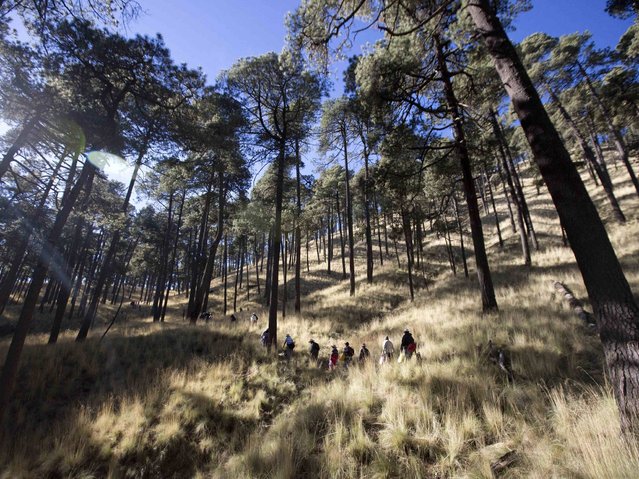
People celebrate the day of Don Gregorio Chino Popocatepetl, as the volcano is known to them, with food, music, dance and fireworks. (Photo by Eduardo Verdugo/AP Photo)

People who live in nearby villages make their yearly pilgrimage as they walk up the slopes of the Popocatepetl volcano in Mexico, Wednesday, March 12, 2014. Every year on March 12, residents make their way up the volcano celebrate the day of Don Gregorio Chino Popocatepetl, as the volcano is known to them, with food, music, dance and fireworks. When the sun rises, hundreds of pilgrims head out from the towns of Santiago Xalintzintla, Tlamacas and San Nicolas de Los Ranchos in van and trucks to drive, then walk up the 17,886-foot (5,450-meter) volcano for their daylong celebration. (Photo by Eduardo Verdugo/AP Photo)

Details
16 Mar 2014 09:09:00
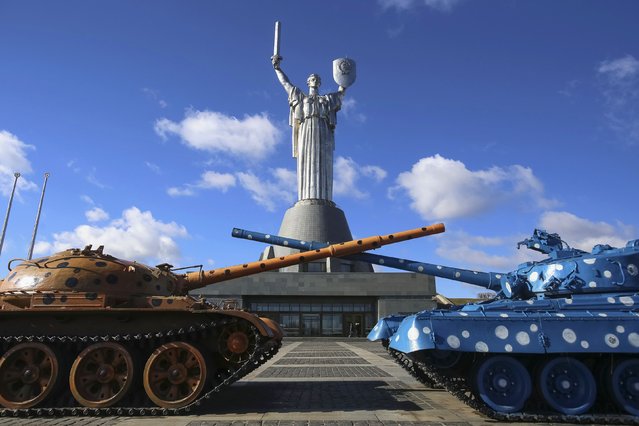
The 100-metre (300-foot), sword-wielding statue of “The Motherland” is seen in the National Museum of the History of the Great Patriotic War in Kiev March 17, 2014. On a blustery day on the banks of the Dnieper, the statue of “The Motherland”, a Soviet hammer and sickle on her shield, towered overhead, a reminder of the common cause Ukrainians and Russians died for side by side in their millions in World War Two and which Russian President Vladimir Putin thinks Ukraine has betrayed by turning to “fascism” and the West. (Photo by Konstantin Grishin/Reuters)

The 100-metre (300-foot), sword-wielding statue of “The Motherland” is seen in the National Museum of the History of the Great Patriotic War in Kiev March 17, 2014. On a blustery day on the banks of the Dnieper, the statue of “The Motherland”, a Soviet hammer and sickle on her shield, towered overhead, a reminder of the common cause Ukrainians and Russians died for side by side in their millions in World War Two and which Russian President Vladimir Putin thinks Ukraine has betrayed by turning to “fascism” and the West. (Photo by Konstantin Grishin/Reuters)
Details
22 Mar 2014 13:47:00
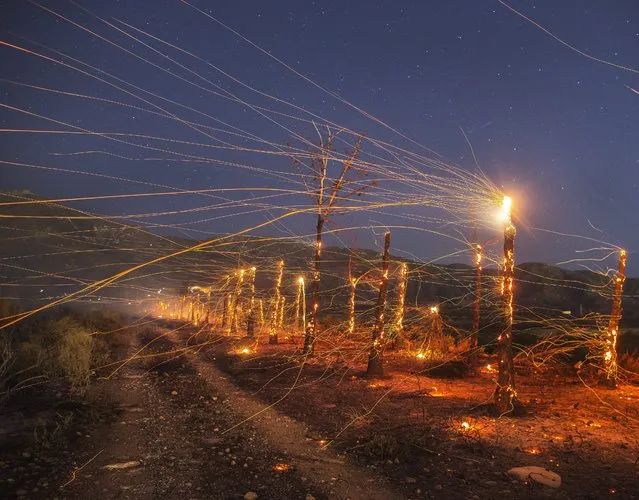
A long exposure image of embers flying off burnt out  trees following the wind driven wildfire ranging in the mountain area near Rancho Cucamonga late 30 April 2014.  Earlier in the day more than 1,500 homes were evacuated as the Etiwanda fire charred around 1,000 acres in San Barnardino National Forest. (Photo by Stuart Palley/EPA)

A long exposure image of embers flying off burnt out trees following the wind driven wildfire ranging in the mountain area near Rancho Cucamonga late 30 April 2014. Earlier in the day more than 1,500 homes were evacuated as the Etiwanda fire charred around 1,000 acres in San Barnardino National Forest. (Photo by Stuart Palley/EPA)
Details
22 Jun 2014 10:19:00