The popular K-pop group Blackpink watch the fireworks at Etihad Park from the stage at the end of the show in Abu Dhabi on Saturday, February 4, 2023. (Photo by Live Nation Entertainment)
Rita Ora attends the World Premiere of JEREMY SCOTT: THE PEOPLE'S DESIGNER, presented by The Vladar Company and Quintessentially at the TCL Chinese Theatre on Tuesday, September 8, 2015, in Hollywood, Calif. (Photo by Matt Sayles/Invision for The Vladar Company/AP Images)
Beryl Lipton, left, douses Matt Lee during the ice bucket challenge at Boston's Copley Square, Thursday, August 7, 2014 to raise funds and awareness for ALS. The idea is: pay up for charity or get doused. The fund-raising phenomenon is catching on fast, propelled by popular videos of the dunkers and the dunked – including famous athletes and entertainers – posted on social media sites. And the challenges are raising tens of thousands of dollars and immeasurable awareness for causes from ALS to breast cancer to a camp for kids who've lost a father to war. (Photo by Elise Amendola/AP Photo)
Tommy Lindsey holds an enormous maple leaf that he found in Mount Vernon, Wash., October 28, 2013. Lindsey was walking with his family when he picked up the leaf that is more than two feet from stem to tip and more than 21 inches wide. (Photo by Frank Varga/The Skagit Valley Herald)
Missing that old days of gaming when games were GAMES and not a dunghill of marketing bullshit with DLC? Sick of all this "press X to win"? So remember the CLASSIC!
Lake Baikal is the world's oldest lake, at 25 million years (possibly older), and deepest, averaging 744.4 metres (2,442 ft).
Located in the south of the Russian region of Siberia, between Irkutsk Oblast to the northwest and the Buryat Republic to the southeast, it is the most voluminous freshwater lake in the world, containing roughly 20% of the world's unfrozen surface fresh water.
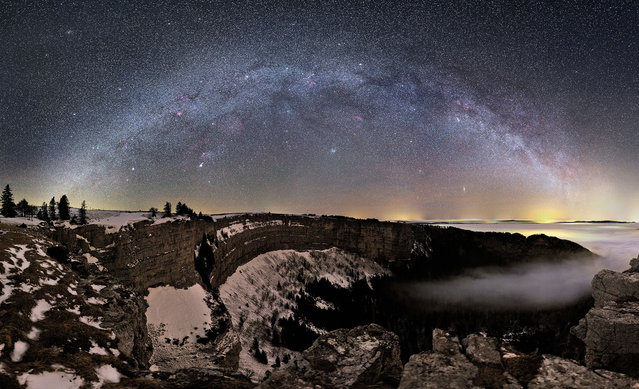
The Milky Way is the galaxy in which Earth is contained. This name derives from its appearance as a dim “milky” glowing band arching across the night sky, in which the naked eye cannot distinguish individual stars. The term “Milky Way” is a translation of the Classical Latin via lactea, from the Hellenistic Greek γαλαξίας κύκλος (pr. galaxías kýklos, “milky circle”). The Milky Way appears like a band because it is a disk-shaped structure being viewed from inside. The fact that this faint band of light is made up of stars was proven in 1610 when Galileo Galilei used his telescope to resolve it into individual stars. In the 1920s, observations by astronomer Edwin Hubble showed that the Milky Way is just one of many galaxies.