Loading...
Done
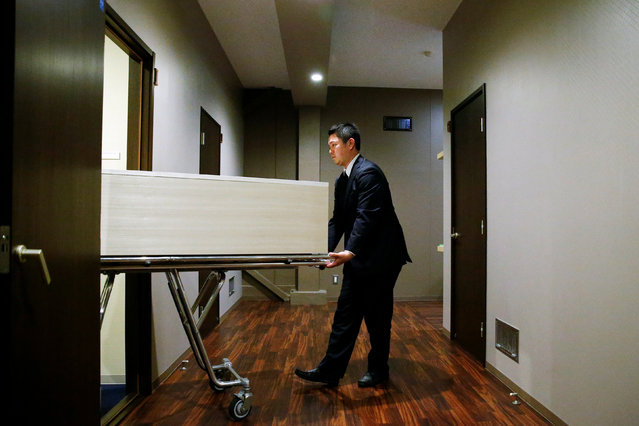
A staff member removes a coffin from a room of the “Corpse Hotel” in Kawasaki, Japan, April 20, 2016. (Photo by Thomas Peter/Reuters)

A staff member removes a coffin from a room of the “Corpse Hotel” in Kawasaki, Japan, April 20, 2016. Many so-called corpse hotels have emerged as a flourishing business in the city following a crunch in crematoriums. Families can rent a room in Sousou on a daily charge of 9,000 Japanese yen (£58, €74, $84) to keep the body of the deceased relative for up to four days until they find a crematorium. (Photo by Thomas Peter/Reuters)
Details
30 Apr 2016 09:46:00
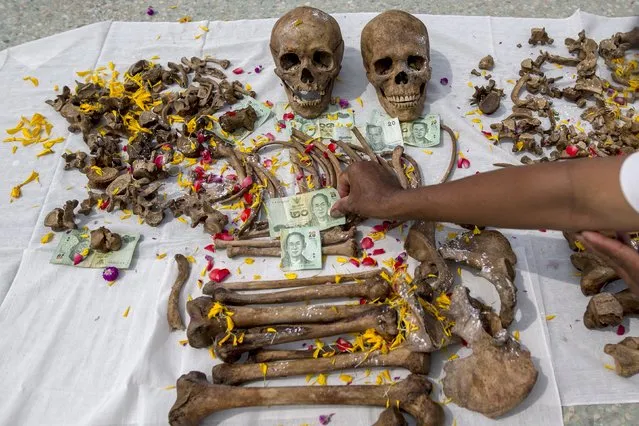
A volunteer puts a banknote on remains for luck during a mass exhumation at Poh Teck Tung Foundation Cemetery in Samut Sakhon province, Thailand November 3, 2015. (Photo by Athit Perawongmetha/Reuters)

A volunteer puts a banknote on remains for luck during a mass exhumation at Poh Teck Tung Foundation Cemetery in Samut Sakhon province, Thailand November 3, 2015. Human remains from 3,890 unclaimed bodies have been dug out of graves to be cleaned and put into storage in a warehouse before being cremated, in order to make room for further unidentified corpses. (Photo by Athit Perawongmetha/Reuters)
Details
06 Nov 2015 08:01:00
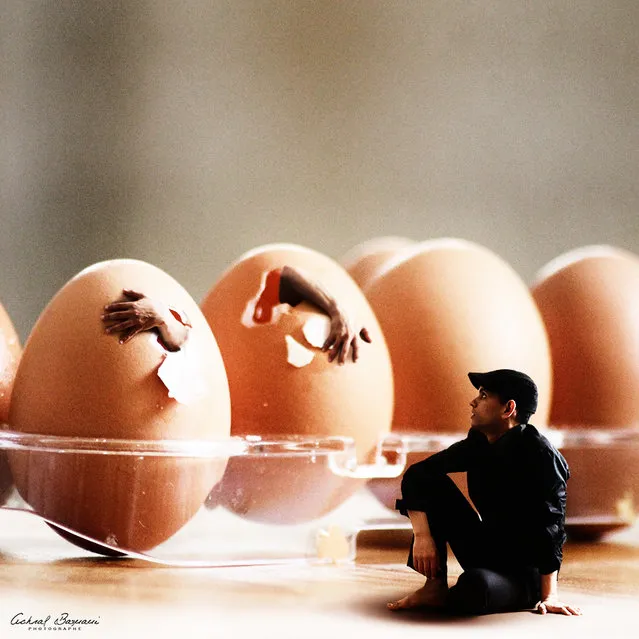
Inside My Dreams By Achraf Baznani

Moroccan photographer and filmmaker Achraf Baznani carries on the traditions of Surrealism with his wild, imaginative, and wholly impractical imagery. Among his inventive scenarios, small human figures—often the artist himself—appear trapped within glass jars or the size of a camera lens; in other works, Baznani more or less dissects his body, as for example, in one, he cleanly removes his brain from his cranium, or in another, twists off his hand, much as if it were a light bulb. Imparted throughout such works are strong senses of humor and wonder, and as such, Baznani’s art offers a Surrealistic take on life experience in the digital age.
Details
03 Aug 2014 12:04:00
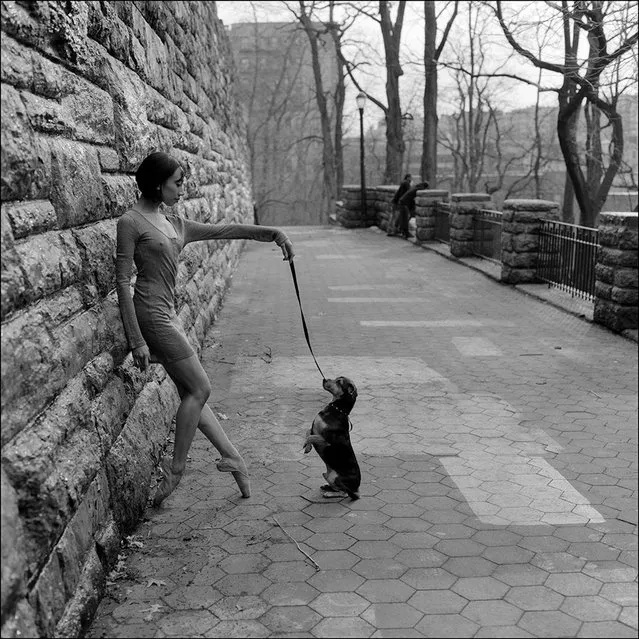
The Ballerina Project by Photographer Dane Shitagi

For over 14 years, photographer Dane Shitagi has been photographing beautiful, strong, and powerful women dancing all over New York City. The juxtaposition of the incredible strength of the dancers’ bodies plus a seemingly devoid urban landscape creates a captivating visual experience. When social media emerged, Shitagi took advantage, creating pages for his photo series on Facebook, Instagram, Tumblr, Pinterest, and Twitter. Currently, it is the largest dance photography page on Facebook with 850,000 “likes” and its Instagram account has about 500,000 followers. (Photo by Dane Shitagi)
Details
06 Aug 2014 10:58:00
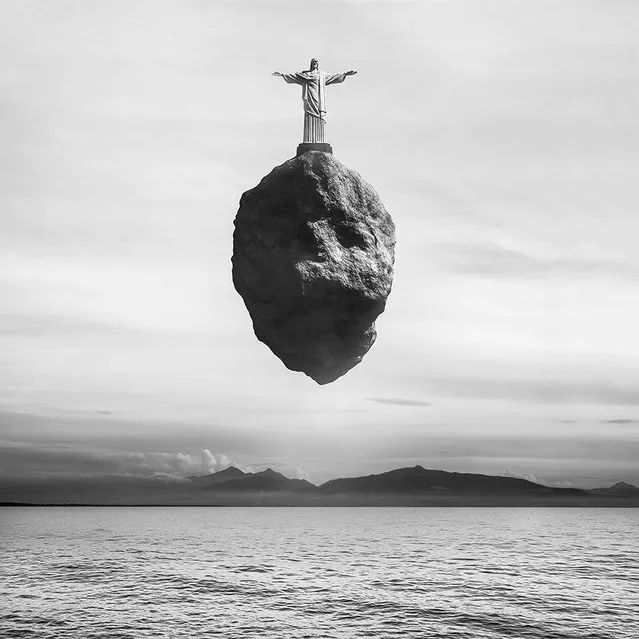
Levitation By Giuseppe Lo Schiavo

The essence of the “masterpieces” created by Giuseppe Lo Schiavo is in taking a famous architectural landmark placing it on a rock, and making it float over some body of water. Well… that’s pretty much it. Of course there will be some people who will look deep within these works of art, and catch the true meaning and intentions of the mastermind who created them, and maybe even purchase them for unreasonable amounts of money. But the rest of us, the common folk, will stare at it for a while, cringe, and move on without a second thought. (Photo by Giuseppe Lo Schiavo)
Details
04 Dec 2014 11:25:00
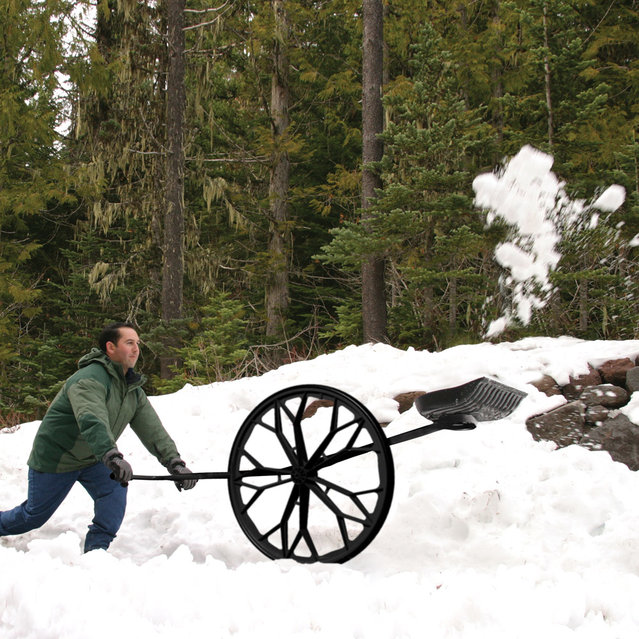
Wovel - The Ultimate Snow Shovel

The Wovel could possibly be the most advanced human snow removal machine ever created, next to simply getting someone else to do it. The revolutionary wheel design reduces the risks associated with heart attacks and back injuries because it uses adjustable leverage and your own body weight to push, lift, and throw snow up to 18" deep. The best feature about the Wovel is compared to a gas-powered snow blower, this one will always start.
Details
22 Dec 2013 11:17:00
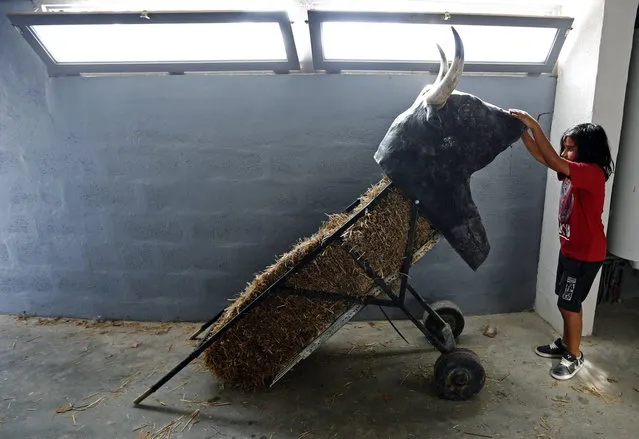
Nino, a ten-year-old toreador apprentice of the French Tauromachy Centre, nicknamed El Nino, touches a practice bull at the bullring of Garons, near Nimes, September 25, 2013. (Photo by Jean-Paul Pelissier/Reuters)

Nino, a ten-year-old toreador apprentice of the French Tauromachy Centre, nicknamed El Nino, touches a practice bull at the bullring of Garons, near Nimes, September 25, 2013. Since 1983, the French Tauromachy Centre in Nimes has trained some 1,000 youths in the art of bullfighting. Twenty of them have gone on to become professional matadors, facing fighting bulls in the arena. Twice a week, students take courses with a matador to learn the movements and gestures of the bullfighter in the ring, but without an animal present. Students train with calves in the surrounding fields during spring, and regularly participate in beginner's bullfights (becerradas) without killing calves. Solal has been taking courses for three years and Nino, for just a year now. Both are normally enrolled in French public schools, but have one thought in mind – bullfighting. They share a passion linked to the city of Nimes, famous for its ferias and bullring. (Photo by Jean-Paul Pelissier/Reuters)

Details
06 Nov 2013 10:12:00
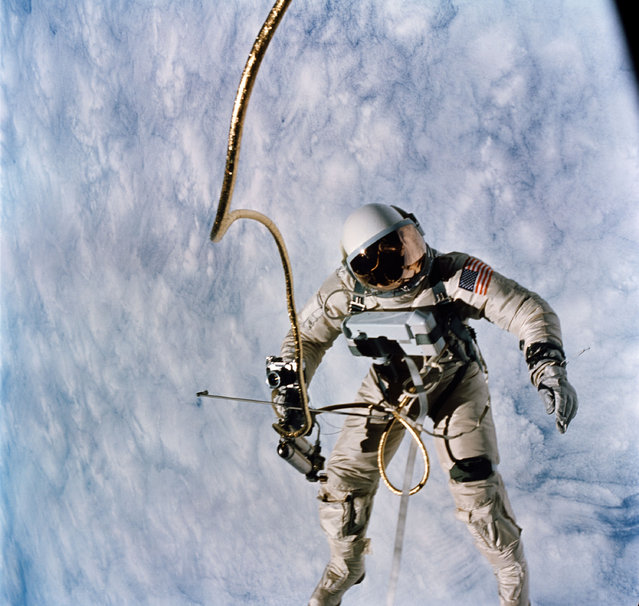
Astronaut Edward H. White II, pilot for the Gemini-Titan 4 (GT-4) spaceflight, floats in the zero-gravity of space during the third revolution of the GT-4 spacecraft on June 3, 1965. White wears a specially designed spacesuit. His face is shaded by a gold-plated visor to protect him from unfiltered rays of the sun. (Photo by NASA)

Astronaut Edward H. White II, pilot for the Gemini-Titan 4 (GT-4) spaceflight, floats in the zero-gravity of space during the third revolution of the GT-4 spacecraft on June 3, 1965. White wears a specially designed spacesuit. His face is shaded by a gold-plated visor to protect him from unfiltered rays of the sun. In his right hand he carries a Hand-Held Self-Maneuvering Unit (HHSMU) that gives him control over his movements in space. White also wears an emergency oxygen chest pack; and he carries a camera mounted on the HHSMU for taking pictures of the sky, Earth and the GT-4 spacecraft. He is secured to the spacecraft by a 25-feet umbilical line and a 23-feet tether line. Both lines are wrapped together in gold tape to form one cord. Astronaut James A. McDivitt, command pilot, remained inside the spacecraft during the extravehicular activity (EVA). Astronaut White died in the Apollo/Saturn 204 fire at Cape Kennedy on January 27, 1967. (Photo by NASA)
Details
22 Jul 2014 12:05:00