Loading...
Done
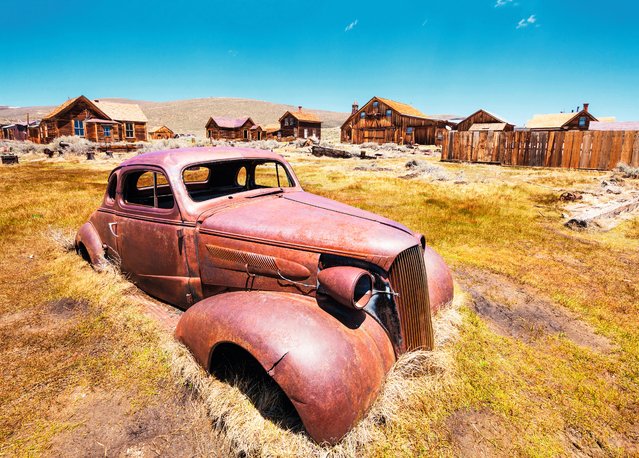
Bodie, Mono County, California. Gold was discovered at Bodie in 1859 (just after the initial California gold rush) and it went from mining camp to boomtown. Its decline began in 1880, when word spread of new boomtowns elsewhere. The Standard Consolidated Mine closed in 1913, and four years later the Bodie Railway was abandoned. By 1940 the population was down to 40. Today, Bodie is maintained in a state of arrested decay as a visitor attraction. (Photo by Alamy Stock Photo)

Kieron Connolly’s new book of photographs of more than 100 once-busy and often elegant buildings gives an idea of how the world might look if humankind disappeared. Here: Bodie, Mono County, California. Gold was discovered at Bodie in 1859 (just after the initial California gold rush) and it went from mining camp to boomtown. Its decline began in 1880, when word spread of new boomtowns elsewhere. The Standard Consolidated Mine closed in 1913, and four years later the Bodie Railway was abandoned. By 1940 the population was down to 40. Today, Bodie is maintained in a state of arrested decay as a visitor attraction. (Photo by Alamy Stock Photo)
Details
07 Sep 2016 09:50:00
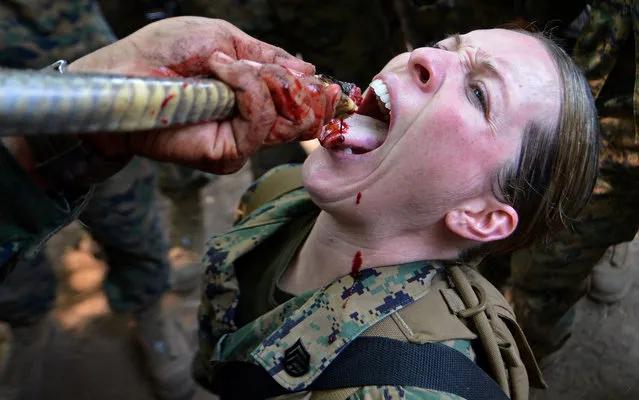
In a military base in the Thai province of Chon Buri February 20 U.S. Marines Navy with Thailand began their studies in jungle survival. The event is held in joint military exercises “Cobra Gold 2013”. During a jungle survival program February 20, 2013 taught by Royal Thai Special Forces in Sannapit, Thailand, U.S. Marines learned to catch cobras and drink their fresh blood, not to mention eat forest insects and pull the heads off of chicken. The training was part of Operation Cobra Gold 13, the 32nd edition of international military exercises hosted by the Thai. According to a U.S. Marines press release, Cobra Gold is the largest exercise of its kind in Asia and incorporates troops from five other nations in addition to the U.S. and Thailand. The Daily Mail reports that the Marines were invited to experience the local custom of drinking cobra blood after being taught to catch and kill cobras in the wild. As CNN notes, Cobra blood is believed to be a panacea and aphrodiasic in parts of Southeast Asia. In Jakarta, vendors can earn over $100 a night selling shots of cobra blood mixed with liquor. (Photo by Pornchai Kittiwongsakul/AFP Photo)

During a jungle survival program February 20, 2013 taught by Royal Thai Special Forces in Sannapit, Thailand, U.S. Marines learned to catch cobras and drink their fresh blood, not to mention eat forest insects and pull the heads off of chicken. The training was part of Operation Cobra Gold 13, the 32nd edition of international military exercises hosted by the Thai. According to a U.S. Marines press release, Cobra Gold is the largest exercise of its kind in Asia and incorporates troops from five other nations in addition to the U.S. and Thailand. The Daily Mail reports that the Marines were invited to experience the local custom of drinking cobra blood after being taught to catch and kill cobras in the wild. As CNN notes, Cobra blood is believed to be a panacea and aphrodiasic in parts of Southeast Asia. In Jakarta, vendors can earn over $100 a night selling shots of cobra blood mixed with liquor. (Photo by Pornchai Kittiwongsakul/AFP Photo)
Details
23 Feb 2013 11:52:00
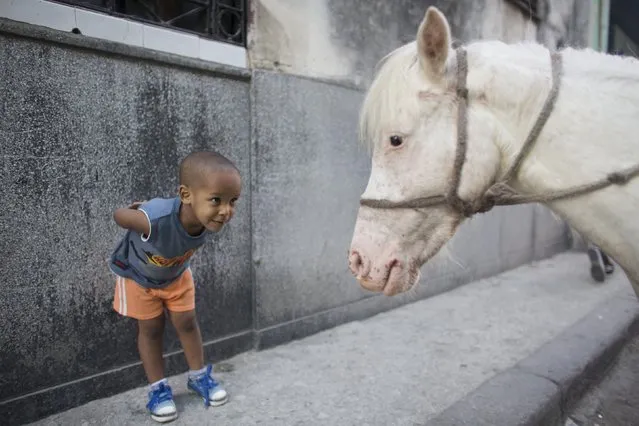
Alexo Carmona, 2, looks at Coco, a two-year-old pony, in downtown Havana, in this March 6, 2015 file photo. Nearly a quarter of a million people follow the Reuters Instagram account – and it's still growing fast. To mark the mid-point of 2015, Reuters has compiled the twenty most-liked pictures so far. This picture was 20th most popular. (Photo by Alexandre Meneghini/Reuters)

Alexo Carmona, 2, looks at Coco, a two-year-old pony, in downtown Havana, in this March 6, 2015 file photo. Nearly a quarter of a million people follow the Reuters Instagram account – and it's still growing fast. To mark the mid-point of 2015, Reuters has compiled the twenty most-liked pictures so far. This picture was 20th most popular. (Photo by Alexandre Meneghini/Reuters)
Details
18 Jul 2015 13:28:00
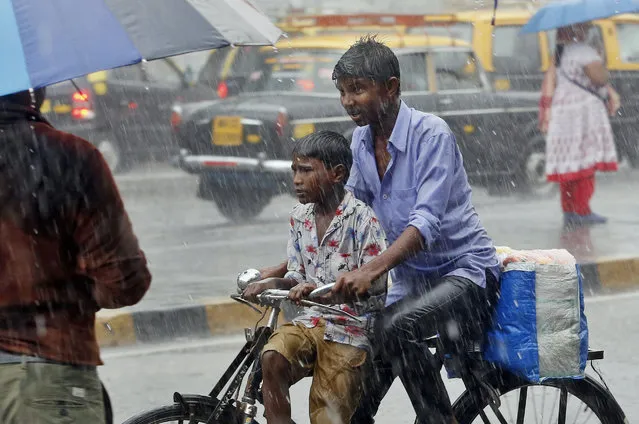
An Indian cyclist pedals with a child during heavy rain in Mumbai, Maharashtra state, India, Friday, July 24, 2015. Several parts of the city witnessed heavy rain Friday. The monsoon rains which usually hit India from June to September are crucial for farmers whose crops feed hundreds of millions of people. (Photo by Rajanish Kakade/AP Photo)

An Indian cyclist pedals with a child during heavy rain in Mumbai, Maharashtra state, India, Friday, July 24, 2015. Several parts of the city witnessed heavy rain Friday. The monsoon rains which usually hit India from June to September are crucial for farmers whose crops feed hundreds of millions of people. (Photo by Rajanish Kakade/AP Photo)
Details
27 Jul 2015 11:00:00
Performers in costume perform in the rain during the parade on the second day of the Notting Hill Carnival in west London on August 31, 2015. Nearly one million people are expected by the organizers Sunday and Monday in the streets of west London's Notting Hill to celebrate Caribbean culture at a carnival considered the largest street demonstration in Europe.  (Photo by Leon Neal/AFP Photo)

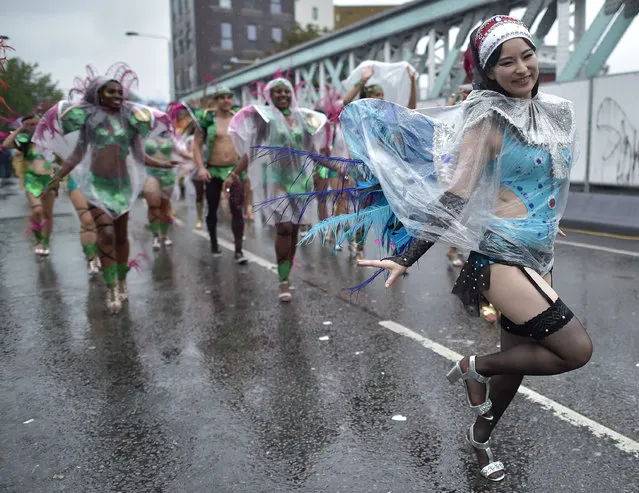
Performers in costume perform in the rain during the parade on the second day of the Notting Hill Carnival in west London on August 31, 2015. Nearly one million people are expected by the organizers Sunday and Monday in the streets of west London's Notting Hill to celebrate Caribbean culture at a carnival considered the largest street demonstration in Europe. The Notting Hill Carnival started in the 1960s, when the area had a large population of immigrants recently arrived from the Caribbean and was notorious for its slums – a far cry from today when it is one of London's most expensive places to live. (Photo by Leon Neal/AFP Photo)
Details
01 Sep 2015 15:17:00
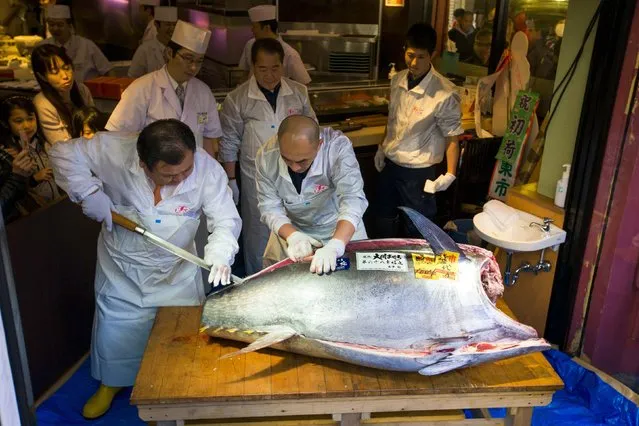
The President of the sushi restaurant chain Sushi Zanmai, Kiyoshi Kimura, cuts a blue fin tuna outside his main restaurant at the outer Tsukiji market in Tokyo January 5, 2015. The 180 kg blue fin tuna traded at a price of 4.5 million yen (37,500 USD) and was the most expensive fish at this year's New Year auction at the Tsukiji market, local media reported. (Photo by Thomas Peter/Reuters)

The President of the sushi restaurant chain Sushi Zanmai, Kiyoshi Kimura, cuts a blue fin tuna outside his main restaurant at the outer Tsukiji market in Tokyo January 5, 2015. The 180 kg blue fin tuna traded at a price of 4.5 million yen (37,500 USD) and was the most expensive fish at this year's New Year auction at the Tsukiji market, local media reported. (Photo by Thomas Peter/Reuters)
Details
06 Jan 2015 11:39:00
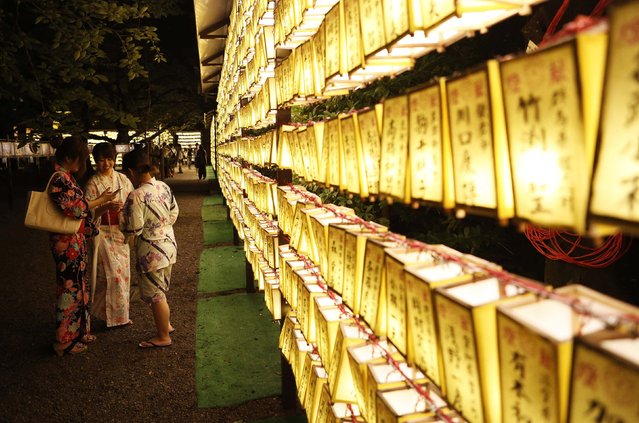
Women in kimonos look at pictures they took in front of paper lanterns during the annual Mitama Festival at the Yasukuni Shrine in Tokyo July 13, 2014. Over 30,000 lanterns light up the precincts of the shrine, where more than 2.4 million war dead are enshrined, during the four-day festival. The festival goes on till July 16. (Photo by Yuya Shino/Reuters)

Women in kimonos look at pictures they took in front of paper lanterns during the annual Mitama Festival at the Yasukuni Shrine in Tokyo July 13, 2014. Over 30,000 lanterns light up the precincts of the shrine, where more than 2.4 million war dead are enshrined, during the four-day festival. The festival goes on till July 16. (Photo by Yuya Shino/Reuters)
Details
15 Jul 2014 10:41:00
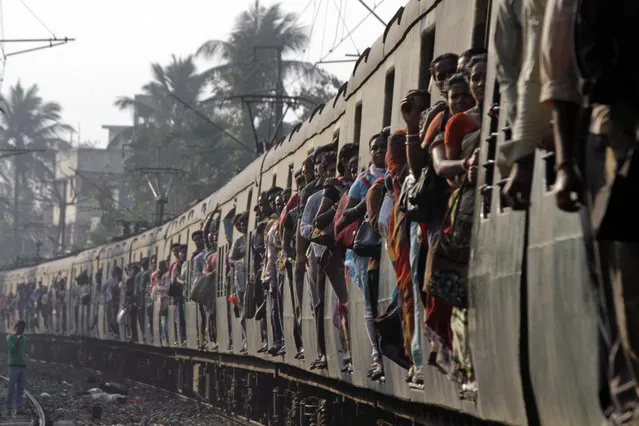
Indian commuters travel in a local train in Kolkata, India, Tuesday, Feb. 26, 2013. Indian Railway Minister Pawan Kumar Bansal is presenting the country's rail budget for next fiscal year in the parliament Tuesday, Feb. 26, 2013. Indian railway network is one of the world's largest, with some 14 million passengers daily and some 64,000 kilometers (40,000 miles) of railway track cut through some of the most densely populated cities. (Photo by Bikas Das/AP Photo)

Indian commuters travel in a local train in Kolkata, India, Tuesday, February 26, 2013. Indian Railway Minister Pawan Kumar Bansal is presenting the country's rail budget for next fiscal year in the parliament Tuesday, Feb. 26, 2013. Indian railway network is one of the world's largest, with some 14 million passengers daily and some 64,000 kilometers (40,000 miles) of railway track cut through some of the most densely populated cities. (Photo by Bikas Das/AP Photo)
Details
05 Mar 2013 12:57:00