Loading...
Done
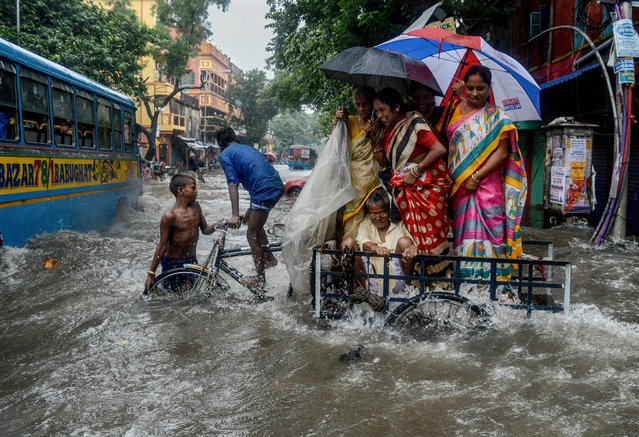
A family tries to cross a flooded road amid gushing water in Kolkata, India on August 17, 2019. Heavy rain continues for a second day in Kolkata, which contuinued to flood many streets all around the city. Authorities are working overtime to clear the roads. (Photo by  Debarchan Chatterjee/Zuma Wire/Rex Features/Shutterstock)

A family tries to cross a flooded road amid gushing water in Kolkata, India on August 17, 2019. Heavy rain continues for a second day in Kolkata, which contuinued to flood many streets all around the city. Authorities are working overtime to clear the roads. (Photo by Debarchan Chatterjee/Zuma Wire/Rex Features/Shutterstock)
Details
20 Aug 2019 00:03:00
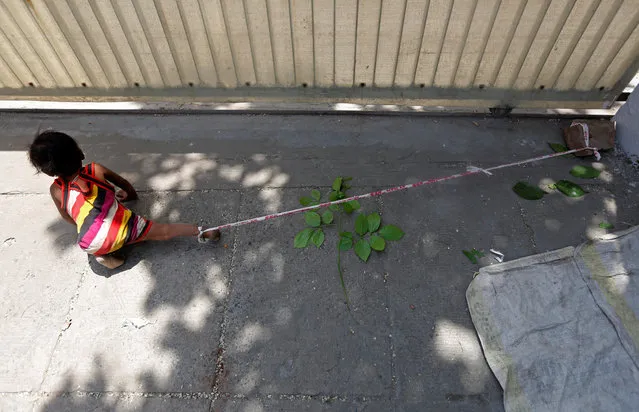
Barrier tape is tied around 15-month-old Shivani's ankle to prevent her from running away, while her mother Sarta Kalara works at a construction site nearby, in Ahmedabad, India, April 19, 2016. Kalara says she has no option but to tether her daughter Shivani to a stone despite her crying, while she and her husband work for 250 rupees ($3.8) each a shift digging holes for electricity cables in the city of Ahmedabad. There are about 40 million construction workers in India, at least one in five of them women, and the majority poor migrants who shift from site to site, building infrastructure for India's booming cities. Across the country it is not uncommon to see young children rolling in the sand and mud as their parents carry bricks or dig for new roads or luxury houses. (Photo by Amit Dave/Reuters)

Barrier tape is tied around 15-month-old Shivani's ankle to prevent her from running away, while her mother Sarta Kalara works at a construction site nearby, in Ahmedabad, India, April 19, 2016. Kalara says she has no option but to tether her daughter Shivani to a stone despite her crying, while she and her husband work for 250 rupees ($3.8) each a shift digging holes for electricity cables in the city of Ahmedabad. There are about 40 million construction workers in India, at least one in five of them women, and the majority poor migrants who shift from site to site, building infrastructure for India's booming cities. Across the country it is not uncommon to see young children rolling in the sand and mud as their parents carry bricks or dig for new roads or luxury houses. (Photo by Amit Dave/Reuters)

Details
14 Dec 2016 07:39:00
A cat sits in the flooding waters from Hurricane Matthew in downtown Nichols, South Carolina, October 10, 2016. (Photo by Randall Hill/Reuters)

A cat sits in the flooding waters from Hurricane Matthew in downtown Nichols, South Carolina, October 10, 2016. (Photo by Randall Hill/Reuters)
Details
14 Dec 2016 08:03:00
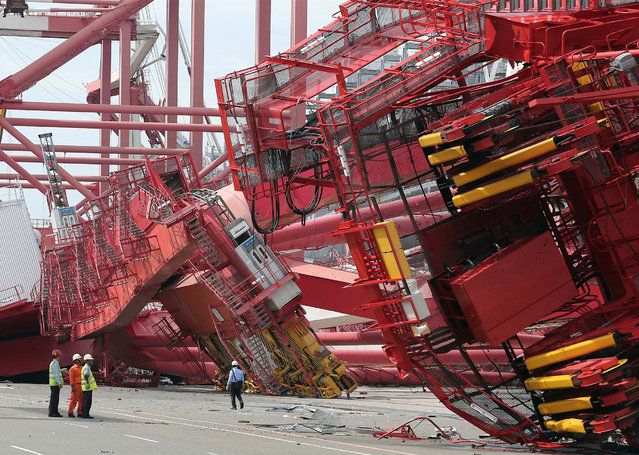
Port staff check the damaged bridge cranes in Kaohsiung, southeast China's Taiwan on September 15, 2016. Kaohsiung Port saw facilities damage due to the effect of Typhoon Meranti. (Photo by Johnson Liu/Xinhua via ZUMA Wire)

Port staff check the damaged bridge cranes in Kaohsiung, southeast China's Taiwan on September 15, 2016. Kaohsiung Port saw facilities damage due to the effect of Typhoon Meranti. (Photo by Johnson Liu/Xinhua via ZUMA Wire)
Details
16 Sep 2016 10:55:00
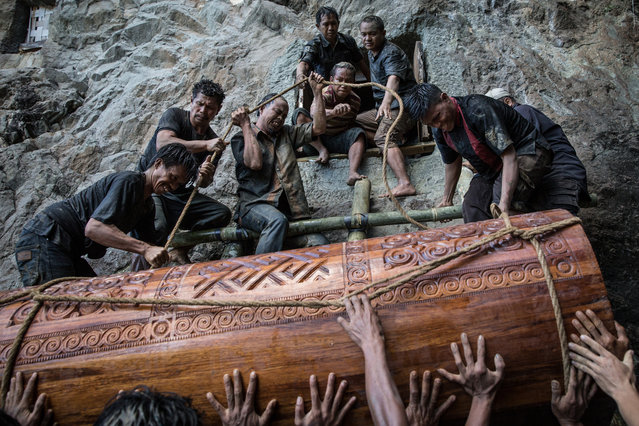
It is said that Torajans are people who “live to die”. For this Indonesian ethnic group, funerals are such extravagant events that they sometimes attract tourists. Families can postpone burials years (and the deceased are considered sick and hosted at home until the funeral) until the family can raise enough money and gather as many relatives as possible. And then it’s a jubilant multiday social event with a parade, dances and animal sacrifices. Agung Parameswara photographed these funerary practices when he traveled to South Sulawesi province, where the Torajans live. But often, their funeral isn’t the last time the dead are seen. In August, crypts are opened, coffins are slid back out and bodies delicately unsheathed. This tender ritual is known as Ma’Nene, which is customarily performed every few years. (Photo by Agung Parameswara/The Washington Post)

It is said that Torajans are people who “live to die”. For this Indonesian ethnic group, funerals are such extravagant events that they sometimes attract tourists. Families can postpone burials years (and the deceased are considered sick and hosted at home until the funeral) until the family can raise enough money and gather as many relatives as possible. And then it’s a jubilant multiday social event with a parade, dances and animal sacrifices. Agung Parameswara photographed these funerary practices when he traveled to South Sulawesi province, where the Torajans live. (Photo by Agung Parameswara/The Washington Post)
Details
06 Oct 2016 09:15:00
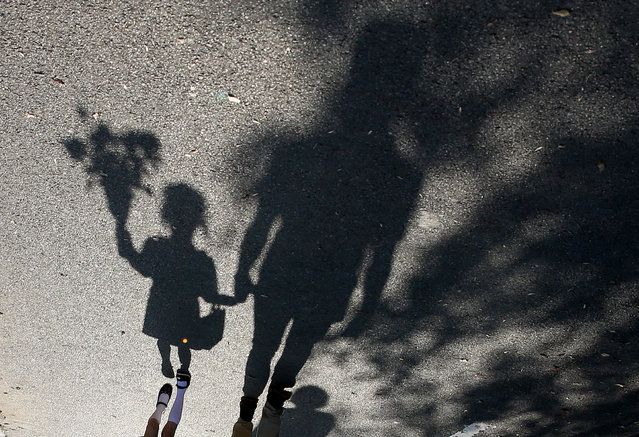
A 180 degrees rotated photograph shows the shadows of Polina (L), a six-year-old Belarusian first grade school girl, and her father, cast on the street while on their way to Polina's first day of school, which marks the traditional start of the academic year, in Minsk, Belarus, 02 September 2019. The start of a new academic year in Belarus, officially called Day of Knowledge, is a festive day for all school and university students in the country. (Photo by Tatyana Zenkovich/EPA/EFE)

A 180 degrees rotated photograph shows the shadows of Polina (L), a six-year-old Belarusian first grade school girl, and her father, cast on the street while on their way to Polina's first day of school, which marks the traditional start of the academic year, in Minsk, Belarus, 02 September 2019. The start of a new academic year in Belarus, officially called Day of Knowledge, is a festive day for all school and university students in the country. (Photo by Tatyana Zenkovich/EPA/EFE)
Details
05 Sep 2019 00:03:00
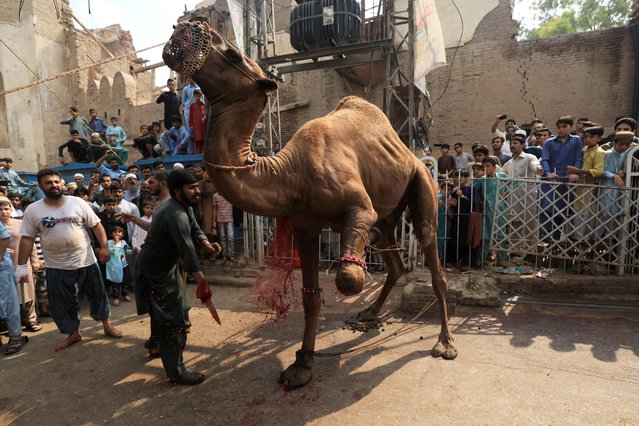
Men and children gather as a camel is being slaughtered in celebration of Eid al-Adha, in Peshawar, Pakistan on August 12, 2019. (Photo by Fayaz Aziz/Reuters)

Men and children gather as a camel is being slaughtered in celebration of Eid al-Adha, in Peshawar, Pakistan on August 12, 2019. (Photo by Fayaz Aziz/Reuters)
Details
07 Sep 2019 00:03:00
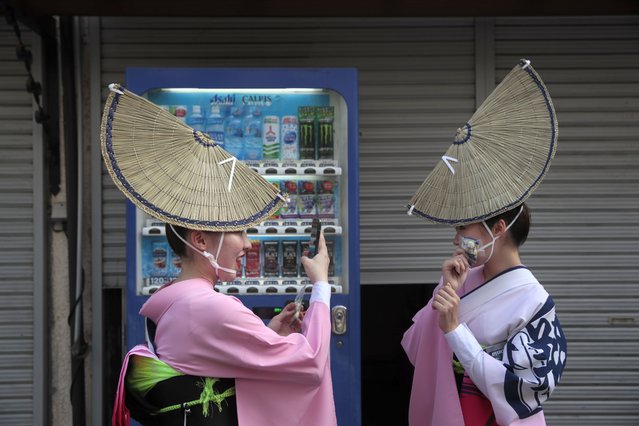
Two young dancers take pictures while waiting for the start of the Koenji Awa-Odori dance festival, in the Koenji neighborhood of Tokyo. Saturday, August 24, 2019, Started in the 1950s, the Koenji Awa-Odori has grown to be one of Tokyo's largest and most popular summer festivals an estimated 10,000 dancers participating in the dance festival. Hundreds of thousands of spectators gather in the neighborhood to watch the two-day summer spectacle. The event is held on the last weekend of August each year. (Photo by Jae C. Hong/AP Photo)

Two young dancers take pictures while waiting for the start of the Koenji Awa-Odori dance festival, in the Koenji neighborhood of Tokyo. Saturday, August 24, 2019, Started in the 1950s, the Koenji Awa-Odori has grown to be one of Tokyo's largest and most popular summer festivals an estimated 10,000 dancers participating in the dance festival. Hundreds of thousands of spectators gather in the neighborhood to watch the two-day summer spectacle. The event is held on the last weekend of August each year. (Photo by Jae C. Hong/AP Photo)
Details
20 Sep 2019 00:03:00