Loading...
Done
A cosplayer portrays Himiko Toga from “League of Villains” outside the convention center during Comic-Con International 2022 on July 22, 2022 in San Diego, California. (Photo by Robyn Beck/AFP Photo)

A cosplayer portrays Himiko Toga from “League of Villains” outside the convention center during Comic-Con International 2022 on July 22, 2022 in San Diego, California. (Photo by Robyn Beck/AFP Photo)
Details
03 Aug 2022 04:48:00
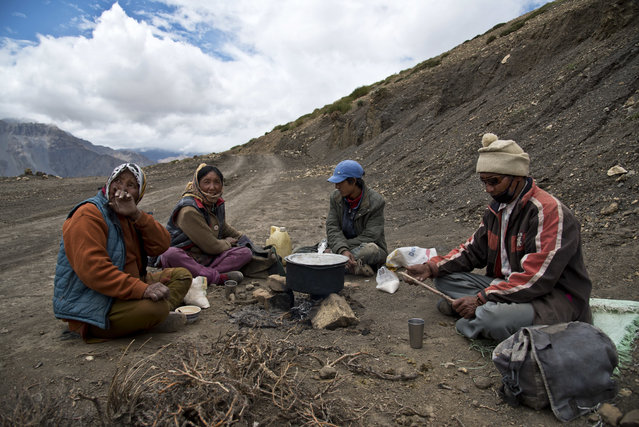
In this August 17, 2016, photo, from left to right, Chhering Chodom, 60, Tashi Yangzom, 50, Lobsang Chhering, 27, and Dorje Tandup, 58, drink milk tea on the side of the road. For centuries, the sleepy valley nestled in the Indian Himalayas remained a hidden Buddhist enclave forbidden to outsiders. Enduring the harsh year-round conditions of the high mountain desert, the people of Spiti Valley lived by a simple communal code – share the Earth's bounty, be hospitable to neighbors, and eschew greed and temptation at all turns. That's all starting to change, for better or worse. Since India began allowing its own citizens as well as outsiders to visit the valley in the early 1990s, tourism and trade have boomed. And the marks of modernization, such as solar panels, asphalt roads and concrete buildings, have begun to appear around some of the villages that dot the remote landscape at altitudes above 4,000 meters (13,000 feet). (Photo by Thomas Cytrynowicz/AP Photo)

In this August 17, 2016, photo, from left to right, Chhering Chodom, 60, Tashi Yangzom, 50, Lobsang Chhering, 27, and Dorje Tandup, 58, drink milk tea on the side of the road. For centuries, the sleepy valley nestled in the Indian Himalayas remained a hidden Buddhist enclave forbidden to outsiders. Enduring the harsh year-round conditions of the high mountain desert, the people of Spiti Valley lived by a simple communal code – share the Earth's bounty, be hospitable to neighbors, and eschew greed and temptation at all turns. That's all starting to change, for better or worse. (Photo by Thomas Cytrynowicz/AP Photo)

Details
15 Sep 2016 09:22:00
Kawakanih Yawalapiti, 9, Upper Xingu region of Mato Grosso, Brazil, 2018: Kawakanih lives with her tribe, the Yawalapiti, in Xingu national park, a preserve in the Amazon basin of Brazil. The Yawalapiti collect seeds to preserve species unique to their ecosystem, which lies between the rain forest and savannah. Kawakanih’s diet is simple, consisting mainly of fish, cassava, porridge, fruit and nuts. “It takes five minutes to catch dinner”, says Kawakanih. “When you’re hungry, you just go to the river with your net”. (Photo by Gregg Segal/The Guardian)

Photographer Gregg Segal travelled the world to document children and the food they eat in a week. Partly inspired by the increasing problems of childhood obesity, he tracked traditional regional diets as yet unaffected by globalisation, and ironically, found that the healthiest diets were often eaten by the least well off. (Photo by Gregg Segal/The Guardian)
Details
03 Jul 2019 00:03:00
A drag performer dances at the end of the “Rally for Our Rights”, ahead of the 2023 Wisconsin Supreme Court election, outside the Wisconsin State Capitol in Madison, Wisconsin, U.S., April 2, 2023. (Photo by Evelyn Hockstein/Reuters)

A drag performer dances at the end of the “Rally for Our Rights”, ahead of the 2023 Wisconsin Supreme Court election, outside the Wisconsin State Capitol in Madison, Wisconsin, U.S., April 2, 2023. (Photo by Evelyn Hockstein/Reuters)
Details
10 Apr 2023 04:00:00
A serviceman walks near an APC while a helicopter flies  on the position of the Ukrainian troops in Donetsk region on August 9, 2014. Fighting with pro-Russian separatists in eastern Ukraine has left 13 troops dead in the last 24 hours, Ukraine's military said Saturday. (Photo by Anatolii Stepanov/AFP Photo)

A serviceman walks near an APC while a helicopter flies on the position of the Ukrainian troops in Donetsk region on August 9, 2014. Fighting with pro-Russian separatists in eastern Ukraine has left 13 troops dead in the last 24 hours, Ukraine's military said Saturday. (Photo by Anatolii Stepanov/AFP Photo)
Details
10 Aug 2014 10:14:00
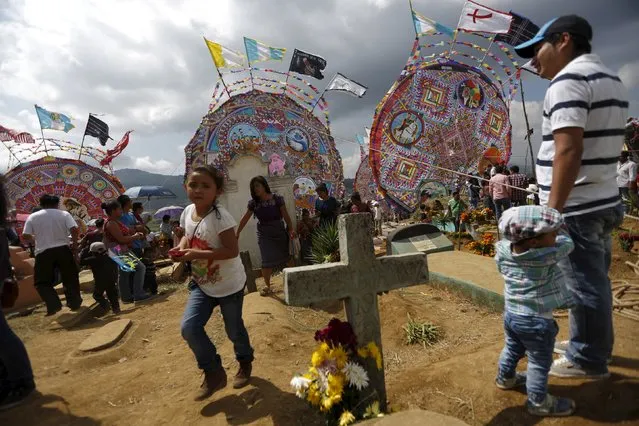
People stand in the middle of the graves and in front of giant kites in the cemetery of Santiago Sacatepequez, Guatemala, November 1, 2015. (Photo by Jorge Dan Lopez/Reuters)

People stand in the middle of the graves and in front of giant kites in the cemetery of Santiago Sacatepequez, Guatemala, November 1, 2015. Dating back 116 years, the tradition of flying kites in the cemetery of of Santiago Sacatepequez, integrates the Catholic feast of All Saints with ancient Mayan practices of honouring the dead. It is believed that the kites connect the living and the dead during the all saints day celebration. (Photo by Jorge Dan Lopez/Reuters)
Details
04 Nov 2015 11:00:00
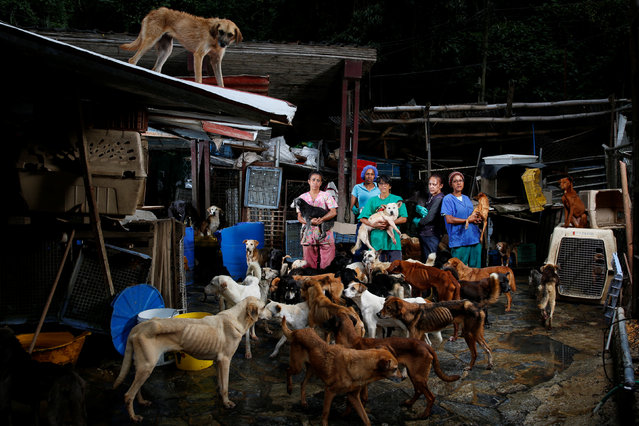
(L-R) Maria Silva, Milena Cortes, Maria Arteaga, Jackeline Bastidas and Gissy Abello pose for a picture at the Famproa dogs shelter where they work, in Los Teques, Venezuela, August 25, 2016. Venezuelans struggling to feed their families let alone their pets are dumping animals on the streets, in parks and at makeshift homes overrun with scrawny animals amid an economic crisis. An hour from Caracas in Los Teques, hundreds of dogs bark and run around the streets scavenging for food outside a makeshift shelter. People come by every few hours to hand over scrawny dogs which are fed by volunteers every day. Venezuela is undergoing a major economic and social crisis, with shortages of basic foods and medicines. Triple digit inflation is hitting everybody hard, including those who own pets. (Photo by Carlos Garcia Rawlins/Reuters)

(L-R) Maria Silva, Milena Cortes, Maria Arteaga, Jackeline Bastidas and Gissy Abello pose for a picture at the Famproa dogs shelter where they work, in Los Teques, Venezuela, August 25, 2016. Venezuelans struggling to feed their families let alone their pets are dumping animals on the streets, in parks and at makeshift homes overrun with scrawny animals amid an economic crisis. An hour from Caracas in Los Teques, hundreds of dogs bark and run around the streets scavenging for food outside a makeshift shelter. (Photo by Carlos Garcia Rawlins/Reuters)
Details
08 Sep 2016 10:01:00
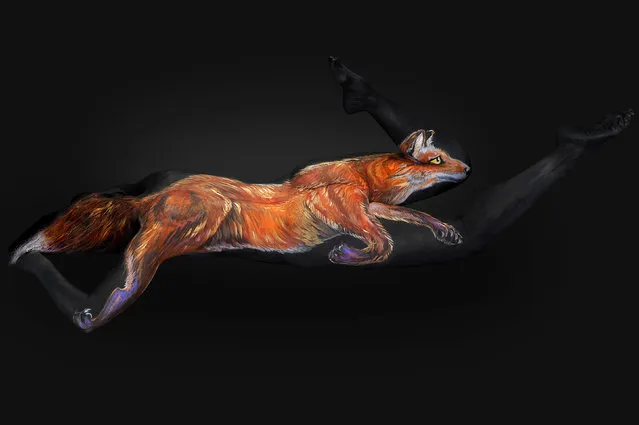
This is the stunning body of work by a talented painter – who transforms humans into amazing animals. From alligators to foxes and even owls, artist Shannon Holt, 39, paints every little detail on models to turn them into wildlife. The incredible paintings, which take anywhere between six to 12.5 hours to complete, are part of her Florida Wildlife Series. (Photo by Ryder Gledhill/Shannon Holt/Caters News)

This is the stunning body of work by a talented painter – who transforms humans into amazing animals. From alligators to foxes and even owls, artist Shannon Holt, 39, paints every little detail on models to turn them into wildlife. The incredible paintings, which take anywhere between six to 12.5 hours to complete, are part of her Florida Wildlife Series. Shannon, from DeLand, Florida, previously worked on different surfaces such as glass, metals and wood. But the animal advocate decided to experiment with human canvasses and incorporate animals in her work. Here: Red Fox. (Photo by Ryder Gledhill/Shannon Holt/Caters News)
Details
16 Dec 2014 12:13:00