Loading...
Done
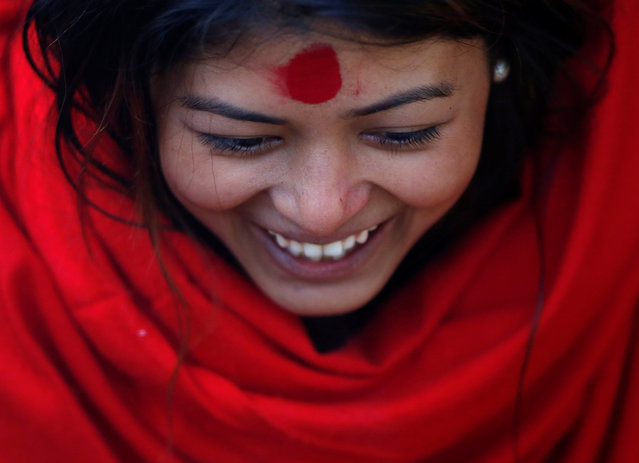
A devotee smiles as she offers prayers during the Swasthani Brata Katha festival in Kathmandu, Nepal January 12, 2017. (Photo by Navesh Chitrakar/Reuters)

A devotee smiles as she offers prayers during the Swasthani Brata Katha festival in Kathmandu, Nepal January 12, 2017. (Photo by Navesh Chitrakar/Reuters)
Details
08 Feb 2017 00:00:00
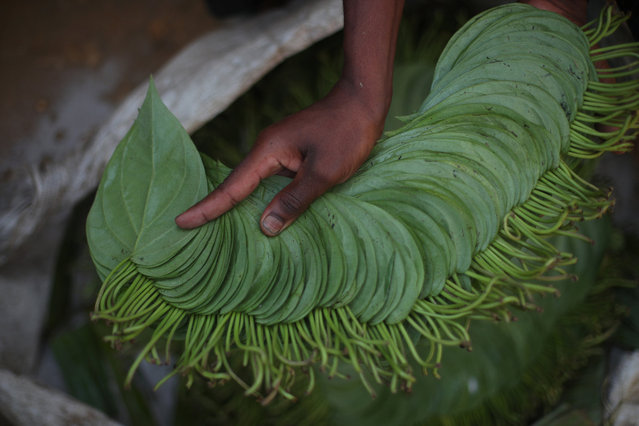
Faruk, 17, a Rohingya refugee trader holds betel leaves which are on sale at a stall in Palong Khali refugee camp near Cox's Bazar, Bangladesh, November 3, 2017. He left his village in Myanmar when the military opened fire towards the Rohingya. “I buy this betel leaf from Palong Khali market, in one bundle there are 160 pieces, I buy it for 80 taka and I sell it for 100 taka. Bangladeshi's and I sell for the same rate in the camp. Outside in the local market it is 80 taka per bundle. My problem is that I don't have money so I can't buy anything to eat, I can't buy fish to eat”, he said. (Photo by Hannah McKay/Reuters)

Faruk, 17, a Rohingya refugee trader holds betel leaves which are on sale at a stall in Palong Khali refugee camp near Cox's Bazar, Bangladesh, November 3, 2017. He left his village in Myanmar when the military opened fire towards the Rohingya. “I buy this betel leaf from Palong Khali market, in one bundle there are 160 pieces, I buy it for 80 taka and I sell it for 100 taka (1 Bangladeshi Taka = 0.012 US Dollar). Bangladeshi's and I sell for the same rate in the camp. Outside in the local market it is 80 taka per bundle. My problem is that I don't have money so I can't buy anything to eat, I can't buy fish to eat”, he said. (Photo by Hannah McKay/Reuters)
Details
27 Nov 2017 08:54:00
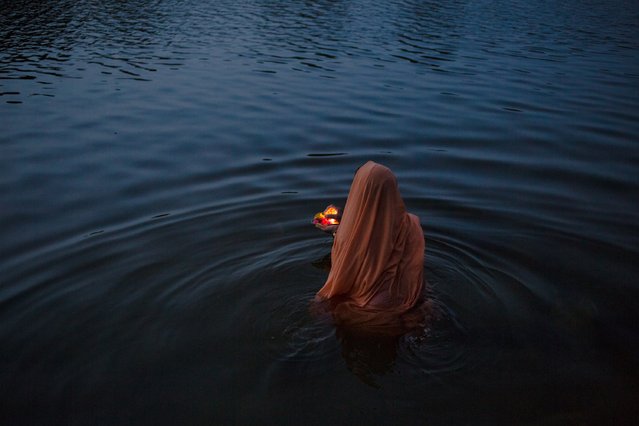
An Indian women offers early-morning prayers or a “puja” at a ghat early in the morning on the banks of the Betawa River in Orchha in the state of Madhya Pradesh on July 5, 2015. (Photo by Rebecca Conway/AFP Photo)

An Indian women offers early-morning prayers or a “puja” at a ghat early in the morning on the banks of the Betawa River in Orchha in the state of Madhya Pradesh on July 5, 2015. (Photo by Rebecca Conway/AFP Photo)
Details
08 Jul 2015 11:56:00
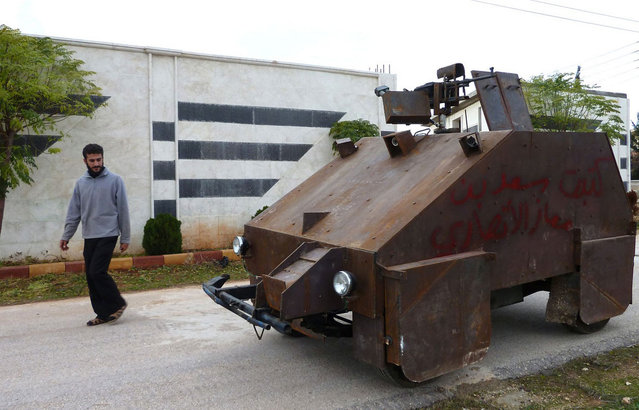
A Syrian rebel walks past Sham 2, a homemade armored vehicle, in Bishqatin, Syria, on December 8, 2012. From a distance it looks rather like a big rusty metal box but closer inspection reveals a homemade armored vehicle waiting to be deployed. Sham II, named after ancient Syria, is built from the chassis of a car and touted by rebels as “100 percent made in Syria”. (Photo by Herve Bar/AFP Photo)

A Syrian rebel walks past Sham 2, a homemade armored vehicle, in Bishqatin, Syria, on December 8, 2012. From a distance it looks rather like a big rusty metal box but closer inspection reveals a homemade armored vehicle waiting to be deployed. Sham II, named after ancient Syria, is built from the chassis of a car and touted by rebels as “100 percent made in Syria”. (Photo by Herve Bar/AFP Photo)
Details
03 Sep 2013 09:30:00
A wolverine is pictured during its first public appearance at the Animal Park of Sainte-Croix in Rhodes, eastern France on January 28, 2016. (Photo by Frederick Florin/AFP Photo)

A wolverine is pictured during its first public appearance at the Animal Park of Sainte-Croix in Rhodes, eastern France on January 28, 2016. (Photo by Frederick Florin/AFP Photo)
Details
31 Jan 2016 08:43:00
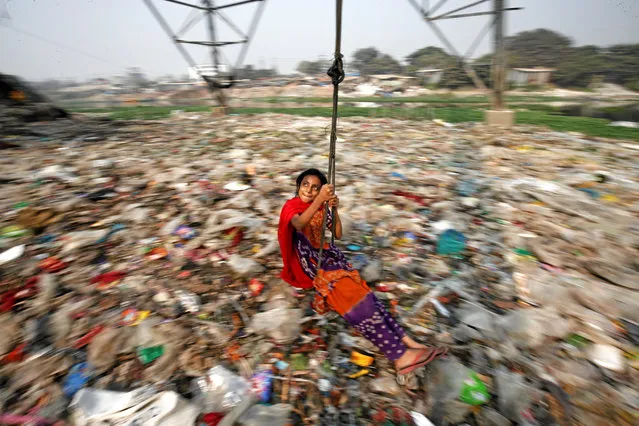
A Bangladeshi girl plays on a swing, in Dhaka, Bangladesh, December 27, 2016. (Photo by Mohammad Ponir Hossain/Reuters)

A Bangladeshi girl plays on a swing, in Dhaka, Bangladesh, December 27, 2016. (Photo by Mohammad Ponir Hossain/Reuters)
Details
17 Jan 2017 12:24:00
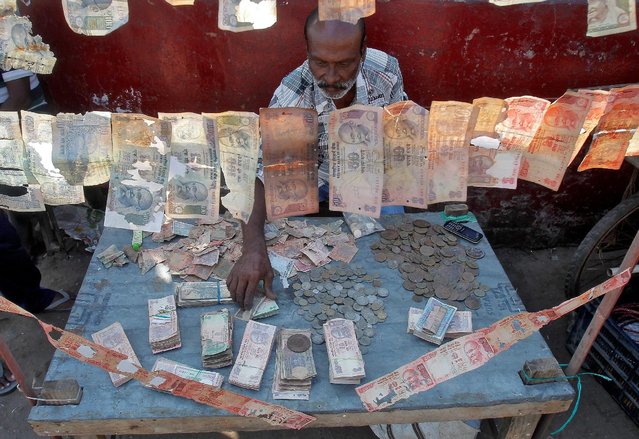
A roadside currency exchange vendor sorts Indian currency notes at his stall in Agartala, India, December 6, 2016. (Photo by Jayanta Dey/Reuters)

A roadside currency exchange vendor sorts Indian currency notes at his stall in Agartala, India, December 6, 2016. (Photo by Jayanta Dey/Reuters)
Details
12 Dec 2016 10:20:00
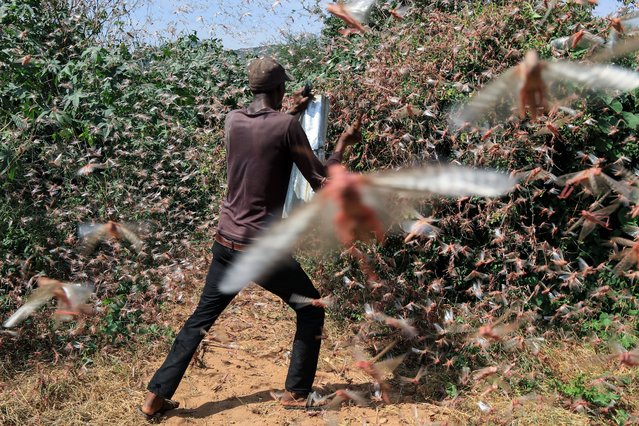
A man uses iron sheet to make noises, as a way of trying to disperse desert locusts that had invaded their farms during the second wave invasion in Kakongo village, in Nuu-Mwingi East, in Kitui, Kenya, 06 February 2021. The second wave invasion of the desert locusts in the country comes at a time where most famers are expecting to harvest their farm produce in the country. According to the United Nations Food and Agriculture Organization (FAO), on 04 February, warned numerous immature desert locust swarms persist in southern Ethiopia and Kenya. Some of the swarms are in community areas and therefore cannot be treated. In Kenya, immature swarms continue to spread westwards across northern and central counties where there are currently about 20 small swarms present, mostly about 50 hectares in size, it said. (Photo by Daniel Irungu/EPA/EFE)

A man uses iron sheet to make noises, as a way of trying to disperse desert locusts that had invaded their farms during the second wave invasion in Kakongo village, in Nuu-Mwingi East, in Kitui, Kenya, 06 February 2021. The second wave invasion of the desert locusts in the country comes at a time where most famers are expecting to harvest their farm produce in the country. (Photo by Daniel Irungu/EPA/EFE)
Details
25 Feb 2021 08:17:00